Jefferson water damage pricing by scope — 2026
If you’re dealing with a water emergency in Jefferson, Butler County, you’ll want clarity on local restoration costs right away. This isn’t the time for generic numbers. Jefferson’s housing is mostly post-1950, with many homes built on full basements that see unfinished or partially finished spaces. More than half of homes here were built before 1980 (U.S. Census Bureau, ACS 2024), and 75% are single-family houses—so losses often mean larger affected floor areas and more structural drying. These realities matter: when water gets into a Jefferson basement, the job often goes beyond carpet or drywall to include structural materials, and that pushes restoration prices higher than what you might see published for slab homes elsewhere.
The table below covers typical 2026 pricing for services most often needed here. Remember, Jefferson enjoys a moderate contractor presence, with firms based both locally and in Butler and Cranberry Township, so waiting days for a pro is rare—most calls get same- or next-day response.
| Service |
What it covers |
Typical duration |
Price range |
| Water extraction + emergency drying (Cat 1) |
extraction, air movers, LGR dehumidifiers, daily moisture monitoring |
3–5 days |
$1,150–$7,200 |
| Structural drying only (post-extraction) |
drying to standard after water is already out |
3–5 days |
$950–$6,800 |
| Mold remediation with containment |
containment, HEPA filtration, removal, antimicrobial, clearance test |
3–7 days |
$1,450–$10,000 |
| Sewage backup cleanup (Cat 3) |
biohazard protocol, disposal of porous materials, disinfection |
2–5 days |
$2,400–$11,500 |
| Emergency board-up / tarping |
stop further water entry, secure the structure |
same day |
$350–$900 |
Estimates for a typical Jefferson home. Category, affected area and how long the water sat move these figures more than anything else.
Choosing a restoration company in twenty minutes
Most advice for picking a restoration company assumes you’ve got days—time for several quotes and research. When you’re standing in water in Jefferson, you’re lucky to have twenty minutes, especially since Butler County isn’t an oversaturated metro. Multiple firms cover the area, often working out of Butler or Cranberry Township, so someone can usually be there same-day—but that doesn’t mean the first one available is the one you want rolling up your carpet and handling your claim.
Your compressed checklist comes down to confirming three things on the phone before anyone shows up:
- Are you registered with the Pennsylvania Office of Attorney General as a Home Improvement Contractor (HIC)?
- Do you carry general liability and workers’ compensation insurance in your company’s name, and can you provide copies?
- Is the lead tech certified by the IICRC (S500 standard), and can they show you a card on arrival?
- Can you give me a written contract as required under the Home Improvement Consumer Protection Act?
- Will I get a clear, itemized scope of work—no blank spaces—before work begins?
- How do you handle documentation for the insurance company?
- What’s your daily monitoring process during drying? Will I get moisture logs?
- Who do I call if there’s a problem after hours?
- Are you local, or are you driving from Pittsburgh or elsewhere?
- Will you arrive with all equipment needed, or just to assess?
Watch for pressure tactics—like being urged to sign an incomplete contract, not seeing a work authorization, or having the crew start unloading before you agree to anything. Don’t let anyone start work in your Jefferson home until you see the basic paperwork in hand. Delay costs you less than signing on blind.
Your belongings after a water loss
In Jefferson, homeowners often focus on walls and floors after a water emergency and overlook their personal belongings. Insurance policies treat contents (“your stuff”) separately from structure, and documenting what’s damaged is on you, not just the restoration firm. Proper restoration should include a pack-out: trained staff inventory and photograph every item before moving it off-site for cleaning and drying, especially if basement flooding is involved. Don’t let anyone remove items from your home until you walk through the areas—with photos—so there’s a clear record for your claim. A written inventory with detailed descriptions and photos will help if anything is lost or if insurance needs proof the item existed and its condition.
What is rarely salvageable in Jefferson’s basements? Upholstered furniture exposed to Category 3 sewage, mattresses, and most particleboard furniture. These must often be discarded, even if they look “dry”—the risk from contamination outweighs the cost of replacement. On the other hand, solid wood, metal, most electronics, and area rugs can often be restored after Category 1 or 2 water if handled promptly. Keep all receipts for cleaning and keep communication with adjusters open. In Jefferson, with many unfinished basements and older homes, the line between a “contents loss” and a “structure claim” is clear in the policy—know which side of the ledger each item falls on before you agree to disposal or cleaning.
What proper drying actually looks like
Drying a Jefferson basement or living space isn’t just setting up fans and hoping for the best. Proper work starts with moisture mapping: the crew uses meters, not guesswork, and logs readings in each affected area daily. You should see a tech taking and recording readings with a pin meter or similar tool, not simply pointing at stains. Why does this matter? The difference between an actual drying plan and theater is a paper trail. Ask for the daily moisture logs—if your crew can’t show those, assume nothing is being measured or managed.
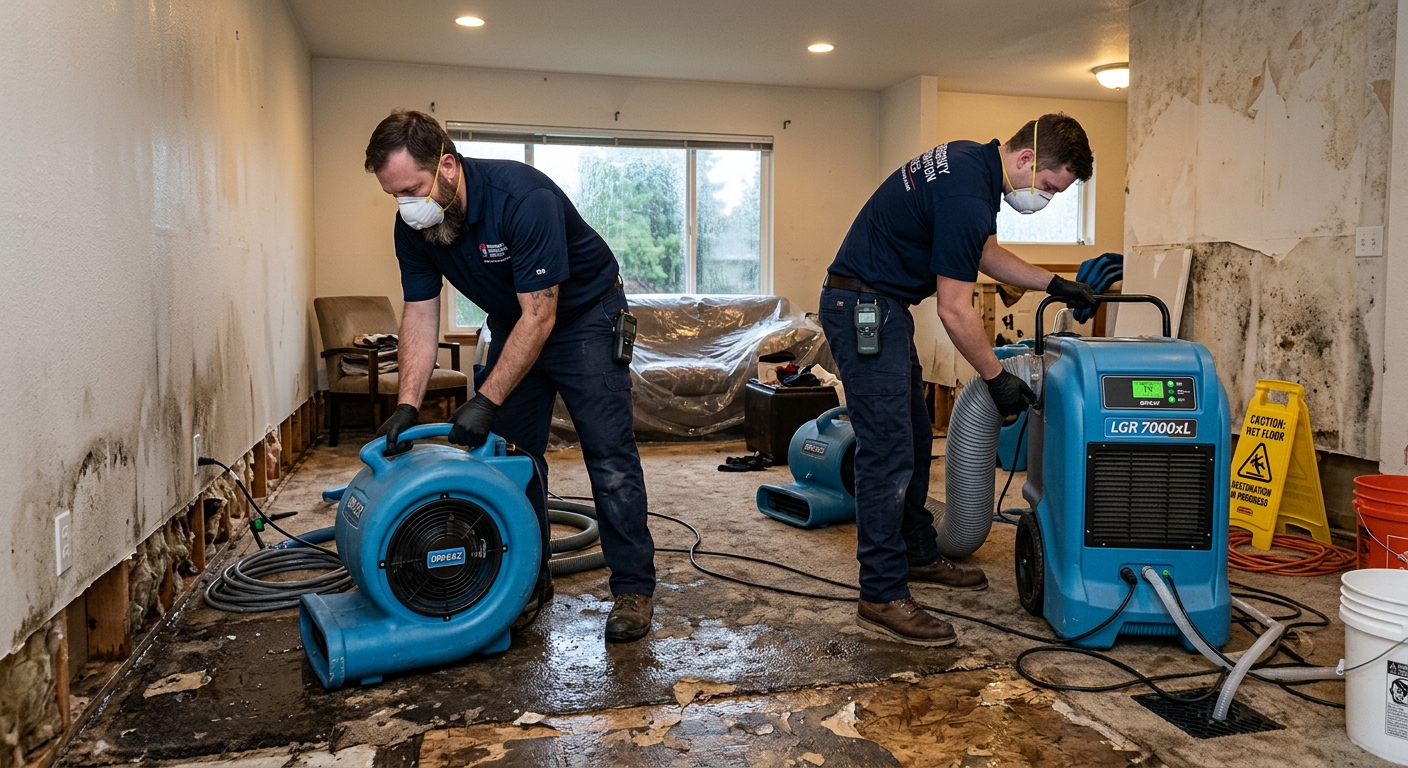
Air movers circulate dry air across wet surfaces. LGR (low grain refrigerant) dehumidifiers pull moisture from the air, even in Jefferson’s humid summers and cold winters (our region averages 5,600 heating degree days, so basements hold chill and moisture in spring). Equipment should run 24/7—shutting things off at night undoes hours of drying and can lead to mold. Your contractor should visit daily to document progress. “Dry” isn’t a gut feeling; it’s a target moisture content in building materials, confirmed by meter, not by touch.
In southwestern Pennsylvania, outdoor conditions matter. Rainy seasons or high humidity mean longer drying times, especially if your home is older with thicker walls. Good firms explain all this up front. Don’t pay for a crew that disappears after day one or skips logs—hold them to the same professional standard you’d expect from a plumber or electrician.
Filing a water damage claim in Pennsylvania
The distinction that costs Jefferson homeowners the most: if water comes from inside (like a burst pipe or dishwasher hose), your standard homeowners insurance usually covers it. If it comes from outside, like surface flooding from Connoquenessing Creek, that’s generally excluded unless you hold a separate flood policy—many first discover this exclusion only when the claim is denied. Gradual leaks, slow drips, and long-standing maintenance problems are almost always excluded from standard policies; insurance may only cover sudden, accidental events.
Sewer backup coverage is not standard in Pennsylvania; it’s a separate rider. If your claim is for a basement sewage backup, check your policy (the cost of proper cleanup starts at $2,400–$11,500). Your limit may be capped regardless of actual cleanup costs. Know the difference between “actual cash value” (depreciated) and “replacement cost” (new-for-old) on your policy, especially for flooring and contents. Demanding an itemized “scope of loss” from your adjuster ensures nothing is missed—a room-by-room tally is the foundation of your settlement.
Direct billing means the contractor bills your insurer directly, often in exchange for an “assignment of benefits”—you let them negotiate and get paid on your behalf. In Pennsylvania, per the Home Improvement Consumer Protection Act, a written contract is required for work over $500 and you have three business days to cancel. Beware any contractor who offers to waive your deductible—it’s not just prohibited, it’s a warning sign for insurance fraud. Every contract needs your signature, a clear price, and a full written scope before work begins. Don’t let anyone start in your Jefferson home without this paperwork—it’s your best protection.
What a sewage loss requires
A sewage backup in Jefferson homes isn’t just “bad water”—it’s a Category 3 biohazard requiring a completely different approach from regular water cleanup. Technicians must wear full PPE, including respirators and impermeable suits, and set containment barriers to prevent cross-contamination. Any porous material—drywall, insulation, carpet, soft furniture—must be bagged and disposed of, no matter how new it looks. This is code and industry standard, not an upsell.
Disinfection and deodorization are the final steps, and residents should not remain inside during major cleanup. Even a few hours can be enough to trigger illness. After completion, the area should test clear for pathogens. Costs start at $2,400–$11,500 depending on how much space is hit and whether the job is in a finished basement or utility space.
While there’s no recurring municipal sewer backup trend in Jefferson specifically, every homeowner with a below-grade drain should consider a backflow prevention valve. These devices can stop city or neighborhood sewer surges from entering your house. Whether installation is subsidized varies by municipality, but for most of Butler County, it’s a homeowner’s expense—an outlay that can prevent a loss costing five figures to clean. Prevention is always cheaper than cleanup after a Category 3 event.
Credentials and permits for restoration work in Jefferson
In Jefferson and the rest of Butler County, Pennsylvania does not license restoration or mold contractors as a trade—anyone can print a business card and call themselves a pro. What matters here is Home Improvement Contractor (HIC) registration, required for contracts over $500. You should always ask for their registration number and verify it with the Pennsylvania Office of Attorney General. Insurance and workers’ compensation coverage are mandatory for employers and should be in the company’s name—ask for these certificates and check for your address on them.
IICRC certification is a technical credential, not a state requirement, but it is the industry standard for water, mold, and biohazard work. You have every right to ask for the lead technician’s IICRC card—if they can’t show you, keep shopping. Permits are not required for water extraction, drying, or mold removal alone, but are necessary for any reconstruction (like wall, electrical or plumbing repair). In Butler County, reconstruction permits are enforced locally by city staff. Before any work starts in your Jefferson home, ensure you have a written, detailed contract, insurance certificates, and a clear scope of work. Don’t accept “we’ll fill this in later.” What you get in writing is all you’ll have if something goes wrong.
Frequently asked questions — water damage restoration in Jefferson
Are Jefferson basements especially prone to flooding?
Homes in Jefferson are more vulnerable to basement flooding than many newer suburbs. Most properties here have full basements, and with 54.9% built before 1980 (U.S. Census Bureau, ACS 2024), waterproofing and sump systems are often outdated or missing. Jefferson also sits in a region with hilly terrain and clay-heavy soil, which doesn’t drain quickly—water can collect against foundations during heavy rains. Many losses start as small leaks, but when a sump fails or Connoquenessing Creek overflows, water finds its way in fast. Restoration for extraction and emergency drying of a typical basement runs $1,150–$7,200, and costs rise if water sits long or reaches utilities. If your home has never been evaluated for drainage and backup protection, it’s worth the call—preventing water entry is always cheaper than cleanup.
Do I need separate flood insurance in Jefferson?
Yes, Jefferson residents need separate flood insurance for coverage against water entering from outside, such as Connoquenessing Creek overflows. Standard homeowner policies in Pennsylvania do not cover ground water, overland flooding, or sewer backup without a specific flood rider. Most people discover this exclusion the hard way—after a claim is denied. For these types of losses, restoration can cost anywhere from $1,150–$11,500 depending on severity, and without flood insurance, you’re responsible for every dollar. If your home’s in a mapped flood zone, your mortgage lender may even require coverage, but even outside those areas, the risk is real in Jefferson’s terrain and climate. Confirm your policy’s language and secure a separate flood plan if necessary.
Is it safe to stay in the house during drying?
In most Jefferson water loss situations—if it’s clean water (Category 1) and the affected area is small—it’s usually safe to remain in the home, but you must avoid the work zones. Air movers and LGR dehumidifiers run around the clock for days (3–5 days is typical for extraction and drying at $1,150–$7,200), and walking or sleeping near the equipment isn’t safe for children or pets. If mold, sewage, or contaminants are involved, or if electrical hazards are present in the basement, you should not stay in the house. Restoration techs will advise based on conditions, and your insurance may cover temporary relocation if the entire utility or living area is affected. Health and safety come before the minor inconvenience of being out of your home for a few nights.
How do I verify a restoration contractor's insurance?
For any restoration job in Jefferson, ask the company for copies of both liability insurance and workers’ compensation certificates. The insured entity on the document must match the name on your contract, and your address or job location should appear on a “certificate holder” line. In Pennsylvania, all employers are required to carry workers’ comp (verify at wcais.pa.gov), and proper insurance protects you from liability if a worker is hurt on your property. Never take a verbal assurance—they should be happy to email or show you actual paperwork before you sign anything for work over $500, which is required under state law. If you can’t get proof, or the certificate is vague, keep shopping. These basics matter just as much as the drying plan, especially when restoration bills can hit $1,150–$11,500.
Can I turn the dehumidifiers off at night?
You shouldn’t turn dehumidifiers or air movers off at night in a Jefferson home undergoing restoration. This equipment is set up specifically to draw moisture out of floors, walls, and air as quickly as possible. Every hour without them running increases drying time and dramatically raises the risk of mold growth—especially given our local heating and cooling swings. Your cost for a full structural drying job (post-extraction) is $950–$6,800, and you’re paying for every day the equipment is active, so “saving electricity” by shutting it off will only extend the process and potentially cause secondary damage. Let the techs do daily checks and don’t move or unplug anything until they give the all-clear.
Is bleach effective against mold?
No, bleach is not the solution—especially in Jefferson’s older homes, where half the homes date before 1980 and have porous surfaces. On drywall, wood framing, and subfloor, bleach sits on the surface, while mold roots remain below and can rebound once things dry. Proper mold remediation in Butler County follows IICRC S520, which means using HEPA-filtered equipment, containment, antimicrobial solutions, and removal of contaminated material—bleach isn’t on the list. A professional job, complete with clearance testing, may run $1,450–$10,000 depending on scope. Don’t waste money on DIY bleach treatments; they rarely pass clearance even if the stain fades. Insist on proper containment and certified, experienced crews.
Is emergency after-hours service more expensive in Jefferson?
Emergency water restoration almost always costs more after hours in Jefferson, as in most of western Pennsylvania. This region has several established firms, so coverage is available 24/7, but night, holiday, or urgent services may come at the higher end of typical price bands—expect water extraction and emergency drying to reach $7,200 on large, urgent jobs. Some companies waive or reduce premiums for returning customers or smaller contained events, but always clarify rates before technicians show up outside normal hours. It’s better to ask about fees directly and get them written into your contract before work begins, rather than get surprised after the fact.
What does structural drying cost if I extracted the water myself?
If you’ve already removed the standing water in your Jefferson home and just need structural drying, you’ll save some cost. The typical band for structural drying alone runs $950–$6,800, depending mainly on how much area is affected, how deeply water penetrated, and how long it sat. DIY extraction needs to fully remove not just visible water but anything trapped in carpets or pad—otherwise pro drying takes longer and can’t guarantee a mold-free outcome. Crews will still set up air movers and LGR dehumidifiers, monitor progress with daily moisture logs, and check for hidden dampness in walls and subfloor. Always document your own steps to prove where you left off; your insurance adjuster will want evidence when you claim lower costs because of your work.
Does insurance cover mold after water damage?
In Jefferson, coverage for mold that follows water damage depends on your specific policy. Standard Pennsylvania homeowners insurance covers mold only if it results directly from a covered water loss—like a burst pipe cleaned up without delay. If mold develops because the water sat unaddressed for several days, or due to a chronic leak, it’s often excluded. Some policies offer a mold rider, but limits are typically low. Complete mold remediation, including containment and clearance testing, ranges from $1,450–$10,000 for our market. Check your declaration page for specifics and always report suspected mold to your insurer right away. Document the timeline and keep communication written—payout depends on how closely you follow claim requirements.
What is Category 3 black water?
Category 3 water, often called “black water,” means contamination with sewage, floodwaters, or anything potentially infectious. In Jefferson homes, this usually occurs with a sewage backup or a major river flooding event. Category 3 cleanup requires full PPE, containment, and removal of all affected porous materials, regardless of how clean or salvageable they look. The risk isn’t just odor—it’s bacteria, viruses, and toxins. Expect sewage backup/black water cleanup costs to run from $2,400–$11,500 locally. Work with an IICRC-certified firm and never let anyone cut corners by trying to “clean and save” contaminated drywall, carpeting, or furniture. The health risks are too high, and insurance expects strict compliance with decontamination protocols.