What water damage restoration costs in New Garden
If you’re dealing with water damage at your New Garden home right now, you want numbers fast. In this area, you’re most likely looking at finished basements and glued-down flooring, which can drive costs higher than open crawlspaces or unfinished spaces. With 80.5% single-family homes and a homeownership rate of 80.1% (U.S. Census Bureau, ACS 2024), much of New Garden’s restoration work happens in owner-occupied houses with some finished lower levels, meaning you may have contents and materials to salvage, not just bare structure to dry.
The main driver of cost here is how far the water spread—and how long it sat before extraction. Suburban layouts mean most homes have below-grade full basements, and once water hits those, the work is more involved. Post-1950 houses often have glued-down vinyl or laminate, which slows drying compared to old hardwood or bare concrete. On the high end, a multi-room finished basement that isn’t dried promptly can quickly escalate, especially as mold gets involved.
Here’s what you can expect to pay for the main water damage services in New Garden:
| Service |
What it covers |
Typical duration |
Price range |
| Water extraction + emergency drying (Cat 1) |
extraction, air movers, LGR dehumidifiers, daily moisture monitoring |
3–5 days |
$1,400–$8,800 |
| Structural drying only (post-extraction) |
drying to standard after water is already out |
3–5 days |
$1,150–$8,200 |
| Mold remediation with containment |
containment, HEPA filtration, removal, antimicrobial, clearance test |
3–7 days |
$1,750–$12,500 |
| Sewage backup cleanup (Cat 3) |
biohazard protocol, disposal of porous materials, disinfection |
2–5 days |
$2,900–$14,000 |
| Emergency board-up / tarping |
stop further water entry, secure the structure |
same day |
$350–$900 |
Estimates for a typical New Garden home. Category, affected area and how long the water sat move these figures more than anything else.
Vetting a contractor when you have no time
If you’re facing wet floors in New Garden, the standard slow-and-steady vetting process is out the window. The local market is served by at least 8 restoration firms sending crews from Exton, Malvern, and Montgomery County—so you might have someone able to show up quickly, but not every first-available crew is the right one. Here’s how to protect yourself in a tight spot.
On the initial call, confirm three things before anyone drives over:
- Ask for their Home Improvement Contractor (HIC) registration number (required for jobs over $500).
- Request written proof of liability insurance and verify their workers’ compensation on the WCAIS system (wcais.pa.gov).
- Confirm that a lead technician with IICRC water restoration certification will be present onsite.
- Get an estimated arrival time and a direct phone number for the crew chief or office.
- Specify in advance that no work beyond emergency stop-gap (such as shutting off water or moving contents) should begin until paperwork is reviewed.
- Ask if your homeowner’s insurance will be billed directly, or if payment is expected upfront.
- Clarify who will handle communication with your insurer regarding the scope of work.
- Reject remote or sight-unseen estimates for anything beyond basic extraction.
- Demand a written scope of initial work—no blank scopes or open-ended authorizations.
- Verify their EPA Lead RRP certification if your home was built before 1978.
Be alert to pressure tactics: you might be asked to sign a “work authorization” with no scope, or presented a contract with blanks. Crews sometimes start unloading gear before you’ve agreed to anything—stop them. Do not sign anything unless you want that crew doing the work and have the details, insurance, and written estimate in hand.
Immediate steps for a New Garden homeowner with active water
If water is actively spreading in your home and no one has been called yet, time matters. Immediately locate your water main (usually in the basement or a utility closet) and shut it off. Only if the electrical panel is dry and safely accessible, shut down all power to circuits in affected areas to avoid shock or fire. Take photos or videos of every room and item before you move anything—these records will matter for the insurance claim.
Next, move furniture, boxes, and rugs up off any wet floors, ideally onto dry surfaces out of affected spaces. Do not use a household or shop vacuum on standing water: most are not rated for this and can create a shock hazard or short out. Leave extraction and major drying to professional equipment.
At this point, call your insurance company’s claims line as soon as possible—even before or at the same time as a restoration contractor. Fast documentation is more important than the sequence; most insurers care about photos and logs more than the timestamp on the call. Don’t sit on it until morning. Every hour you wait is more time for mold to start growing, and what could be a $4,600 drying job can drift into $7,000–$12,500 territory with a mold claim.
How a New Garden crew dries a house
A competent water restoration crew in New Garden will always start with moisture mapping—measuring with professional meters and logging where the water actually spread. You should see them creating or updating a log of moisture readings for floors, walls, trims, and tricky areas like behind cabinets or under finished basements.
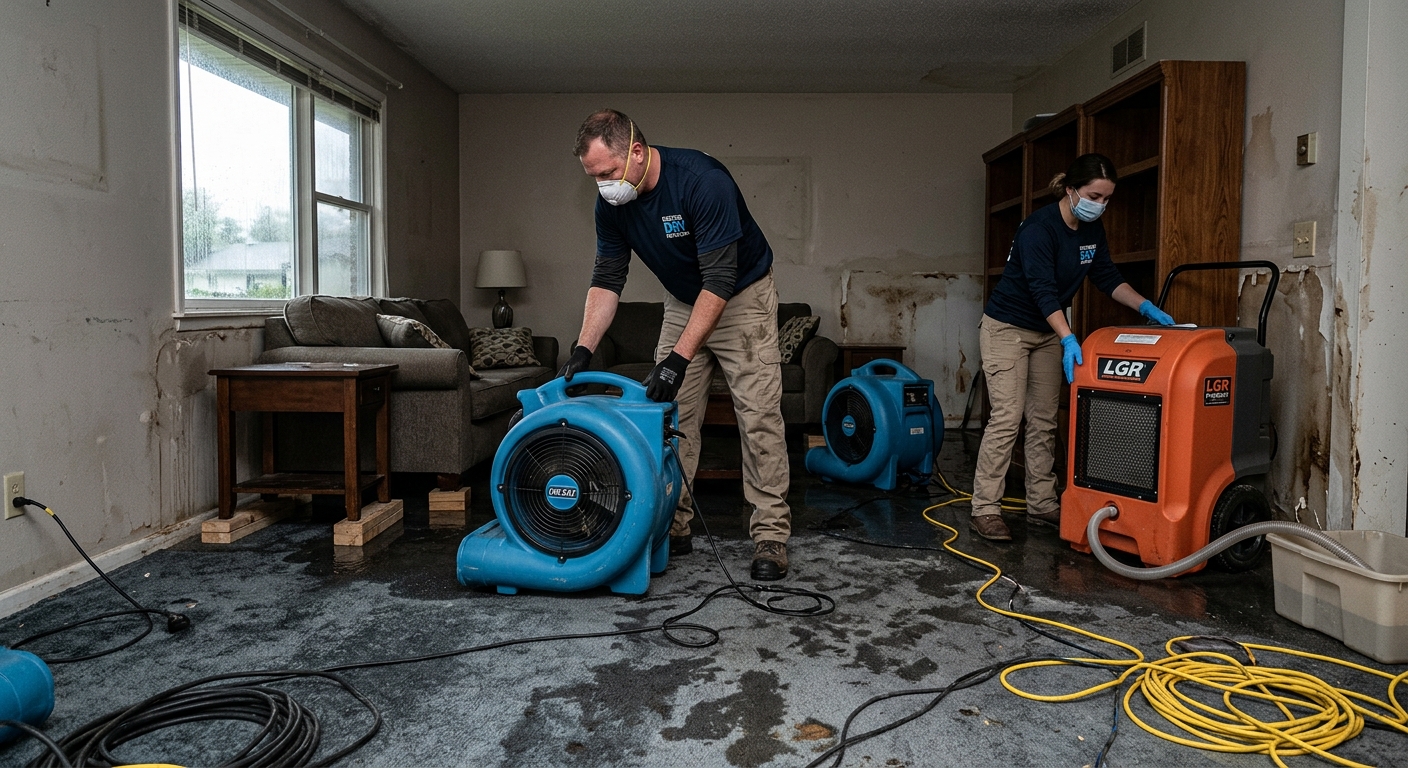
Air movers (big fans) and LGR (low grain refrigerant) dehumidifiers do the heavy lifting. Air movers speed up evaporation, while LGR dehumidifiers pull that vapor out of the air—it works best left running, even overnight. Don’t unplug these machines: pausing them stalls progress and can ruin days’ worth of effort, especially given southeastern Pennsylvania’s summer humidity and frequent coastal storm remnants.
The crew should visit daily for monitoring, taking and recording fresh moisture readings in the same log. The drying goal is a specific moisture content that matches “dry standard” in your region, not just “feels dry.” For Chester County, this has to account for humid summers and moderate freeze-thaw, so outside air is not always your friend.
Ask for the daily moisture logs. If a company cannot provide them, they are guessing—real pros measure, record, and adjust based on numbers.
Regulation, certification and verification in New Garden
Pennsylvania does not have a state license for water restoration or mold contractors. A business card is not proof of qualification. The standard here is IICRC certification: expect to see an IICRC S500 card from the lead tech for water work, or S520 for mold. Mold remediation has no state license, but a certified firm is what insurers expect.
Permits are only triggered in West Chester Borough if you’re doing reconstruction (like wall framing, electrical, or plumbing work), not for drying, moisture monitoring or like-for-like drywall replacement. Always ask any firm if a permit will be required for your specific repair—otherwise, you may run into trouble with resale or insurance.
Before anyone brings in equipment, get a copy of the HIC registration for any contract over $500. Verify active workers’ compensation at wcais.pa.gov and ask to see proof of insurance naming the contractor and your address if possible. For homes built before 1978, ask for the EPA Lead RRP certification.
Get a detailed written contract or work order specifying the exact rooms and square footage before any work begins—blank scopes are a warning sign.
After the repair: hardening the house
Once you’re back to dry, think about preventing the next emergency—but don’t over-spend. A Wi-Fi water shutoff valve installed at the main runs $420–$900 and can pay for itself with a single avoided loss, especially in Chester County’s finished basements. Replacing rubber supply lines on washers and water heaters (often under $120 per line) is a high-value DIY or plumber job; these burst more often than anything else.
If your house has a basement, a sump pump with battery backup ($600–$1,200 installed) makes sense. For homes on combined sewers, a backflow valve ($900–$2,800) can prevent a Category 3 sewage backup, but only if local plumbing allows. Water heater pan and drain installations ($180–$350) are low cost and take care of the most predictable leak.
Leak sensors ($30–$80 each) should go near the water heater, under the kitchen sink, and behind washing machines. Freeze isn’t the leading water loss driver here, but if you’ve got plumbing on exterior walls, Chester County’s 30-inch frost depth means real freeze risk.
Skip “flood alarms” without automatic shutoff—they rarely stop real damage.
New Garden's housing and its water damage profile
New Garden’s housing is dominated by post-1950 suburban construction, with just 26.2% built before 1980 (U.S. Census Bureau, ACS 2024). Most homes here feature full basements and drywall interiors, not plaster, so water losses usually mean working fast to save basement finishes or replace sections of sheetrock. Cast iron drains are mostly limited to older stock—PVC now rules, especially in homes built since the early 1990s. PVC can handle water well, but joints are sometimes the failure point.
The big risk in housing built since 1970 is aging-but-not-antique supply lines and water heaters. If your home went up in a subdivision boom (say, 1997–2004), plumbing and appliances hit replacement age just as the seals and soldered joints fatigue; first-generation plastic and rubber washers go brittle, which means a big loss if a line pops. Basements in these homes tend to be finished living space, so a leak can quickly cost more, requiring full flooring pull-up and baseboard removal.
Glued-down flooring slows the dry-out, letting water wick sideways and under cabinets—expect a higher demolition scope than surface-only work. If your home is among the 26% built pre-1980, expect heavier, often cast iron lines and some plaster walls, which resist initial damage but make repairs slower and more labor-intensive.
Frequently asked questions — water damage restoration in New Garden
What does mold remediation cost in New Garden?
Mold remediation costs in New Garden typically fall between $1,750–$12,500, with most projects averaging around $7,000. The price depends on how widespread the affected area is, whether the mold got into finished basements (common in the area), and if any structural framing or HVAC cleaning is involved. If you catch the problem early, the lower end of the range—think isolated patches on drywall—applies. If the issue was hidden behind glued-down flooring or cabinets and sat undetected (not rare here given how basements are finished), budget for the higher end. Every project should include containment barriers and post-work clearance testing. Don’t pay for expensive removals without visible justification—remediation should follow actual testing and visible signs, not fear-mongering or scare-tactic salesmanship.
Does Pennsylvania license mold remediation contractors?
No, Pennsylvania does not license mold remediation contractors at the state level. There’s no state registration or required exam for mold work, so anyone can technically advertise these services. In New Garden and Chester County, the insurance industry and most local adjusters expect to see IICRC S520 training and certification as proof of competence. Always request to see the lead technician’s IICRC card before work begins on your property. Typical mold removal costs—from $1,750 to $12,500—mean you should vet the company yourself. Ignore any promises about “Pennsylvania mold licenses”—there is no such license. Your safest bet is to hire a firm with substantial local references and independent certification, not just a fancy website or a claim of “state approval.”
Can hardwood floors be saved after flooding?
In many New Garden houses with real hardwood (rather than laminate or vinyl plank), whether you can save the flooring depends on how long the water sat and how quickly professional drying began. If drying gear is on-site within the first 24 hours, and if the flooding was clean water, chances are decent—especially if the crew uses high-pressure drying mats. But when water is trapped under glued flooring or has wicked into the subfloor, or if mold is already present, removal could be unavoidable. If the wood is starting to cup or buckle, sometimes repairs cost almost as much as replacing. Typical extraction and drying for wood floors runs $1,400–$8,800. Once you cross into mold remediation, costs could jump to $7,000–$12,500. Immediate action saves money here; waiting rarely does.
What does structural drying cost if I extracted the water myself?
If you managed to get all the standing water out on your own, bringing in a professional crew just for structural drying usually falls between $1,150–$8,200, depending on square footage and how long materials were wet. The lower end applies to small, uncomplicated rooms in a New Garden basement, while the higher end hits when water soaked under glued flooring or traveled behind walls. Crews will bring in air movers and LGR dehumidifiers, plus do monitoring until dry standards are reached. Even if you did the first part solo, daily moisture monitoring and proper drying are what keeps a $3,500 drying job from turning into a much more costly mold remediation. Don’t spend on professional extraction unless you truly need it—if surfaces are dry, direct the contractor to start at the drying phase only.
What is an assignment of benefits and should I sign one?
An assignment of benefits (AOB) is an agreement that lets the restoration contractor deal directly with your insurance company and collect payment on your behalf. In New Garden, most reputable firms use a straightforward AOB form, but you should never sign anything blind. Read the fine print—an AOB can give a contractor control over scope and billing, and tie your hands if you get unhappy with their work. Never sign an AOB before you receive an itemized estimate and verify their Home Improvement Contractor number. If the work is relatively small (under $4,600 for standard extraction and drying), consider handling payment yourself and seeking reimbursement. Only sign when you’re comfortable with the company and contract terms. Be cautious of high-pressure sales tactics—AOBs should be about convenience, not ceding all control.
How long before mold starts growing?
Mold growth can begin in as little as 24–48 hours after water intrusion—so if you’re in New Garden and have a finished basement or basement-level laundry, you have a short window to act. This time frame is the same whether the water came from a clean broken supply line or river water from the Brandywine Creek. Once mold takes hold in drywall, carpet, or glued-down flooring, a drying job that might have cost $3,500 can quickly balloon to $7,000–$12,500 with remediation and clearance testing. That’s why insurance adjusters and restoration pros alike urge action fast; drying equipment needs to be deployed as soon as possible, even if it’s the middle of the night.
Can I clean up water damage myself in New Garden?
If the affected space in your New Garden home is less than 25–30 square feet, and the water is clean (from a broken pipe, not flood or sewer), a homeowner with the right tools and safety gear can sometimes handle initial cleanup. Move contents and get airflow started. But if water soaked into walls, insulation, or finished basement materials—or if it’s a bigger loss—professional structural drying and monitoring are worth it, with costs starting around $1,150–$3,500. Never tackle Category 3/sewage cleanup or anything involving electrical risk on your own. For larger claims, insurers often require professional moisture readings and logs to support a claim, so DIY could hurt your reimbursement. Always keep good photos and records, even for small jobs.
Why did the crew cut my drywall two feet up?
The “two-foot flood cut” is a common best practice in the Chester County area. When drywall is soaked from the floor up, cutting 24 inches above the floor allows restoration crews to remove all wet insulation, check sill plates and studs for hidden moisture, and reduce the risk of lingering mold. In New Garden, where finished basements are typical, this is quicker than trying to dry drywall in place (which rarely works beneath vinyl or laminate flooring). The removed section is easier—and often cheaper—to replace than risking mold growth which would require full remediation and add several thousand dollars ($7,000–$12,500) more to your tab. Expect cuts higher than two feet only if moisture meters show water traveled farther up the wall cavities.
What if the insurer's estimate is lower than the contractor's?
If your insurance company’s estimate is lower than the contractor’s proposal, it’s not unusual in New Garden. Insurers try to set pricing based on averages, while restoration contractors base theirs on the actual site conditions—like whether they need to remove glued-down flooring or do extra demolition in a finished basement. Always ask your contractor to explain and document each line item. Submit all outgoing invoices, moisture logs, and photos. If you get pushback, ask both parties to walk through the house together. Most disagreements get resolved with more detail and better records. Even so, some gaps—especially on mold remediation ($1,750–$12,500) or sewage backup cleanup ($2,900–$14,000)—are common. Avoid contractors who “promise to eat your deductible,” as waiving deductibles is prohibited in Pennsylvania.
What causes most water damage in New Garden homes?
In New Garden, the most common sources of water damage are aging supply lines—especially in homes built after 1950—and finished basements with plumbing fixtures or laundry. Rubber and flexible washer hoses, water heaters hitting 10–18 years, and glued-down flooring that hides leaks all combine for high-risk spots. Storm events—especially heavy rain from coastal remnants—sometimes cause basement seepage due to high groundwater from the region’s full-basement design. When leaks go unnoticed behind finished walls or under flooring, water sits longer, leading to bigger claims. That’s why an early intervention that costs $1,400–$4,600 for extraction and drying is so important compared to delayed discovery, which ends up in mold remediation territory. Upgrading old hoses and appliances is the most cost-effective prevention in New Garden’s housing stock.