Reading water damage pricing by scope — 2026
If you are reading this in Reading, PA, there’s a fair chance you’re dealing with a basement or lower-level water issue right now. With 89.5% of local homes built before 1980 and only 11.9% being single-family detached (U.S. Census Bureau, ACS 2024), water losses here often play out below grade—and restoration costs reflect that. Older foundations and drains in much of Reading and the surrounding Berks County townships mean water intrusions, especially from heavy rain or sewer backups, are common and can quickly escalate if not tackled promptly.
Below you’ll find the typical price bands you can expect in Reading, including homes in Muhlenberg, Exeter, and the other nearby townships. These estimates include both labor and equipment, though large losses or work involving major reconstruction after water extraction require additional budgeting.
| Service |
What it covers |
Typical duration |
Price range |
| Water extraction + emergency drying (Cat 1) |
extraction, air movers, LGR dehumidifiers, daily moisture monitoring |
3–5 days |
$1,150–$7,200 |
| Structural drying only (post-extraction) |
drying to standard after water is already out |
3–5 days |
$950–$6,700 |
| Mold remediation with containment |
containment, HEPA filtration, removal, antimicrobial, clearance test |
3–7 days |
$1,450–$10,000 |
| Sewage backup cleanup (Cat 3) |
biohazard protocol, disposal of porous materials, disinfection |
2–5 days |
$2,400–$11,500 |
| Emergency board-up / tarping |
stop further water entry, secure the structure |
same day |
$350–$900 |
Estimates for a typical Reading home. Category, affected area and how long the water sat move these figures more than anything else.
The mold clock: 24, 48 and 72 hours
The first critical hours after a water loss in Reading shape whether you’re looking at basic drying, demolition, or a full-blown mold remediation job. Mold can begin colonizing in as little as 24–48 hours, especially in our region’s basements—where humidity builds up and lower winter temperatures outside push condensation into foundation walls. In many Reading homes, water intrusion hides behind 1950s-era finished basement paneling or drywall. If you act within 24 hours, dry-in-place with targeted air movement and dehumidification is usually enough. This is the difference between a bill at the lower end ($1,150–$7,200 for extraction plus drying) and something far more complex.
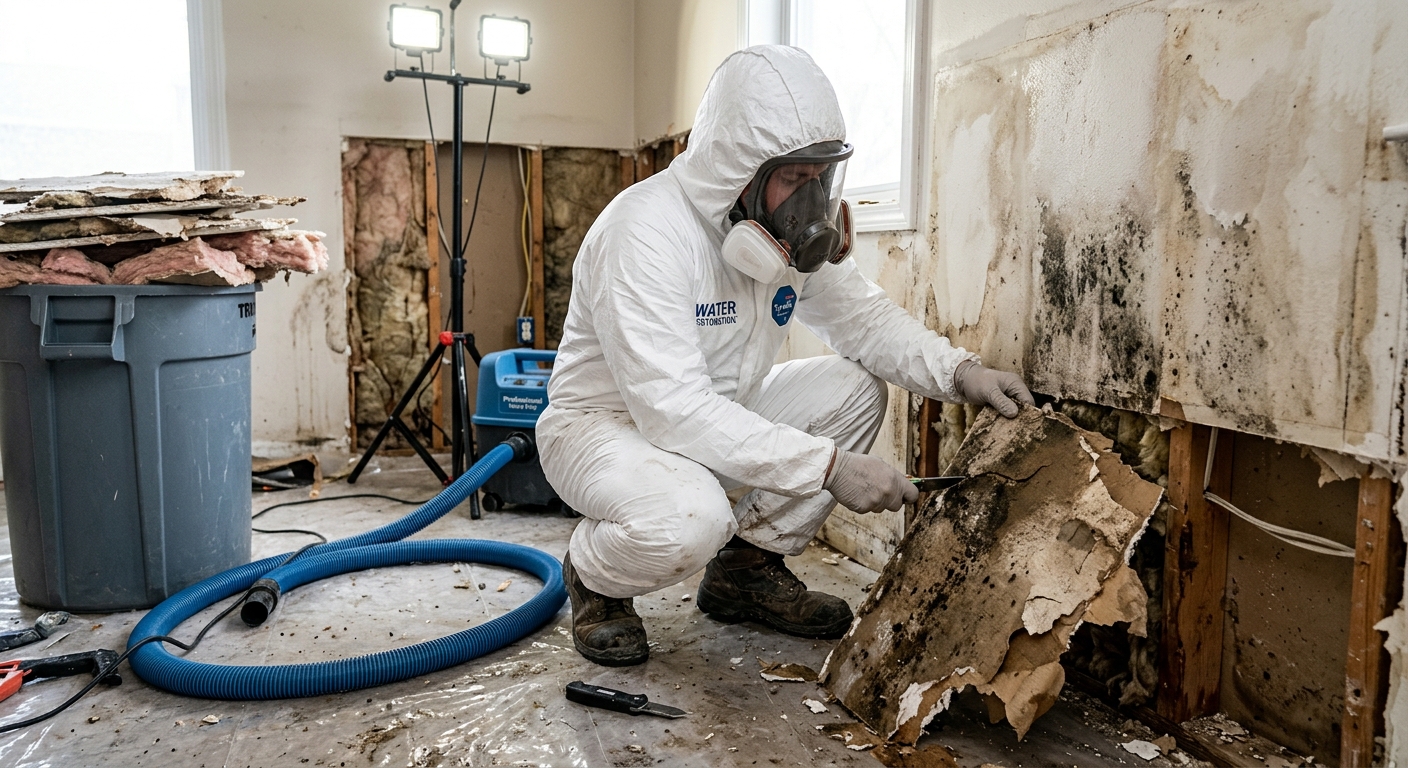
After 48 hours, sheetrock and lower wall sections may need selective demolition. Microbial growth may have begun out of sight—even if you can’t yet smell or see it. By 72 hours, if water is still present, mold remediation becomes necessary, driving costs up to the range of $1,450–$10,000 or more depending on the area and how deep the water penetrated. Remediation at this stage demands full containment, HEPA air filtration, and a clearance test—where a third party samples the air or surfaces to ensure spore counts are safe before you rebuild. Always ask for this clearance report in writing. It is your documented proof that mold sources were properly removed, not simply covered up. Quick response in Reading's climate is both a health safeguard and a cost savings.
What a Pennsylvania restoration contractor must actually hold
Pennsylvania does not license restoration or mold contractors by trade—there is no state-issued restoration license or mold remediation credential. Every reputable firm in Berks County operates under Home Improvement Contractor (HIC) registration, which is mandatory for any job over $500. You should always check this at the Pennsylvania Attorney General’s website before signing, especially since the contract is required by law and gives you a 3-day right to cancel for any reason. There is also no specific mold licensing, but IICRC S520 (for mold) and S500 (for water restoration) are the industry standards—ask the lead tech to show you an IICRC card before they start your job.
Emergency extraction or drying alone does not require a building permit in Berks County townships, but if the work includes reconstruction with new framing in Reading proper, you’ll need a permit from the City Codes office. For insurance, all restoration crews must carry workers’ compensation, which you can check through the WCAIS system. Before anyone starts extracting, ask for the contractor’s HIC number, certificate of insurance naming you and your address, and the name of the lead technician. You don’t need to pay for credentials you don’t see in writing.
How restorers classify water damage
Restoration professionals rate water losses along two axes: CATEGORY, measuring contamination, and CLASS, measuring how thoroughly the building absorbed water. These are independent: a small, contaminated (Category 3) loss—a sewer backup affecting a single room—costs more than a clean (Category 1) supply break that affected three rooms. In Reading, even small Category 3 losses are in the $2,400–$11,500 range, while Category 1 jobs can come in much lower.
Time is a crucial factor. Clean water (Category 1) left sitting will absorb materials and degrade: after 48 hours it’s usually recategorized as grey (Category 2), and after 72 hours, especially in a basement or in warmer weather, it may be considered black (Category 3) due to microbial growth. So, waiting can actually move your loss into a pricier and riskier category, regardless of the source.
| Classification |
Source or extent |
Health risk |
Cost effect |
| Category 1 — clean |
supply line, appliance line, rainwater |
low |
baseline |
| Category 2 — grey |
washing machine, dishwasher, sump failure |
moderate |
+20–40% |
| Category 3 — black |
sewage, groundwater, water standing 72+ hrs |
biohazard |
$2,400–$11,500 |
| Class 1 |
small area, little absorption into structure |
— |
low end of service1 |
| Class 2 |
whole room, water into walls and subfloor |
— |
$1,150–$7,200 |
| Class 3 |
saturation from above; insulation and walls wet |
— |
$950–$6,700 |
| Class 4 |
deep saturation of hardwood, plaster, concrete |
— |
service2 upper range |
Finished basements and water damage in Reading
Below-grade spaces dominate Reading and much of Berks County. Older Schuylkill Valley homes were built with full basements that now hide trouble: hydrostatic pressure against aging fieldstone or block foundations, high groundwater during snowmelt, and the absence of gravity drainage. Sump pump failure, sometimes caused by storms or power outages, is the number one single source of basement flooding. If you don’t have a battery backup, a strong thunderstorm can quickly turn a finished rec room into a Category 2 or 3 loss.
A finished basement doubles the restoration scope compared to an unfinished one. Water here soaks insulation, drywall, framing, flooring, and sometimes built-ins—all of which need both drying and, often, surgical demolition to prevent mold later. Reading’s 30-inch frost depth means freeze-thaw cycles stress old foundations; cracks and movement make intrusion more likely. Humidity stays trapped, and with hidden cavities, water migrates further before you even notice a musty smell. That’s why billing for a finished basement water loss often registers closer to the top of the $1,150–$7,200 water extraction band—or higher if sewage is involved.
What construction era means for a water loss here
Nearly 90% of Reading homes were built before 1980. That statistic shapes almost every water claim in this area. Expect older supply lines—copper, sometimes galvanized steel—facing their service life’s end and contributing to leaks. Plaster walls (thick over wood lath) absorb moisture differently than drywall, holding water longer and slowing down the drying process. Cast iron and clay drains appear in pre-1960 homes, and while they are tough, they’re also prone to cracks, settling, and root infiltration. When these fail, sewage can back up fast—especially in Reading’s denser neighborhoods with older infrastructure.
Drying older materials often takes longer. Plaster holds more water, and old-growth framing dries at a different rate than new pine. Full basements found under most Reading homes, especially in rowhouse neighborhoods, provide hidden migration paths under floors and inside partition walls. All told, construction era sets the baseline for scope: older houses need more careful moisture mapping, possible lead-safe work practices, and, in some cases, a more aggressive approach to demolition if water has gone undetected for days.
What to expect week by week in Reading
Water damage restoration splits into two distinct phases. Mitigation happens fast—3 to 7 days of extraction, drying, and demolition. This is urgent work, often billed straight to insurance, and can start the day you call. Once the equipment is gone, however, you may feel stuck: the “quiet” period between mitigation and reconstruction can last a week or much longer, especially in busy seasons given Berks County’s moderately saturated market. This is when you line up reconstruction estimates, permits if you’re in Reading city, and choose materials.
Reconstruction—replacing drywall, insulation, flooring, and trim—may take 2 to 8 weeks, depending on scope and how quickly your contractor schedules trades. In Reading and adjacent townships, local firms respond quickly for emergencies, but framing and finish work may not begin immediately. Many homeowners are surprised by this gap, but it’s a normal part of the process. Knowing this in advance means you’re not calling your mitigation crew—whose job really is finished—just because your basement still looks half-built three weeks out.
Frequently asked questions — water damage restoration in Reading
Will my premium go up after a water damage claim?
Insurance premiums in Reading and across Pennsylvania can sometimes rise after a water damage claim, but this is not universal. If you have a history of other claims, especially for water or sewer backup, your insurer may increase your rate or change your coverage. First-time, smaller claims (in the $1,150–$7,200 range) are less likely to affect your premium than the large or repeated ones. Since many Reading properties have older plumbing and full basements, water losses are not rare here—and some carriers may view older homes as a higher risk after a claim. Always check with your agent, and remember: Pennsylvania law prohibits a contractor from waiving your deductible. File a claim only for losses that clearly exceed your deductible and are beyond your ability to address fully and safely.
How long before mold starts growing?
In Reading’s climate, mold can begin to colonize as soon as 24 to 48 hours after a water intrusion, especially in cool, humid basements with limited airflow. Poorly drained foundations and older finished basements trap moisture, speeding up the process. If water remains by the 72-hour mark, you’re likely looking at mold remediation in addition to basic extraction and drying, pushing your total estimated bill from the $1,150–$7,200 bracket up to the $1,450–$10,000 range. Fast response is more than customer service—it’s about controlling scope and cost. Always insist on a written clearance test after remediation, so you know spore counts are safe before rebuilding.
Why does plaster take longer to dry than drywall?
Plaster is denser and holds far more moisture than drywall. In Reading’s pre-1980 housing stock, thick plaster over wood lath is the norm—especially in homes from the 1940–1970 construction era. When it gets wet, water penetrates the full depth, and drying can take several days longer than with modern drywall. Drywall can sometimes be dried in-place if caught early, keeping costs in the $1,150–$7,200 range. Plaster, though, usually needs extra drying time, more aggressive air movement, and sometimes careful demolition to remove saturated sections, all of which lengthen scope and can increase the total bill.
Does Pennsylvania license mold remediation contractors?
Pennsylvania does not require a state license for mold remediation or water restoration contractors. In Reading and throughout Berks County, the practical industry benchmark is IICRC S520 for mold and S500 for water damage—for which the technician carries an IICRC card, not a state license. Always ask your contractor to show you this card. Make sure the business is Pennsylvania Home Improvement Contractor (HIC) registered for any contract over $500. Just because a company says they do mold does not guarantee training or credentials, so check references and registration before you spend $1,450–$10,000 on a remediation job.
Can I clean up water damage myself in Reading?
If the water is clean (Category 1) and confined to a small, hard-surfaced area, a handy Reading homeowner can sometimes self-extract and dry—using wet-dry vacs, fans, and dehumidifiers. But the risk climbs fast with larger, finished or below-grade spaces, or anything Category 2 or 3 (greywater or sewage). In those cases, DIY often ends up costing more as undetected moisture leads to mold, where professional remediation then runs $1,450–$10,000. If you choose to attempt drying yourself, always use a moisture meter, remove baseboards and check behind walls, and be realistic about what you cannot see or smell—especially in older Reading basements.
How much does a flooded basement cost to restore in Reading?
In Reading, restoring a wet basement depends on the source and how much of your finished space was affected. For basic water removal and drying in an unfinished basement, expect the bill to run $1,150–$7,200. Finished basements—typical in the region’s 1940–1970 homes—mean more demolition and more contents handling, so the upper end or even the next pricing band comes into play. If the intrusion involves sewage or goes undetected long enough for mold to colonize, the typical job reaches $2,400–$11,500. The key variables are how long the water sat, category, and how much needs rebuild after drying.
Does insurance cover mold after water damage?
Coverage for mold after a water loss varies by policy and by the timing of your response in Reading. Most homeowner insurance in Pennsylvania covers mold remediation if it stems directly from a sudden and accidental covered event—a pipe burst or washing machine hose failure, for example—and you act promptly. However, if you delay reporting or responding and mold develops days later, insurers often deny coverage, seeing it as preventable. Mold remediation jobs locally run $1,450–$10,000 depending on area. Read your policy and call your agent early; in Reading’s older homes, quick reporting can mean the difference between approved coverage and an out-of-pocket bill.
Is emergency after-hours service more expensive in Reading?
Most Reading-area restoration firms provide 24/7 emergency response, but after-hours work can cost more—primarily because overhead and labor rates rise at night or on weekends. That said, you’re rarely charged a separate emergency fee; it’s built into the overall bill. For example, a sewage backup addressed on a Saturday evening could reach the upper end of the $2,400–$11,500 band, but the main driver is scope, not just scheduling. If insurance is involved, these off-hour costs are typically covered. In urgent situations, waiting often raises costs more than calling in immediate help.
Can I turn the dehumidifiers off at night?
It’s a mistake to unplug restoration dehumidifiers or air movers overnight. Full drying after a water loss in Reading—especially in dense rowhouse basements or finished spaces—relies on running equipment 24/7 until moisture levels meet industry standard. Turning off machines even for a few hours slows drying considerably and risks mold growth, potentially moving your loss from a $1,150–$7,200 bill up to $1,450–$10,000 if remediation is needed. If the equipment noise is unbearable, ask your contractor to reposition units or set up a temporary sleeping area elsewhere. Always let the pros monitor and decide when drying is truly done.
Are Reading basements especially prone to flooding?
Reading’s foundation styles and neighborhood topography make its basements especially vulnerable to flooding. Full-basement construction, common from 1940–1970, plus hills and proximity to Schuylkill River tributaries, create hydrostatic pressure and overland flow problems. Older storm and sanitary systems lead to more sewer backups, particularly in Reading’s rowhome blocks. Even finished basements—sometimes newly renovated—regularly see water losses, especially if sump pumps fail or power goes out. Because so much of the area’s housing stock is pre-1980, water claims are higher here than in newer suburbs, and bills for sump-related events routinely land in the $1,150–$7,200 range, higher if sewer is involved.