What water damage restoration costs in Moosic
If you're in Moosic and looking at water across your basement floor or dripping down a wall, you want to know what it's going to cost—fast. Here, prices line up with the features of local housing and climate. Moosic’s housing stock is mostly single-family homes, with a majority built before 1980 (U.S. Census Bureau, ACS 2024), which means you may be dealing with plaster, lath, and finished basements that trap moisture far deeper than drywall. That makes mitigation here more involved than in newer suburbs.
Costs vary sharply depending on the type of loss, how much area is affected, and—importantly—how long the water has gone undiscovered. Restoration firms here routinely encounter basement floods, hidden leaks inside lath walls, and contaminated contents. Below are the typical durations and price ranges you’ll encounter for essential services in Moosic:
| Service |
What it covers |
Typical duration |
Price range |
| Water extraction + emergency drying (Cat 1) |
extraction, air movers, LGR dehumidifiers, daily moisture monitoring |
3–5 days |
$1,150–$7,200 |
| Structural drying only (post-extraction) |
drying to standard after water is already out |
3–5 days |
$950–$6,700 |
| Mold remediation with containment |
containment, HEPA filtration, removal, antimicrobial, clearance test |
3–7 days |
$1,450–$10,000 |
| Sewage backup cleanup (Cat 3) |
biohazard protocol, disposal of porous materials, disinfection |
2–5 days |
$2,400–$11,500 |
| Emergency board-up / tarping |
stop further water entry, secure the structure |
same day |
$350–$900 |
Estimates for a typical Moosic home. Category, affected area and how long the water sat move these figures more than anything else.
Credentials and permits for restoration work in Moosic
Pennsylvania does not issue any trade license for water damage restoration or mold remediation; there is no such thing as a “licensed” restoration contractor here—anyone can print a business card. Instead, the recognized industry standard is IICRC certification (specifically S500 for restoration and S520 for mold). Ask to see your crew leader’s IICRC card; he or she should carry it, and it should have their name and level of training. For contracts over $500, anyone doing home improvement work—including all restoration firms in Moosic—must be registered with the Pennsylvania Office of Attorney General. You can and should verify Home Improvement Contractor (HIC) registration at the official state portal.
If you live in Scranton and work goes beyond emergency drying—like replacing drywall or framing—a local permit is required. Pure mitigation (extraction, drying, minor finish replacement) typically does not require a permit in Scranton or the surrounding Lackawanna County municipalities. Before any crew sets up fans or moves your contents, you should get a written contract that spells out scope and price, as required by the Home Improvement Consumer Protection Act. Insurance and workers’ comp can be verified using the WCAIS system; don’t just take their certificate at face value. Never pay for work in cash or with a blank check—always insist on clear paperwork, especially in a market where “licensed” is not a meaningful label.
Mitigation, then reconstruction: two different timelines
In Moosic, drying your home after a leak or flood unfolds in two clear phases—mitigation and reconstruction. Mitigation is the emergency phase: water is extracted, equipment is set the same day or next, and your structure is stabilized. This rarely takes more than three to seven days, with the aim to prevent further damage and mold. This urgent work is often billed directly to your insurance company under a separate contract.
Reconstruction comes after. Rebuilding floors, replacing drywall, and restoring cabinets require local permits and scheduling. This is where homeowners often feel forgotten: once the dryers leave and fans shut off, a waiting period begins before a reconstruction crew is scheduled. In Lackawanna County’s moderate suburban market, there may be a gap of weeks between dry-out completion and a reconstruction start date, especially if several firms are servicing the larger Scranton metro area at once.
Expect the drying contractor and rebuild contractor to be different companies, each with their own paperwork. If you haven’t heard back about rebuilds a week after equipment removal, start calling—don’t assume the process moves itself. That lag isn’t abandonment; it’s a result of permit processing and market capacity in our area.
How a Moosic crew dries a house
Restoration in Moosic starts with mapping moisture throughout the property. This is critical in a town where finished basements and plaster-lath construction can hide damp pockets. Crews use professional moisture meters, not just eyeballs, and log these readings daily. If you want proof your house is getting drier, ask to see these logs—properly trained teams should be able to show you how today’s readings compare to yesterday’s at each spot.
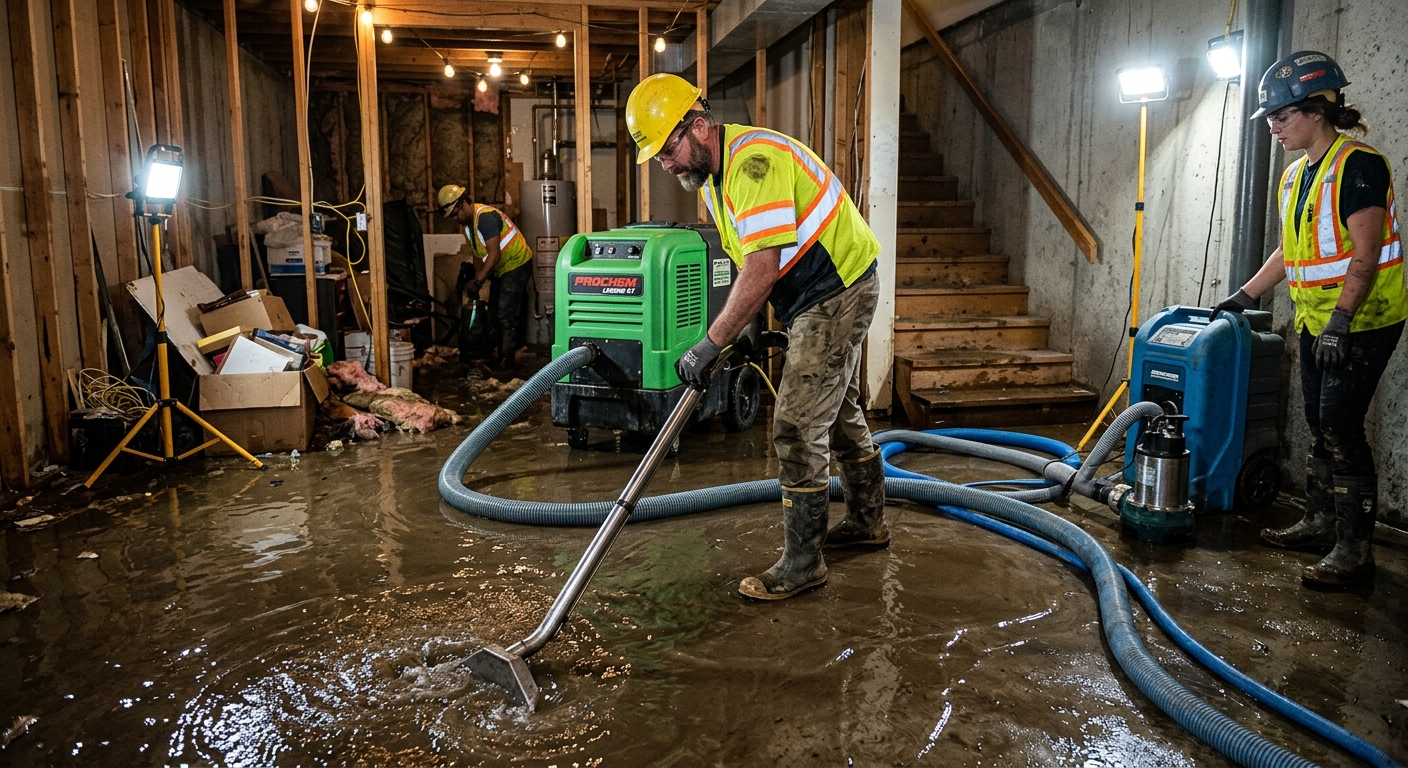
Air movers (high-velocity fans) and LGR (low-grain refrigerant) dehumidifiers are positioned to circulate air and draw out moisture from wet structure and contents. In our cold Northeastern Pennsylvania climate, a winter dry-out can take a day or two longer thanks to the 4 °F winter design temp and 40 psf snow loads that saturate foundation walls. It’s vital that this equipment runs 24/7 until readings hit the drying goal—a target moisture content defined by IICRC S500, not someone’s guess. Shutting off equipment at night can add days and risk mold, especially with our region’s high heating degree days and well-insulated basements.
Crew supervisors should visit daily, check readings, adjust equipment, and update a log. Homeowners can—and should—ask for these records. If your contractor cannot produce daily meter logs, there’s a very real chance parts of your Moosic house are staying wet beneath the surface, especially if lath or a finished basement hides a problem spot.
Filing a water damage claim in Pennsylvania
The most expensive surprise for Moosic homeowners comes down to the difference between sudden “internal water” leaks—like burst pipes—and water coming in from outside. Standard homeowners policies in Pennsylvania generally cover accidental, sudden events: burst supply lines or failed water heaters. But if the water entered from the ground or the river (the Lackawanna River is our key local risk), standard coverage won’t help—flood insurance is a separate policy, often with a 30-day waiting period to take effect.
Claims for gradual leaks—say, persistent drips behind a wall—are often denied as “maintenance” issues. Sewer backups are not standard coverage; you usually need a separate rider. Ask your agent about this specifically. When your claim is processed, your payout can be on an actual cash value (depreciated) or replacement cost basis. Check your policy for which applies.
The mitigation contractor will give your adjuster a scope of loss document detailing areas affected, materials removed, and drying logs. Some firms offer direct billing or will ask for an assignment of benefits, meaning your insurance pays the contractor directly—but you lose some control in case of dispute or incomplete work, so read the paperwork carefully.
Under Pennsylvania’s Home Improvement Consumer Protection Act, you must receive a written contract for work over $500, with a 3-business-day right of cancellation. Waiving your insurance deductible is not permitted here—if you’re offered this, it’s a warning sign of an unethical operator or future claim issue.
Flooding vs plumbing failure in Moosic
The Lackawanna River is a real risk factor for many Moosic addresses, so it’s critical to know the difference between a flood and a burst pipe—insurance companies treat them as day and night. “Flood zone” status means you are officially mapped by FEMA as having a higher risk for surface water entering your home from the outside, usually after heavy storms or snowmelt. Standard homeowner policies do not cover this; you must buy separate flood insurance, either from the federal program or a private insurer, and you cannot wait for a forecast to trigger a purchase—policies enter effect only after a waiting period, commonly 30 days.
To complicate things, the aftermath looks identical: standing water, saturated walls, ruined floors. But adjusters will check cause first, not just what’s wet. If water entered because of the river, heavy rain, or groundwater seepage, that’s “flood,” and only a flood policy helps. If it’s a pipe that broke inside the walls, standard coverage should apply. Know which you have and be ready to document the source, as policy payouts and next steps depend entirely on this distinction in Moosic.
What can be saved and what has to go
In Moosic, the age and construction of your home determine what can be dried and what needs removal. With many early-20th-century Scranton-era homes still standing, it’s common to find plaster and lath walls versus modern drywall. Plaster absorbs and holds moisture far longer, requiring weeks to dry and making hidden mold more likely if not checked thoroughly. If your basement is finished, water often finds its way into voids, behind built-ins, and under older tile, all of which are traps for moisture.
Fiberglass insulation and carpet pad typically get discarded—they harbor bacteria and are hard to dry fully. Drywall below the waterline usually gets cut out and replaced; if your home has plaster walls, invasive testing or even some demolition may still be necessary. Solid hardwood floors sometimes survive with specialty drying mats, but engineered products almost always delaminate and need removal. Kitchen or bathroom cabinets could be saved if they are solid wood, but particleboard bases swell and fail quickly after water exposure.
If a contractor insists on gutting everything immediately in an older Moosic home, it’s worth questioning—sometimes hidden damage demands it, but a trustworthy crew will show you meter readings or demo only as necessary. Conversely, anyone promising to dry everything (especially in an older house with finished basements or lath walls) is setting up a future mold problem. Demand a written plan and don’t accept all-or-nothing answers.
Frequently asked questions — water damage restoration in Moosic
Is a shop vacuum enough for standing water?
A shop vacuum can help with a small spill on a hard floor, but it’s not enough if you have more than a few gallons or if water has soaked into carpet, walls, or a finished basement—especially common in Moosic’s older homes. Shop vacs aren’t designed to extract water from padding, subfloors, or wall cavities. For proper mitigation, professional crews use truck-mounted extractors and LGR dehumidifiers, and they often need three to five days to dry out a typical loss (costing $1,150–$7,200 depending on area and materials). Using only a vacuum leaves hidden moisture that can cause mold, rot, and structural damage in our region’s well-insulated, older housing stock. If in doubt, call for at least an assessment.
Does insurance cover mold after water damage?
In Pennsylvania, most standard homeowners policies limit or exclude mold remediation—coverage often depends on whether the mold resulted from a “covered peril” like a sudden pipe break or whether it arose from a slow, undetected leak. If a burst supply line leads to visible mold before mitigation can begin, some policies will cover remediation up to a fixed cap. However, if mold is discovered weeks later or is from a source the carrier considers maintenance, you may be on your own for remediation, which can range from $1,450–$10,000 in Moosic. Always read your policy for mold-specific language and talk to your adjuster the moment you spot fungal growth after a loss.
What is a clearance test and do I need one?
A clearance test is an air or surface sampling conducted after mold remediation to ensure your Moosic home meets safety and cleanliness standards before reconstruction or re-occupancy. It involves measuring spore levels against local baselines and confirms the remediation was effective. For most insurance-paid mold claims—especially when the loss exceeded $1,450—the carrier or adjuster will require a third-party clearance test before approving payment for rebuilds. In older homes with lath or finished basements, skipping this test can leave unseen mold that puts your family and future insurance claims at risk. Insist on a documented clearance if any remediation work is performed.
Do I need a permit for water damage repairs in Moosic?
In Moosic and the rest of Lackawanna County, pure mitigation—removing water, drying, and perhaps pulling up carpet—generally does not require a permit. If you’re inside Scranton city limits and you move to replace drywall, flooring, or demolish any part of your interior, a permit is required for reconstruction. For emergency drying jobs under $7,200, expect no permit in most municipalities; for projects that turn into rebuilding structural or finish carpentry, Scranton will likely require you to pull one. Always confirm with your contractor and get this requirement in writing before work starts.
Does wet insulation have to be replaced?
In almost every case in Moosic, wet fiberglass insulation—especially in finished basements below grade—must be removed and replaced. The material collapses and its R-value drops with water exposure. More critically, it becomes a breeding ground for mold that’s hard to spot behind old plaster or basement walls common to early-20th-century homes here. Attempting to save wet insulation risks a much costlier remediation project, sometimes running $1,450–$10,000 if mold sets in. For health and insurance reasons, insist on removal, and ask the crew to photo-document what’s taken out.
Do I need separate flood insurance in Moosic?
Yes—standard homeowner’s insurance will not cover water that enters from outside, such as floods from the Lackawanna River. Flood insurance is a separate policy, must be purchased in advance, and usually has a 30-day waiting period before coverage begins. Many Moosic homeowners only realize this after a storm event, when it’s too late to buy coverage for active damage. Flood claims are processed separately and can reach into the $1,150–$7,200 range or higher, depending on basement contents and reconstruction needs. Check your address for flood zone status and talk to your agent before you ever see water.
Why is water damage priced per square foot?
Restoration pricing in Moosic (and across Pennsylvania) is often quoted per square foot because drying, demolition, and equipment needs scale directly with the affected area. However, the final bill depends on more than size: older homes with lath, plaster, or finished basements may hide moisture that makes the job take longer—and raises the price into the $3,700 range for typical jobs. Complicated structures, contaminated water (like from a sewage backup), or extensive mold remediation increase costs. Always ask for a detailed scope of work and walk through the affected areas with your adjuster and contractor.
Is it safe to stay in the house during drying?
Most Moosic homeowners can stay during mitigation if the damage is limited and clean water is involved. Equipment will run nonstop for three to five days and it’s loud, produces heat, and may increase humidity temporarily. If sewage or gray water is involved, or if mold is present, it’s safer (and sometimes required) that you relocate until proper cleaning and air quality can be restored. Mold remediation often requires containment and may run $1,450–$10,000 for thorough abatement. Talk to your contractor and insurance adjuster about health concerns, especially if anyone in your household is immune-compromised.
How much does sewage backup cleanup cost in Moosic?
Sewage backups are classified as Category 3 water losses and require specialized equipment, disposal, and disinfection. In Moosic, cleanup jobs typically fall between $2,400–$11,500, depending on how far water traveled, whether finished basements or lath walls are affected, and how long the loss sat before response. Because many local homes have full basements and sometimes older, lower drains, prompt professional response is key. Insurance may only pay if you carry the right sewer backup rider—not standard in most Pennsylvania homeowner policies. Don’t delay: category 3 losses always cost more the longer they wait.
Are Moosic basements especially prone to flooding?
Yes, Moosic’s hillside neighborhoods and older housing stock mean full basements are almost universal, and these basements are prone to water entry due to the valley’s steep lots and the proximity to the Lackawanna River. Snowmelt, high groundwater, and run-off from storms can all lead to water in basements—even homes with updated foundations. Restoration costs for basement floods vary but often run $1,150–$7,200 just for extraction and drying. If you live in an older or low-lying part of town, it’s wise to review your flood risk with a qualified agent and have a mitigation plan on hand.