What water damage restoration costs in West Hazleton
If you’re in West Hazleton and dealing with water in your basement or lower level right now, you’re not alone—local housing and climate set the stage for these emergencies. With 86.6% of homes here built before 1980 and a majority as single-family units (U.S. Census Bureau, ACS 2024), the risk isn’t theoretical: aging piping and full basements make up most water-related calls in this area. Post–World War II tract housing in Wilkes-Barre and Hazleton still produces recurring pipe failures and stubborn basement leaks, especially after snow melts or heavy rain. The numbers below represent real 2026 prices for Luzerne County homeowners, reflecting not just extraction, but the full cycle: drying, mold risk, and backup or sewer problems that affect many neighborhoods around the Susquehanna River and Solomon Creek.
| Service |
What it covers |
Typical duration |
Price range |
| Water extraction + emergency drying (Cat 1) |
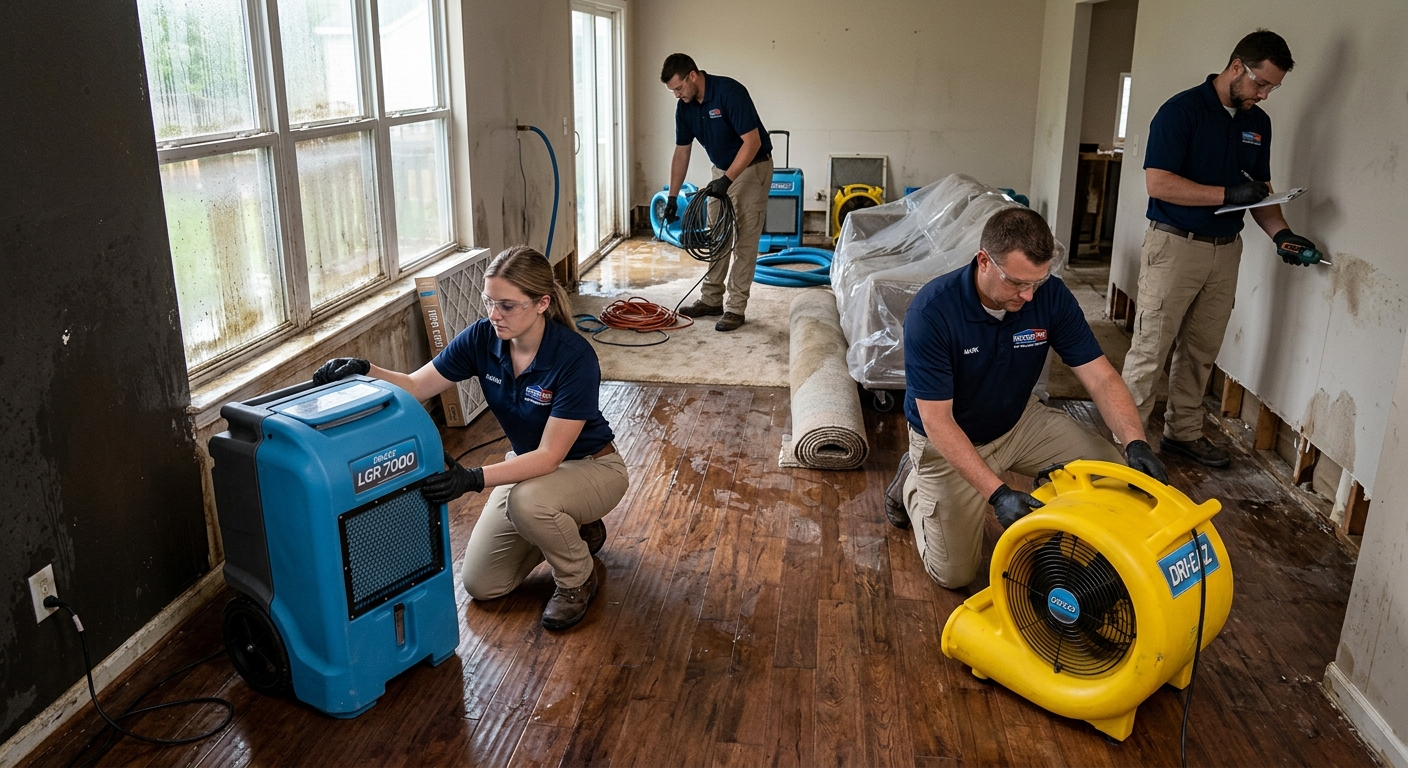
extraction, air movers, LGR dehumidifiers, daily moisture monitoring |
3–5 days |
$1,050–$6,500 |
| Structural drying only (post-extraction) |
drying to standard after water is already out |
3–5 days |
$850–$6,100 |
| Mold remediation with containment |
containment, HEPA filtration, removal, antimicrobial, clearance test |
3–7 days |
$1,300–$9,200 |
| Sewage backup cleanup (Cat 3) |
biohazard protocol, disposal of porous materials, disinfection |
2–5 days |
$2,200–$10,500 |
| Emergency board-up / tarping |
stop further water entry, secure the structure |
same day |
$350–$900 |
Estimates for a typical West Hazleton home. Category, affected area and how long the water sat move these figures more than anything else.
Hiring under pressure in West Hazleton
Few West Hazleton homeowners expect to shop for emergency restoration at midnight. With a moderately dense market and regional firms dispatching crews from Hazleton or Wilkes-Barre, help can often arrive quickly, but that doesn’t mean you can skip the basics. When the carpet is squishing and the clock’s ticking, three things to confirm by phone are: 1) Are you registered as a Home Improvement Contractor in Pennsylvania? 2) Do you carry active workers' compensation and liability insurance for this work? 3) What standard (IICRC S500 for water, S520 for mold) do you operate under, and can your tech show certification upon arrival? Before any equipment comes off the truck, get these three: 1) A contract with clear scope and cost, signed by both parties. 2) Written confirmation of HIC registration (get their number to verify at hic.attorneygeneral.gov). 3) Proof of insurance showing your address named as certificate holder.
- Confirm HIC registration by phone—do not take "yes" for an answer, look it up online.
- Ask for active workers' comp documentation—check via WCAIS (wcais.pa.gov).
- Request IICRC certification proof for the lead technician working your loss.
- Require a written scope (not just a start/finish date).
- Ask who will be directly supervising the job.
- Request an estimate in writing, even if it’s a range.
- Make sure the contract lists your exact address and loss details.
- Insist on seeing a business card or work order with local contact info.
- Check for emergency number—ask if you’ll get updates after hours.
- Clarify how changes or added costs will be handled (and approved by you).
Common pressure tactics: Some crews start setting up without paperwork, or slide a blank-scope authorisation at the door. Do not sign work authorisations or contracts with missing details, and do not let them unload equipment until your three main documents are complete. If anyone balks at this, move on—another crew is available in this market.
Regulation, certification and verification in West Hazleton
Pennsylvania does not license restoration, mold remediation, or water mitigation contractors at the state level. A business card itself guarantees nothing—legally, anyone can print one. That said, the IICRC S500 (for water restoration) and S520 (for mold remediation) are the insurance industry’s baseline standard. Always ask: “Can your lead technician show an IICRC card?” before the job begins. Emergency water extraction and drying in Hazleton rarely require a municipal permit when there’s no structural repair, but reconstruction after a flood or sewer loss in Wilkes-Barre absolutely does—usually through the city’s building permit system.
For any contract over $500, Pennsylvania requires formal Home Improvement Contractor registration. Always verify at hic.attorneygeneral.gov before signing. Legitimate companies have mandatory workers’ compensation for their employees—if someone tells you otherwise, check the coverage via the state’s WCAIS system (wcais.pa.gov). No permit or trade license exists for water or mold jobs here, so documentation and certification matter.
Before extraction starts, get: the contractor’s registered name and HIC number, a signed and dated contract with your address and documented scope, a copy of the company’s insurance certificate naming your address, and assurance that their field team lead carries IICRC credentials.
Why your neighbour's bill was half of yours
The biggest point of confusion in West Hazleton? Two jobs that look similar—a wet basement after a washing machine leak and one after a sewer backup—can produce bills that are night and day. That’s because of two scales: CATEGORY (how dirty or hazardous the water is) and CLASS (how much of the building absorbed it).
Say your neighbor has 300 square feet of clean water from a supply line: they get out for $1,050–$6,500. If you have a small Category 3 event—sewage backup affecting just part of a finished area—the bill might jump to $2,200–$10,500, even though less surface is wet. Why? Biohazard handling, material disposal, and protective measures drive cost far more than area. The other axis: waiting turns any cleanup into a bigger deal. Clean water left for more than 48–72 hours in a Luzerne County summer will climb from Category 1 to 2, or even black-water Category 3 (especially with our regional basement humidity).
| Classification |
Source or extent |
Health risk |
Cost effect |
| Category 1 — clean |
supply line, appliance line, rainwater |
low |
baseline |
| Category 2 — grey |
washing machine, dishwasher, sump failure |
moderate |
+20–40% |
| Category 3 — black |
sewage, groundwater, water standing 72+ hrs |
biohazard |
$2,200–$10,500 |
| Class 1 |
small area, little absorption into structure |
— |
low end of $1,050–$6,500 |
| Class 2 |
whole room, water into walls and subfloor |
— |
$1,050–$6,500 |
| Class 3 |
saturation from above; insulation and walls wet |
— |
$850–$6,100 |
| Class 4 |
deep saturation of hardwood, plaster, concrete |
— |
service2 upper range |
The upshot: The longer water sits, the worse (and more expensive) the cleanup—even if the leak was “clean” when it started. Get action quickly to avoid compounding cost and damage.
Preventing the next one
Spending a few hundred dollars can save thousands in Luzerne County’s flood-prone housing stock. Start with the essential: replace washing machine and water heater supply lines with braided stainless steel ($60–$120 parts, DIY-friendly). Next, sump pumps with battery backup: indispensable in any West Hazleton basement, especially after heavy rain or snowmelt ($550–$1,100 installed). Leak sensors belong beside water heaters, under kitchen sinks, and behind washing machines; modern models with Wi-Fi start at $45–$80 each and can prevent small leaks from becoming insurance claims. If you’re near the Susquehanna or in a backup-prone neighborhood, a sewer backflow valve ($900–$2,000 installed) is worth every cent in a finished basement.
Automatic water shutoff valves ($500–$1,500) are only worth the cost in homes with a history of main breaks or those regularly vacant. Water heater drain pans (with floor drains, under $200 total) make sense only if you’ve got a finished basement and a new tank install. For this climate: insulate pipes exposed to the 36" frost depth and keep foundation walls caulked—pipe freezes here are far more likely than in milder regions. Don’t waste money on expensive “whole-home” monitoring unless you travel most winters, since local labor can install spot sensors far more cost-effectively.
West Hazleton's flood exposure and what it means for coverage
The Susquehanna River and Solomon Creek are the twin drivers of real flood risk in Wilkes-Barre, Hazleton, and nearby Luzerne County neighborhoods. If your home is anywhere near these waterways, standard homeowner’s insurance will not cover a true flood loss—flood zones are mapped by FEMA, and coverage must be bought separately (usually via the National Flood Insurance Program). Crucially, flood insurance policies come with a waiting period (often 30 days), so you can’t buy protection from a forecast or after the creek’s already rising.
This matters because a basement full of water from a river flood and a basement flooded by a burst pipe look practically identical the next morning in West Hazleton. But adjusters treat them as black-and-white different: one is “water damage” (covered if sudden and from inside the house), the other is a “flood loss” (excluded unless you’ve got the separate policy). Many area homes have one but not both. If you’re not sure about your coverage, ask your agent: Am I insured if Solomon Creek overflows, or only if my water line bursts? No one wants to find out the hard way.
What to expect week by week in West Hazleton
Nearly every water loss in West Hazleton unfolds in two acts: mitigation and reconstruction. Mitigation—everything from water extraction and drying to mold treatment—happens in days. Crews arrive with fans, dehumidifiers, and meters for moisture readings, usually direct-billed to insurance when you sign a contract. Once the structure hits “dry standard,” though, the job shifts: mitigation crews pack up, and you wait. Reconstruction is weeks to months. This means new drywall, baseboards, flooring—work that’s separately contracted, sometimes even by a different company.
Because Luzerne County is part of the densely served Scranton–Wilkes-Barre metro, you’ll find reconstruction lead times are measured in weeks in peak storm or freeze season. Don’t take a quiet house for neglect—your case is in queue, waiting for permits (if in Wilkes-Barre) or for a local drywaller to become available. Knowing about this gap now is half the battle: you’re not being abandoned, you’re just between phases in a heavily booked market.
Frequently asked questions — water damage restoration in West Hazleton
Does homeowner's insurance cover water damage in West Hazleton?
Insurance here typically covers “sudden and accidental” water damage—think burst pipes, water heater failures, or washing machine hoses letting go—which is common in West Hazleton’s older postwar tract homes. That said, coverage excludes rising surface water or floodwaters from the Susquehanna River or Solomon Creek, which are real risks in Luzerne County. Always ask your agent for specifics about your policy, as language varies and a sewer backup from aging city infrastructure may or may not be included. Typical insured water damage events—like clean water extraction and drying—run $1,050–$6,500 here, with insurance paying less than full if carpets, walls, or contents go uncovered. Don’t wait to report a loss; delays can turn a covered event into a denied claim.
How do I know the house is actually dry?
Restoration contractors in West Hazleton use meter readings, not guesswork. Moisture meters—pin-type for wood, non-invasive for drywall and solid surfaces—give hard numbers. In our climate, crews set "dry standard" based on unaffected areas of your home, which means baseline moisture for our 6100-degree-day zone. Daily logs should back this up; get a copy before you sign off. A full drying job (including monitoring and equipment pull) is generally wrapped in 3–5 days and included in the average extraction price range of $1,050–$6,500. If a contractor refuses to provide readings or mark a passing point, press pause—you’re entitled to proof, especially for an insurance claim.
Why is water damage priced per square foot?
West Hazleton’s houses vary from small brick capes to larger tract homes, so per-square-foot pricing keeps estimates realistic. But it’s not just area: pricing also reflects depth of moisture (class), what materials are affected, and clean vs. contaminated water (category). For example, drying 500 square feet of clean water in a concrete basement will fall on the lower end of $1,050–$6,500, while the same square footage in a finished family room, with wet drywall and insulation, bumps higher. Always ask for a clear written breakdown, so you know what’s included—just drying, or demo and disposal as well.
Is sewer backup covered under a standard policy?
Coverage for sewer backups in West Hazleton is not built into most homeowner’s insurance policies—you typically need to add a special endorsement. With Wilkes-Barre’s aging combined sewers and risk spikes after heavy rain or high river stages, this coverage is worth reviewing. When it’s available, it usually comes with a cap (often $5,000 or $10,000) that may not stretch to a full Category 3 cleanup, which in Luzerne County often runs $2,200–$10,500. Never wait until after a backup: ask your agent now how your policy reads, and what (if any) limitations exist in your ZIP code.
Are West Hazleton basements especially prone to flooding?
Yes—with so many local homes featuring full basements and aging foundation drains, water intrusion is a common callout. Our terrain and freezing winters (4 °F design temp, 36" frost depth) produce both pipe breaks and snowmelt flooding. When Solomon Creek or the Susquehanna is high, and with a substantial portion of homes built before 1980, seepage or outright flooding is a cycle many in Luzerne County know first-hand. Emergency mitigation for this work typically costs $1,050–$6,500, with higher bills for mold if drying waits too long.
What should I do in the first hour of a water leak?
In West Hazleton, if you find standing water, turn off electricity to the area (if safe), then shut off the main water valve. Remove small valuables and move furniture out of standing water, but don’t try to extract carpet or open walls yourself—it can spread damage if done poorly. Take photos for insurance. If the leak source is a supply line or appliance, keep the part for your adjuster. Call a local, HIC-registered restoration crew with IICRC certification, and if you can, get someone on-site within those first hours. Water extraction plus emergency drying will put you in the $1,050–$6,500 range, but you’ll avoid far higher bills if the structure stays wet overnight.
What does mold remediation cost in West Hazleton?
Mold remediation in West Hazleton, when handled professionally with full containment and testing, ranges from $1,300–$9,200. The broad range is due to the square footage involved, whether demolition is needed, and how long the moisture has been present—mold tends to grow faster in Luzerne County’s post-flood basements, especially with our region’s high winter humidity. Insurance does not always cover mold unless it results directly from a covered water loss and you acted quickly. Always get a contract quoting both removal and clearance testing, which forms the basis for future sale or disclosures.
What water damage can I safely handle alone?
Small, clean-water events in unfinished spaces—like a puddle in a concrete basement corner—can usually be shop-vac’d and dried with box fans. Never attempt DIY cleanup for sewage (Category 3), known mold, or when water has soaked drywall or insulation. In West Hazleton's older basements, hidden moisture is a real risk: wet drywall and framing can stay damp behind the surface and spawn mold. If removal or professional drying is needed, expect costs from $1,050–$6,500 up. Know your limits—what looks small can get expensive fast if it lingers.
What is IICRC certification and does it matter?
IICRC (Institute of Inspection, Cleaning, and Restoration Certification) is not a Pennsylvania license, but it’s the industry standard demanded by insurers for water and mold work. It means the company follows protocols for drying, containment, and documentation that protect you, the homeowner. Always ask to see the crew chief’s IICRC card upon arrival in West Hazleton—especially because anyone can legally call themselves a water restoration pro here. Proper IICRC work ensures your insurance claim (typically $1,050–$6,500 for water extraction) isn’t rejected for improper methods. If they wave off the question, call someone else.
What is Category 3 black water?
Category 3 (“black water”) events are the most hazardous—either genuine sewage, rising river/creek water, or standing water left in place long enough for bacteria and mold to grow. In West Hazleton and wider Luzerne County, any cleanup involving sewage or water that has soaked into a finished basement for 72+ hours is considered Category 3. Remediation here follows strict protocols: biohazard disposal, personal protective equipment, and complete removal of porous materials. Costs in this category range from $2,200–$10,500. Never let anyone attempt a quick “dry out” of Category 3 water—improper cleaning risks both health and the future value of your home.