What water damage restoration costs in Carnegie
If you’re facing a water emergency in Carnegie, you need straight numbers, not vague promises. With 83.8% of local homes built before 1980 (U.S. Census Bureau, ACS 2024), and frequent basement water intrusions due to old pipework and hillside construction, water losses here are not rare—and neither are steep bills if work drags on or is oversold. The majority of homes in Carnegie are detached houses with full basements, which means clean-up almost always involves extracting water and drying the structure, not just the carpet or drywall. Because so much local housing is prewar, many losses are driven by corroded plumbing or seepage through aged masonry, so expect quick action to be critical.
Here’s what you’ll pay for typical water and flood restoration jobs in Carnegie right now:
| Service |
What it covers |
Typical duration |
Price range |
| Water extraction + emergency drying (Cat 1) |
extraction, air movers, LGR dehumidifiers, daily moisture monitoring |
3–5 days |
$1,150–$7,100 |
| Structural drying only (post-extraction) |
drying to standard after water is already out |
3–5 days |
$950–$6,600 |
| Mold remediation with containment |
containment, HEPA filtration, removal, antimicrobial, clearance test |
3–7 days |
$1,400–$9,900 |
| Sewage backup cleanup (Cat 3) |
biohazard protocol, disposal of porous materials, disinfection |
2–5 days |
$2,400–$11,500 |
| Emergency board-up / tarping |
stop further water entry, secure the structure |
same day |
$350–$900 |
Estimates for a typical Carnegie home. Category, affected area and how long the water sat move these figures more than anything else.
Equipment, monitoring and drying standards
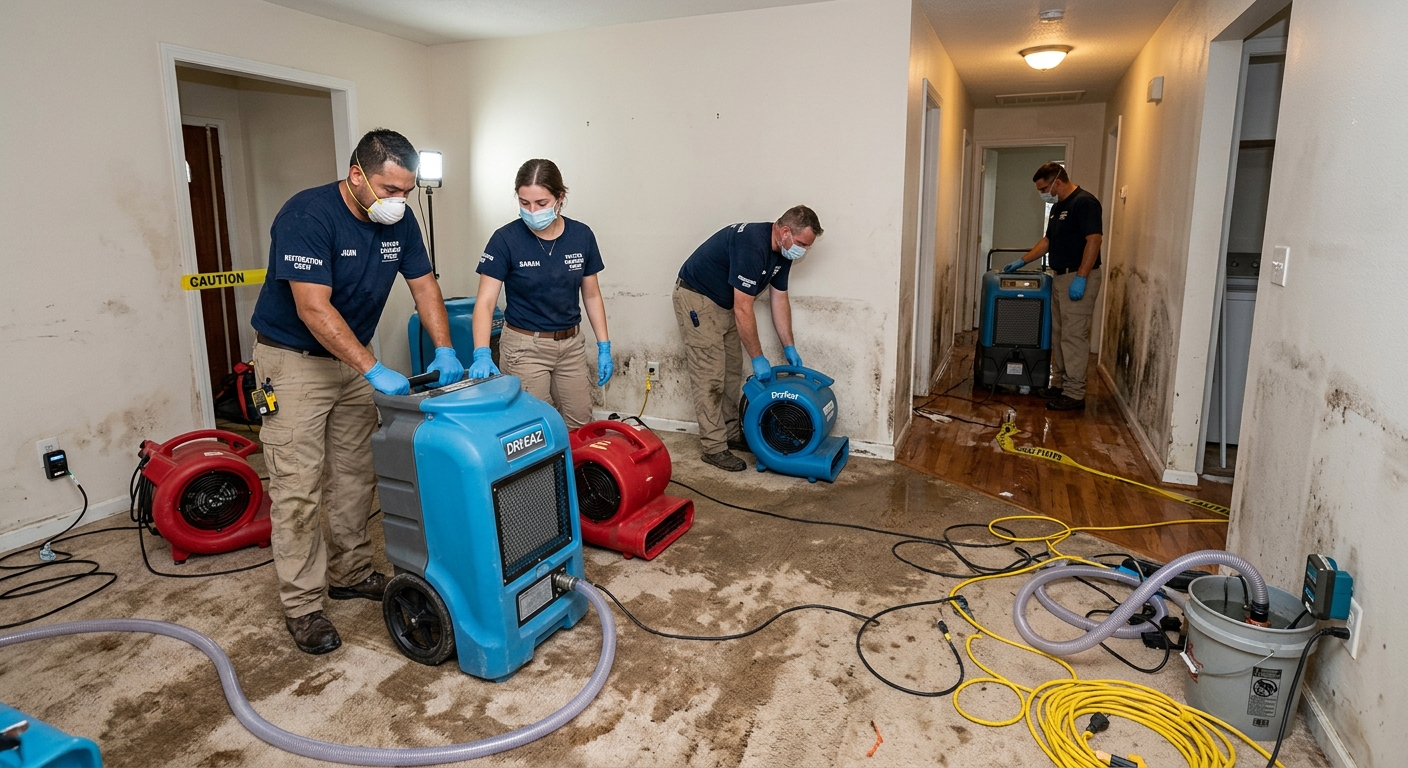
Restoration firms in Carnegie that know what they’re doing follow a systematic drying process—not just running loud fans. Every job starts with moisture mapping: using meters to check humidity and moisture content deep in building materials, not just on the surface. Crews log these readings daily to track progress. If the person in your living room cannot show you a meter log from today, they either aren’t trained or aren’t measuring—both are red flags.
Specialized air movers circulate air across wet surfaces to speed evaporation, but it’s industrial low-grain refrigerant (LGR) dehumidifiers that actually pull the water out of the air and building. Older homes here have thick plaster, hardwood, or masonry, which absorb deep water and dry slowly, especially when Carnegie’s outdoor air is cold or humid (think spring basement season). Equipment must stay on 24/7—turning it off at night can let moisture rebound and easily double drying time, especially with clay soils and high humidity in Allegheny County.
The goal is not “feel dry”—it’s a documented drying goal based on the moisture content of undamaged material (e.g. ≤16% in framing lumber). Crews should check and record moisture daily, show you the log, and keep you posted on when goals are met. You have every right to ask for those logs. In this region’s climate, shortcuts or gaps in monitoring can mean missed wet pockets and later mold.
Credentials and permits for restoration work in Carnegie
Pennsylvania does not license individual water, fire, or mold restoration firms—there is no state-issued trade license or certification proving expertise. It’s the Home Improvement Contractor (HIC) registration from the Attorney General’s office that is legally required for work over $500, not a badge of skill. Ask for it and verify at hic.attorneygeneral.gov. For mold work, there’s no state or Allegheny County license. The gold standard is IICRC certification—ask to see the lead technician’s card, not just the company’s claim.
Permits aren’t needed in Carnegie and most nearby suburbs for minor water cleanup or drying work that doesn’t change structure or framing. However, if repairs include structural work (e.g., reframing, subfloor replacement), Pittsburgh or any borough may require a permit. Your contractor should clarify permit needs based on the specific municipality before demolition or rebuild.
Before a crew starts, you should see: the HIC registration; proof of workers’ compensation which can be checked at wcais.pa.gov; their insurance certificate naming you as “certificate holder”; and a detailed, written contract. Pennsylvania’s Home Improvement Consumer Protection Act requires this contract and gives you a 3-business-day right to cancel. Don’t sign a blank estimate or let work start without paperwork.
What a sewage loss requires
Sewage backup isn’t just “worse water damage.” In Carnegie and greater Pittsburgh, aging combined sewer systems create real risk—hundreds of homes experience backups, especially during heavy rain. Unlike a burst supply line, sewer water carries pathogens, bacteria, and visible and invisible solids. Entry requires full personal protective equipment (respirator, gloves, boots, disposable suit), and the area should be physically blocked off until work is complete. Occupants, especially the very young, elderly, or immunocompromised, should stay out.
Cleanup protocols require tearing out all porous materials—carpet, pad, drywall, and insulation touched by contaminated water, regardless of how “clean” they appear. Surfaces need EPA-registered disinfectants and specialized deodorization due to persistent odors. No professional will promise to salvage carpet or drywall hit by a Category 3 (sewage) loss.
Prevention in Allegheny County is difficult because the risk comes from outside the property. Backwater prevention valves can be installed, but most municipalities do not subsidize this improvement, so costs fall on the homeowner. Restoring a typical sewage backup runs $2,400–$11,500, depending on area, contamination, and contents affected. This is a serious biohazard, not a DIY task.
Choosing a restoration company in twenty minutes
In Carnegie, waiting for three quotes isn’t practical—water and mold aren’t pausing while you deliberate. You’re not in a rural county where nobody picks up the phone after 6 PM. Allegheny County’s saturated restoration market (with round-the-clock firms based out of the city, not flown in) means a qualified crew may be there in under an hour, so you should expect professionalism, not desperation.
On the first call, confirm: (1) Home Improvement Contractor (HIC) number and verify it online, (2) immediate proof of liability insurance, (3) IICRC-certified technician leads the crew (not just “supervises” or “consults”). Once they arrive but before equipment leaves the truck, get in hand: (1) a written, specific work authorization or contract (not a blank form), (2) scope of work—what’s being done and why, (3) a copy of workers’ comp coverage naming the company and you as certificate holder.
- HIC registration number, verified at hic.attorneygeneral.gov
- Certificate of liability insurance (your name as holder)
- Workers’ compensation proof—search at wcais.pa.gov
- IICRC certification for lead technician
- Detailed estimate of scope (tasks, not just “restoration”)
- Name and contact for the project manager or supervisor
- Written contract (not just a verbal go-ahead)
- Agreement before any demo or chemical use
- Schedule for daily progress updates/logs
- All costs and exclusions spelled out before equipment enters
Be alert for: crews pressuring you to sign before explaining scope, forms with “TBD” on key work, work starting before details and pricing are clear, and the trick of unloading fans or dehumidifiers as leverage to prevent you from slowing down. A reputable firm will not rush paperwork or hide behind “corporate policy.”
Who pays for water damage in Carnegie
The most expensive misunderstanding in local restoration is the difference between covered and uncovered events. In Carnegie, sudden and accidental water events—like a burst pipe or malfunctioning appliance inside the house—are typically covered by standard homeowners policies. By contrast, any flooding from outside, such as stormwater overtopping the foundation or surface water inundation, is almost always excluded unless you have a separate flood insurance policy. Many homeowners here (especially in full-basement, pre-1980 houses) discover this only when their loss is denied.
Things get trickier: slow leaks, seepage, and issues from poor maintenance are nearly always excluded. Sewer or drain backups are a particular problem in the Pittsburgh area’s aging combined sewer system; you need an explicit rider or endorsement for backup coverage, which some companies add for an extra fee. When policies do pay, it’s important to know if you’re getting “replacement cost” (full value) or “actual cash value” (depreciated based on age and condition) for damaged materials.
Restoration companies can sometimes bill your insurer directly if you sign an assignment of benefits (AOB), which hands some settlement rights to the contractor. You gain convenience but give up some control if disputes arise. Insist on a detailed scope of loss document—the written list of rooms, items, and damage found, which should match both your contractor’s and your insurer’s assessment.
Under the Home Improvement Consumer Protection Act, you get three business days to cancel any contract over $500. Any offer to “waive your deductible” is not just fishy—it’s illegal in Pennsylvania. Insist that the estimate shows your portion separately. If someone offers to erase this, you have a problem, not a deal.
Category and class: the two words that set your price
Restoration costs in Carnegie are set by two separate factors: water category (how contaminated it is) and water class (how deeply it soaked the structure). Homeowners often mix these up. CATEGORY 1 is “clean” water (like a supply line), CATEGORY 2 is “grey” (like a dishwasher or sump), CATEGORY 3 means black water—sewage, creek water or anything that sat for more than 72 hours. Even a small Category 3 cleanup can run $2,400–$11,500, way more than a large clean-water job.
Class describes how much building material absorbed moisture: Class 1 is a little, Class 4 means concrete, hardwood, or plaster are saturated. Costs rise rapidly with class; an old Pittsburgh basement with water up to the outlets, soaked framing, and standing for more than a day may be both Category 3 and Class 4—pushing the upper price bands. The crucial mechanic: clean water becomes contaminated over time, so a swift response keeps both health risk and price down. Don’t delay hoping things will dry on their own.
| Classification |
Source or extent |
Health risk |
Cost effect |
| Category 1 — clean |
supply line, appliance line, rainwater |
low |
baseline |
| Category 2 — grey |
washing machine, dishwasher, sump failure |
moderate |
+20–40% |
| Category 3 — black |
sewage, groundwater, water standing 72+ hrs |
biohazard |
$2,400–$11,500 |
| Class 1 |
small area, little absorption into structure |
— |
low end of $1,150–$7,100 |
| Class 2 |
whole room, water into walls and subfloor |
— |
$1,150–$7,100 |
| Class 3 |
saturation from above; insulation and walls wet |
— |
$950–$6,600 |
| Class 4 |
deep saturation of hardwood, plaster, concrete |
— |
service2 upper range |
Frequently asked questions — water damage restoration in Carnegie
How do I verify a restoration contractor's insurance?
In Carnegie and anywhere in Pennsylvania, it’s not enough for a contractor to simply say they’re insured. You should ask for a copy of their certificate of liability insurance, with your name listed as "certificate holder." This means their agent issued it directly for your job—not a generic old document. For workers’ compensation, use the state’s system at wcais.pa.gov to confirm coverage is current and covers their actual employees. The Home Improvement Contractor (HIC) registration is your first checkpoint (double check at hic.attorneygeneral.gov), but that only verifies registration, not skill or insurance itself. Any professional outfit covering jobs in the $1,150–$7,100 range should provide both of these routine documents readily.
Is emergency after-hours service more expensive in Carnegie?
In the dense Allegheny County market, there are multiple 24/7 restoration firms who do not charge a premium just to show up at night—travel time isn’t baked into the bill the way it is in rural counties. What affects your price more is the size and severity of the job, not just the hour. Expect that a typical water extraction and emergency drying call (all categories) will fall in the $1,150–$7,100 range, no matter when you call. You should, however, ask for the full price and scope in writing before work starts. If a company tries to charge extra just for showing up late, get a second opinion—they’re not reflecting standard practice in Carnegie.
Does homeowner's insurance cover water damage in Carnegie?
Most homeowner’s policies in Carnegie cover “sudden and accidental” water events — like a burst supply line or washing machine overflow — but will not cover flooding that comes from outside (stormwater through doors, seepage after heavy rain). If you want coverage for that, especially in older homes common here, you need a separate flood policy. Sewage backups also require an extra endorsement on most policies covering homes anywhere near the combined sewers in Pittsburgh’s network. Claims typically cover dry-out and material replacement up to policy limits, with estimates in the $1,150–$7,100 range for clean water jobs, but can exceed $2,400–$11,500 for contaminated losses. Always check your policy for exclusions around gradual leaks and maintenance issues.
Do older Carnegie homes need different treatment?
Yes, older homes in Carnegie—especially those built before 1940—often have plaster, hardwood, and full masonry basements, which means water doesn’t just sit on top, it soaks deep into walls and floors. The drying process requires more time and heavier equipment, and sometimes specialized methods to avoid damaging historic finishes. You may find you’re at the higher end of the $950–$6,600 band for structural drying only. Insist that your contractor documents pre-loss conditions thoroughly (photos, moisture logs) because insurance adjusters often need extra detail for these older structures.
What water damage can I safely handle alone?
In Carnegie, you can handle a small spill or an appliance leak (under two buckets, sitting for less than a few hours) if no water contacted wall cavities, insulation, or electrical. Promptly remove water, ventilate with fans, and monitor for musty odors. However, if water wicks into walls, saturates flooring, or sits for more than 24 hours, you’re risking mold growth and hidden damage. Once you approach the lower end of the $1,150–$7,100 band for water extraction and drying, that’s professional territory for very good reason: older construction conceals moisture and amplifies problems if not managed thoroughly.
Is sewer backup covered under a standard policy?
Not by default. In Carnegie, many homes—especially those downstream from the city’s combined sewers—are exposed to backup during serious storms. Most insurance policies require an extra rider (“sewer and drain backup”) for coverage. Without this, you’re responsible for the full cost, typically $2,400–$11,500 for proper sewage cleanup and disposal. Always check your policy and don’t assume coverage, even if your agent assures you water in the basement is “always covered.”
Can I turn the dehumidifiers off at night?
No—you should not turn off any equipment at night in a water-damaged Carnegie home. The region’s humidity, thick masonry, and ground moisture mean rewetting happens fast if drying stops for even a few hours. Interrupting the drying cycle can slow the job by days and even double your bill in severe cases. Leaving the system running 24/7 is what brings the total dry-out cost in at the normal $950–$6,600 range rather than letting mold or additional damage rack up costs. If noise is an issue, ask your contractor to adjust equipment placement, not schedule.
How much does a flooded basement cost to restore in Carnegie?
A typical flooded basement in Carnegie—especially if it’s one of the many pre-1980 homes with full masonry walls—will cost anywhere from $1,150–$7,100 for water extraction and emergency drying, depending on how much is affected and how long it sat. If gray or black water (Category 2 or 3) is present, costs rise quickly to the $2,400–$11,500 band, especially if sewage or long-standing water is involved. Fully documenting the source, time sitting, and all affected materials helps keep costs—and insurance disputes—down.
How long before mold starts growing?
Mold can begin to colonize damp building materials in as little as 24 to 48 hours in Carnegie’s climate, especially when spring or summer humidity is high. Older homes here, with their masonry basements and dense plaster, are even more at risk, since moisture hides deep in walls and crawlspaces. Once fungal growth starts, what was a straightforward drying job ($950–$6,600) can quickly escalate to full remediation with containment ($1,400–$9,900). Speed and aggressive drying are your best defenses.
Do I need mold testing or just remediation?
For most water losses in Carnegie, you do not need pre-remediation mold testing unless there’s a dispute about insurance coverage or occupant health. If you can see visible mold on wallboard, baseboards, or framing, immediate remediation following IICRC S520 standards is the priority—skip the test and focus on removal, cleaning, and clearance verification afterward. Mold remediation jobs here average $1,400–$9,900, which includes post-work clearance testing. Independent testing is mostly needed for legal disputes or rental properties, not as a first step after water damage.