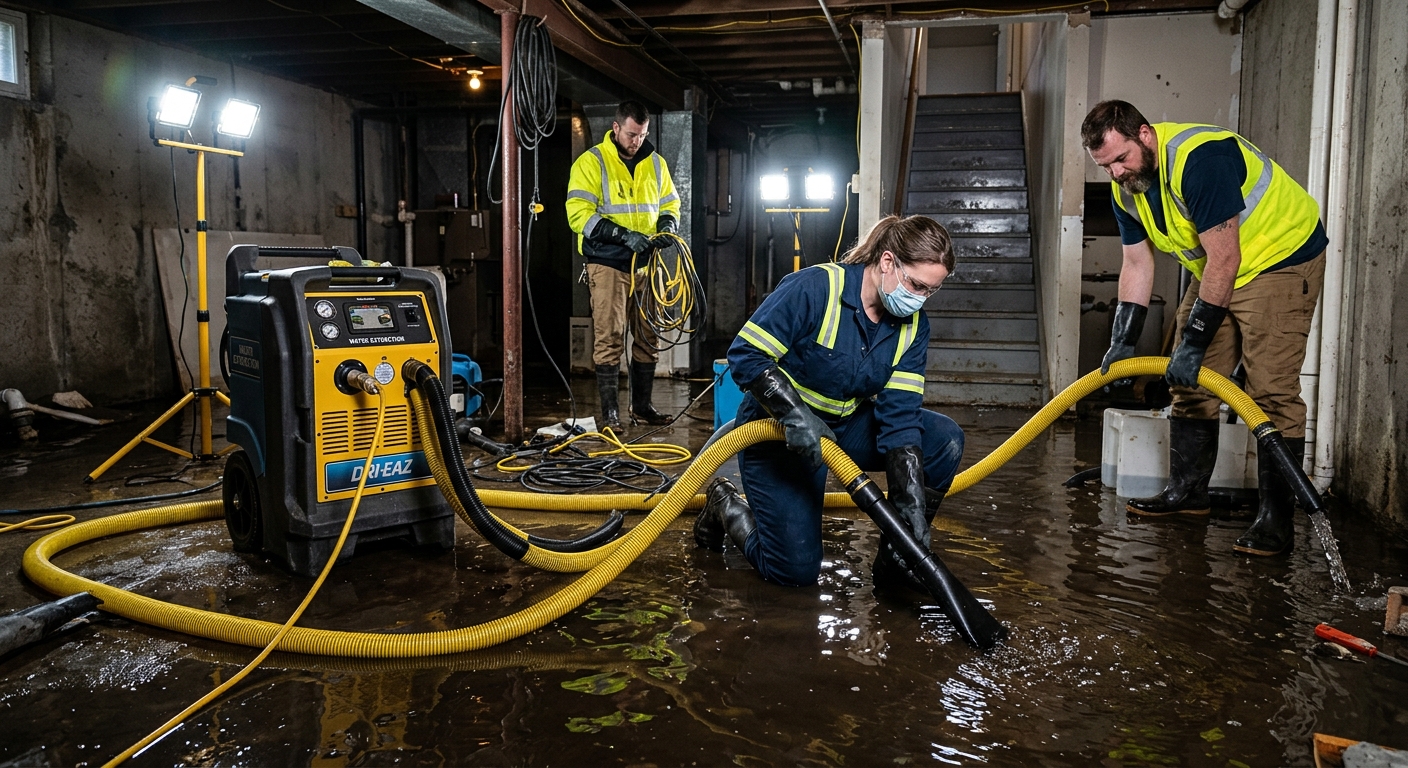
What water damage restoration costs in Plains
If you’re facing water in your Plains basement or just got hit by a leak, you’re likely wondering what restoration will actually cost here—not in some other part of Pennsylvania. The reality is, with 72.8% of the local housing stock built before 1980 and a homeownership rate of over 70.2% (U.S. Census Bureau, ACS 2024), costs get driven by the age and construction style of our homes. Post–World War II tract housing in Wilkes-Barre and Hazleton leads to repeat pipe failures and chronic basement water issues, which skews local claims toward larger, full-level cleanups rather than a quick dry-out of just a corner. Here’s what you’ll see:
| Service |
What it covers |
Typical duration |
Price range |
| Water extraction + emergency drying (Cat 1) |
Extraction, air movers, LGR dehumidifiers, daily moisture monitoring |
3–5 days |
$1,150–$7,200 |
| Structural drying only (post-extraction) |
Drying to standard after water is already out |
3–5 days |
$950–$6,700 |
| Mold remediation with containment |
Containment, HEPA filtration, removal, antimicrobial, clearance test |
3–7 days |
$1,450–$10,000 |
| Sewage backup cleanup (Cat 3) |
Biohazard protocol, disposal of porous materials, disinfection |
2–5 days |
$2,400–$11,500 |
| Emergency board-up / tarping |
Stop further water entry, secure the structure |
Same day |
$350–$900 |
Estimates for a typical Plains home. Category, affected area and how long the water sat move these figures more than anything else.
What can be saved and what has to go
In Plains and greater Wilkes-Barre, recurring basement water intrusion combined with postwar wood-framed construction means certain materials almost always need to be removed—and it’s not “overkill” by your contractor. Wet fibreglass insulation (common inside finished walls in these full-basement houses) rarely dries before mold develops and must be replaced. Carpet pad should never be saved. Drywall soaked below the waterline, especially in basements, gets cut one foot above visible water—don’t waste money trying to dry it in place, as hidden moisture against cold foundation walls lingers long after the surface feels dry.
Solid hardwood floors can sometimes be rescued with specialty drying panels and aggressive dehumidification, but engineered or laminate floors, which are more recent additions in Plains area remodels, almost always swell and delaminate. Plaster is tougher; it holds dampness much longer but doesn’t always have to come out unless surface mold appears or high meter readings persist. Kitchen and bathroom cabinets built from plywood sometimes survive if dried immediately, while particleboard (typical of lower-cost remodels post-1960) turns mushy and must go.
If a contractor pushes total demolition of unaffected materials, be skeptical—unless the water was Category 3 (sewage or outside flood), there’s rarely a need to gut “just in case.” But any company promising they can always “save everything” (especially drywall and insulation below grade) is likely setting you up for a mold remediation bill later. Your goal is to cut what can’t be dried safely, save what is still sound, and be strict about what sits against those humid Luzerne County basement walls.
Finished basements and water damage in Plains
Plains homes, like those across Wilkes-Barre and Kingston, overwhelmingly have full basements—a direct result of Northeast Pennsylvania’s postwar building pattern and hilly terrain. These below-grade spaces come with water risks homeowners elsewhere never face. When water gets in, there’s no gravity to help it drain, and hydrostatic pressure from the outside keeps pushing moisture through tiny cracks, especially when snow melt or heavy rain raises ground saturation above the 36-inch frost line common to the region.
In finished basements, water hides behind framing, insulation, and drywall—making the full extent tough to see without removing baseboards or cutting access holes. Sump pump failures, often caused by power outages or overwhelmed drainage during Susquehanna flooding events, are the single most common cause of basement water calls in Plains. If your pump doesn't have a battery backup, you’re exposed no matter how new the pump is—and when water gets behind finished walls or under subfloors, the job doubles in scope compared to an unfinished basement the same size.
What does this mean for cost and time? Every wall cavity, finished floor, or step increases drying days and the number of air movers and dehumidifiers required. In Plains, especially in homes built during the housing booms of the ’50s and ’60s, finished basements regularly mean a total gut of affected materials. Don’t be surprised if the contractor’s scope is bigger than you expected—if it means they’re actually getting the water out of the building, not just off the carpet.
How fast mold starts after a leak in Plains
Mold growth is a fast-moving threat as soon as water enters your Plains home. In our climate—especially in below-grade basements with persistent humidity and low airflow—mold can colonize wet building materials within 24 to 48 hours. This isn’t a scare tactic; it’s the simple reason response time is so critical in keeping a water mitigation job at $1,150–$7,200 for a rapid Category 1 dry-down versus crossing into a full-scale mold remediation at $1,450–$10,000.
Immediately after water extraction, a “dry-in-place” strategy can be used only if materials are cleaned and dried within that 48-hour window. If drying lags, selective demolition—cutting out drywall, removing base and shoe moldings, pulling wet insulation—is needed to keep spores from taking hold inside cavities. Past 72 hours, visible mold growth almost always triggers the need for full containment (plastic sheeting, negative air machines) and clearance testing.
Clearance testing (performed after work is done) uses air or surface sampling to ensure spore counts are back to normal and the area is safe to restore. Always ask for a written clearance report; it’s your proof the company met the insurance-required IICRC S520 standard, not just a promise the mold is “gone.”
What a Pennsylvania restoration contractor must actually hold
Pennsylvania does not issue a state restoration, mold, plumbing, or HVAC license outside the few major cities named in local statutes. In Luzerne County, and for work in Plains, restoration companies work under the Home Improvement Contractor (HIC) registration—a consumer protection statute—not a trade skill license. This means a logo on a truck or a business card doesn’t prove technical competence. For mold or water work, the de facto standard is IICRC certification (S500 for water, S520 for mold). Always ask to see the lead technician’s IICRC card; reputable crews in Plains expect it.
Permits in Wilkes-Barre and Luzerne County are typically required only if structural repairs (wall or floor rebuilds) follow the initial mitigation. Drying and removal do not require a permit—but any company starting demolition without a contract over $500 is not following state law (see HICPA). Make sure their insurance and workers’ compensation are valid by checking through the WCAIS system before any extraction or demolition starts. Get a signed contract in hand, with totals and scope, before the first hose unrolls.
Equipment, monitoring and drying standards
Effective drying in Plains isn’t about how much equipment makes noise in your house, but how well your contractor maps and measures moisture each day. Every job, by standard, starts with moisture mapping—technicians check every wall, floor, and ceiling with meters and log readings so they know what’s wet and how wet it is. These logs aren’t for show; they prove to you, your insurer, and their supervisor that drying is working as expected and when equipment can come off the job.
Air movers push water out of building materials into the air. LGR dehumidifiers (Low-Grain Refrigerant) pull that moisture out of the air and collect it as water. Equipment stays running 24 hours a day—turning machines off at night means the materials suck moisture right back in, especially with our region’s 6,100 annual heating degree days and frequent damp spring air. Daily technician visits adjust the setup, log new meter readings, and move equipment as areas hit the drying goal (a predetermined safe moisture content for that material in Pennsylvania climate, not just “it feels dry”).
If a crew can’t show you the daily logs or doesn’t meter every affected surface, they’re winging it. A reputable company serving Plains will always provide those records on request, proving they’ve actually achieved what they claim—not just run machines in a room for a set number of days.
Plains's flood exposure and what it means for coverage
Plains homeowners face a specific risk: the Susquehanna River and Solomon Creek, both cited flood sources for Wilkes-Barre and Luzerne County, periodically breach levees or overwhelm storm systems, driving water into basements and lower levels. Flooding from these named waterways puts some Plains neighborhoods in federally designated flood zones, but the majority of standard homeowners’ policies in Pennsylvania strictly exclude “flood”—meaning any water entering from outside the structure, regardless of how similar the damage looks to a burst pipe.
Flood insurance must be purchased as a separate policy, often through the National Flood Insurance Program or private insurer, and there is almost always a 30-day waiting period—no buying it after a big rain is forecast. Standard water losses (pipe bursts, appliance failures) are typically covered, but if an adjuster determines water entered during a Susquehanna surge or from overland flow, you’re out of pocket for the entire claim unless you’ve bought the extra coverage. This distinction matters: two Plains basements flooded on the same day may look identical, but only one gets paid if the water’s origin is traced to the river or creek.
Frequently asked questions — water damage restoration in Plains
Is bleach effective against mold?
Bleach is not an effective long-term solution for mold on porous materials like drywall or wood. In Plains, homes built before 1980 often feature plaster or drywall that traps moisture deep below the surface, where bleach simply doesn't reach—especially in those postwar basements where water intrusion is known. Professional mold remediation typically means physically removing affected material and using HEPA-filtered equipment, plus an EPA-registered antimicrobial, followed by clearance testing. Cutting corners with bleach can result in regrowth and a much larger (and more expensive) remediation later, sometimes running from $1,450–$10,000 for a job that could have been halted at containment stage.
Is sewer backup covered under a standard policy?
Most standard homeowners policies in Plains exclude coverage for sewage or drain backups unless you specifically added a sewage backup endorsement. Given the known combined sewer issues near the Susquehanna levee system, this is not hypothetical: backups happen, especially in heavy rain. Without this extra coverage, the full cost of cleanup—routinely in the $2,400–$11,500 range in Luzerne County—can fall entirely on the homeowner. If you’re not sure you’ve got the endorsement, check your declarations page or ask your agent today.
Do older Plains homes need different treatment?
Yes, older homes in Plains—where over 72% were built before 1980—often have thick plaster walls, full basements, and legacy construction details that affect both where water travels and how quickly it dries. Plaster doesn’t dry as fast as drywall and sometimes hides moisture trapped against block walls. These homes often require longer or more targeted drying, more monitoring with moisture meters, and sometimes selective removal of baseboard and trim to check for hidden damage. Costs can run at the higher end of local averages, with full drying and repair easily reaching $6,700 if several rooms are involved.
Why is water damage priced per square foot?
Restoration work in Plains and Luzerne County is typically estimated by the square foot because labor and equipment needs scale with affected area—whether it’s five feet of main floor in a kitchen or 800 square feet of finished basement. Each wall, ceiling, and floor surface requires extraction, air movement, and dehumidification. Price per square foot lets you track if your estimate reflects the actual area—knowing that most Plains basements add up fast, driving jobs to the higher side of the $1,150–$7,200 band for full-level floods.
What is IICRC certification and does it matter?
IICRC certification (Institute of Inspection, Cleaning, and Restoration Certification) is the insurance industry’s recognized training standard for water, mold, and sewage contractors in Pennsylvania—even though not required by state law. For Plains homeowners, it’s your assurance the company follows protocols proven to prevent mold, track moisture, and document the job fully, using S500 (water damage) and S520 (mold remediation) standards. Always ask to see your Plains restoration crew’s lead technician card, as reputable outfits competing with big names like SERVPRO in Luzerne County expect this question. Certified crews tend to be more thorough, and this can prevent minor jobs from escalating to a $10,000 mold remediation.
How much does sewage backup cleanup cost in Plains?
Sewage backup—known as Category 3 water loss—costs more than general water damage because crews follow strict biohazard removal standards, including demolition of porous materials. In Plains, the typical sewage cleanup runs $2,400–$11,500, depending on square footage affected and whether finished basements are involved. Wilkes-Barre area homes are especially vulnerable near the Susquehanna levee during heavy rain. Most policies require a specific sewage backup endorsement for this, so check your coverage before you get stuck with out-of-pocket costs for this high-ticket cleanup.
Is it safe to stay in the house during drying?
In most Plains cases, yes—you can stay during the drying phase after clean water leaks, especially if only one or two rooms are affected. The equipment is loud and the process can be disruptive, but it is not generally hazardous. For sewage or mold remediation (Category 3 water or heavy colonisation), you might be temporarily displaced, especially if negative air containment is built. On average, a full water dry-out takes 3–5 days and can cost anywhere from $1,150–$7,200. If you or family members have severe allergies, consider staying elsewhere until clearance testing confirms safe conditions.
Does wet insulation have to be replaced?
Most of the time—especially in Plains’s full-basement homes—the answer is yes. Fiberglass and cellulose insulation trap water, take much longer to dry behind drywall, and become a perfect spot for hidden mold. Professional restoration crews remove saturated insulation as part of the standard protocol; trying to “dry in place” is risky unless the area is very small and was dried within the first 24 hours. Otherwise, lingering moisture can escalate your problem to a full mold job costing $1,450–$10,000 if ignored. Always ask your technician to photograph and meter-check any insulation left in the wall.
What equipment should a restoration crew bring?
A typical Plains water loss requires at least a set of high-velocity air movers and LGR (Low-Grain Refrigerant) dehumidifiers, as well as a moisture meter and a thermal imaging camera to check hidden moisture. For sewage, you’ll see personal protective gear, HEPA-filtered vacuums, and commercial extraction pumps. Any reputable Luzerne County crew should leave you with written moisture readings from each major surface. Expect 3–10 machines running for 3–5 days, with total costs at $1,150–$7,200 for a standard dry-down.
What is an assignment of benefits and should I sign one?
An assignment of benefits (AOB) is a contract that lets the restoration contractor bill your insurance company directly and sometimes even negotiate or settle your claim. In Plains, signing an AOB transfers a lot of control over your claim—including payment details and repair choices—to the contractor. While this can make things smoother if you trust the company, it can also lock you into disputes or costs you didn’t anticipate. For smaller clean water jobs ($1,150–$7,200), you’re often safer paying your contractor and settling up with the insurer yourself to keep transparency and control.