Montgomery water damage pricing by scope — 2026
Montgomery homeowners facing water damage—whether from a burst aging copper line or a heavy storm overwhelming the basement—need real numbers fast, especially with how quickly a loss can escalate in a typical Norristown or Abington home. Restoration costs here reflect both Montgomery’s above-average homeownership rate and the era of the housing—post‑1945 tract homes, more than one in five built before 1980 (U.S. Census Bureau, ACS 2024). The most common causes here are hidden pipe leaks from original copper supply lines, groundwater intrusion into full basements, and local sewer backups. Jobs run from partial room drying to full-scale Category 3 sewage remediation, and the difference in scope shows up in the bill. Expect these 2026 banded prices for standard jobs in Montgomery County:
| Service |
What it covers |
Typical duration |
Price range |
| Water extraction + emergency drying (Cat 1) |
extraction, air movers, LGR dehumidifiers, daily moisture monitoring |
3–5 days |
$1,350–$8,500 |
| Structural drying only (post-extraction) |
drying to standard after water is already out |
3–5 days |
$1,150–$8,000 |
| Mold remediation with containment |
containment, HEPA filtration, removal, antimicrobial, clearance test |
3–7 days |
$1,700–$12,000 |
| Sewage backup cleanup (Cat 3) |
biohazard protocol, disposal of porous materials, disinfection |
2–5 days |
$2,800–$13,500 |
| Emergency board-up / tarping |
stop further water entry, secure the structure |
same day |
$350–$900 |
Estimates for a typical Montgomery home. Category, affected area and how long the water sat move these figures more than anything else.
Preventing the next one
In Montgomery, the best water loss prevention often comes down to simple upgrades and targeted investments. Start with the most cost-effective: change out old rubber or plastic supply lines on washers and water heaters for braided stainless steel versions—most leaks in post-1945 homes start here and parts run $30–$50 each, plus a plumber’s minimum for peace of mind. Placing $15 water leak sensors on the basement floor, under sinks, and at the water heater is cheap insurance; these will pay for themselves if they even catch one slow leak early.
If your home has a basement (as most here do), a sump pump with battery backup ($420–$800 installed) addresses hydrostatic pressure—critical given our 30-inch frost depth and moderate freeze-thaw cycles. If your risk is sewer backup, consider a backflow valve for $900–$1,800; Norristown’s wet-weather sewage inflow issues mean that's not paranoia. Automatic whole-house water shutoff valves start around $300 for materials (up to $900–$1,500 installed) but, unless you travel often or have a history of big leaks, that cost may not pay back.
Water heater pans with drains ($45–$100) help catch early leaks and are especially useful in finished basements. But high-end “smart home” water monitoring systems often run $300–$700 and aren’t essential for most Montgomery owners—stick to targeted upgrades first, especially supply lines and reliable sump coverage. In cold snaps, insulate exposed piping to guard against freeze-related bursts, but the bulk of local losses come from aging lines, not cold temperature failures.
What construction era means for a water loss here
Montgomery County’s housing stock is defined by its expansive post‑1945 suburban growth, meaning most residents deal with homes built on full basements, with original copper supply lines serving as a hidden risk for slow leaks. With just over 21% of homes built before 1980, you’re most likely looking at a mix of plaster and early drywall interiors. The practical effect? Plaster walls (common in older sections of townships like Lower Merion or Cheltenham) respond differently than gypsum board—plaster dries more slowly and often needs less aggressive demolition, but once compromised, it's costlier to repair.
Many homes are still running first-generation water heaters and drain pipes. Once your system hits the 30+ year mark—a real possibility in homes from the 1980s and even into the late ‘90s—you see more failures at valves and supply connections. Cast iron drains will show up in pre-1980 homes, whereas PVC is found in newer builds; cast iron can withstand water exposure a bit longer, but once saturated, both require selective removal.
Finished basements with drywall over framing are common, so water that seeps below-grade can spread undetected, doubling the affected area and drying time. In sum, while Montgomery doesn’t have the brittle plumbing of city rowhomes, the original copper supply lines and below-grade living space put every age of home at real risk for complex, lengthier drying—and often selective demolition—once a loss occurs.
Finished basements and water damage in Montgomery
Montgomery homes, built with full basements as the norm, face unique challenges when water finds its way below grade. Hydrostatic pressure from the water table or surface runoff—especially after heavy rain hitting the Schuylkill or Wissahickon—forces moisture through even small cracks, and there’s rarely gravity drainage to help. Humid southeastern Pennsylvania summers don’t help; once water gets in, it lingers and raises relative humidity, making drying a finished basement slower and more demolition-heavy than an unfinished one.
The single most common failure? Sump pump malfunction, whether loss of power or worn-out hardware. Without a battery backup, a standard sump pump leaves your finished basement exposed—many restoration bills here could have been a $500–$800 investment instead of $4,400 or more. Finished basements complicate things: water wicks up behind drywall, saturates insulation and trims, and hides in lower wall cavities. Scope doubles because what looks like “just the carpet” often means hidden damage to studs or built-ins behind the walls.
Expect twice the demolition and equipment run-time compared to an unfinished space, since porous materials must be removed and all moisture measured behind finishes. The region’s 30-inch frost depth compounds water entry risk, especially near walkout areas or stairwells with poor grading. The bottom line: if your basement is finished, don’t just look at what’s visible—a full moisture assessment is essential, and cost can escalate quickly the longer water sits concealed.
The mold clock: 24, 48 and 72 hours
In Montgomery County’s summer humidity and common below-grade living spaces, the “mold clock” is a real and costly countdown. Within 24 hours of an untreated water loss, spores can begin to take hold—especially in carpet, wood framing, and behind drywall. While no visible growth is likely at this stage, the structure is moving past what can be handled with basic dry-in-place methods (structural drying after extraction at $1,150–$8,000).
After 48 hours, conditions are right for active colonization—now, drying alone isn’t enough. Partial demolition, targeted removal of wallboard and trim, and setting up containment barriers are all required steps. Delay past this point and the job approaches the territory of full mold remediation with containment, HEPA filtration, and post-remediation clearance testing, which can run $1,700–$12,000 depending on coverage.
By 72 hours, the distinction between a routine water recovery and a Category 3 (biohazard) event blurs. Rising humidity and concealed moisture in full Montgomery basements mean costs rise with every day’s wait. Clearance testing—a paid third-party or documented post-remediation air/surface sampling report—proves remediation worked and should always be provided in writing. In most cases, getting that in your hands is what puts the insurance claim to bed and protects the house from future value loss. Timing isn’t just a service issue here—it’s a direct price driver you control.
Regulation, certification and verification in Montgomery
Pennsylvania does not issue a state license for water damage restoration or mold remediation contractors—and in Montgomery, that means a business card alone proves nothing. The de facto industry standard is IICRC certification, specifically S500 for water and S520 for mold. Ask for the lead technician’s IICRC card on-site, and don’t assume any firm is properly trained unless they show it.
Permits in Norristown and elsewhere are triggered for structural repairs after significant Category 3 water damage, not for basic water extraction or like-for-like carpet replacement. Reconstruction means pulling a building permit; mitigation work (drying, tear-out, cleaning) does not. If you’re in a pre‑1978 home and work disturbs paint, confirm the crew is certified to comply with the federal EPA Lead RRP Rule.
By law, any contract over $500 in Pennsylvania requires a written contract with clear scope, price, and your three-day right to cancel. You cannot legally waive your insurance deductible here. Before work starts, verify the company’s Home Improvement Contractor registration (for jobs over $500) at the official state site and confirm their workers’ compensation coverage through WCAIS. Insist on insurance documents in your hands—don’t settle for “we’re covered” on a clipboard.
Why your neighbour's bill was half of yours
Homeowners in Montgomery often compare restoration bills and wonder how theirs climbed so much higher than a similar-sounding loss next door. It boils down to two axes: CATEGORY (how dirty the water is) and CLASS (how much the structure soaked up), and these can make even minor events costly if the variables line up wrong.
CATEGORY defines contamination. A burst copper supply line (Category 1) costs less because it’s clean water—think extraction and drying only. A sump failure after a rainstorm that sits for 72 hours? Now it’s Category 3, with infectious risk, higher PPE requirements, and disposal of porous materials—regardless of the original source. As a Montgomery example: a finished basement with clean supply-line loss often lands at $4,400, while a small Category 3 bathroom backup with limited demo can hit $7,400—double, just due to category.
CLASS is about spread and absorption. If water wicks deep into insulation or hardwood (Class 4), drying and demolition multiply, sometimes making a “small” loss as expensive as a headline-making flood. Category rises with time: a Category 1 event turns to 2 and even 3 as water sits, picking up contaminants and raising restoration costs. That “delay mechanic” is the linchpin—speedy mitigation is the one controllable factor you have.
| Classification |
Source or extent |
Health risk |
Cost effect |
| Category 1 — clean |
supply line, appliance line, rainwater |
low |
baseline |
| Category 2 — grey |
washing machine, dishwasher, sump failure |
moderate |
+20–40% |
| Category 3 — black |
sewage, groundwater, water standing 72+ hrs |
biohazard |
$2,800–$13,500 |
| Class 1 |
small area, little absorption into structure |
— |
low end of service1 |
| Class 2 |
whole room, water into walls and subfloor |
— |
$1,350–$8,500 |
| Class 3 |
saturation from above; insulation and walls wet |
— |
$1,150–$8,000 |
| Class 4 |
deep saturation of hardwood, plaster, concrete |
— |
service2 upper range |
Frequently asked questions — water damage restoration in Montgomery
What is an assignment of benefits and should I sign one?
An assignment of benefits (AOB) is a document that allows your restoration contractor to deal directly with your insurance company and receive payment for covered services. In Montgomery, some contractors may offer you an AOB at the beginning of an emergency project. While an AOB can speed up the process when handled by a trustworthy, established firm, you give up direct control over your insurance claim. Only sign an AOB if you trust the contractor and all scope and price are spelled out in writing. Never feel rushed—legally, in Pennsylvania, you have a three business-day right to cancel contracts over $500. Without oversight, poor or inflated work could be performed, and you could be on the hook if your insurer refuses parts of the claim. For a standard water extraction and emergency drying job here, you could be signing for $1,350–$8,500.
How much does a flooded basement cost to restore in Montgomery?
Restoration of a flooded basement in Montgomery can vary widely because most area homes have finished basements and full-size below-grade foundations. If the water was clean, extraction with drying runs $1,350–$8,500. For Category 3 water, sewage cleanup, or mold remediation, expect costs from $2,800–$13,500. Finished basements nearly double the demo and rebuild compared to unfinished spaces. Adding to that, Montgomery’s moderate freeze-thaw cycle and older copper pipes contribute to both slow and sudden failures, so the full price depends on response time, water quality, and how far the moisture spread behind walls and flooring.
Can I clean up water damage myself in Montgomery?
For minor spills on tile or concrete, a hands-on homeowner in Montgomery can sometimes handle clean-up without hiring a contractor. But with full basements and frequent hidden moisture behind finishes, it’s easy to miss trapped water, especially after a supply line leak or sump failure. If affected materials include drywall, insulation, carpet, or anything that got wet for more than a day, drying and monitoring should be professionally managed—costs start around $1,150–$8,000 for structural drying. Further, insurance may only honor claims with documentation from a certified restorer, and improper DIY clean-ups lead to mold risks (not always immediately visible). For safety, call a professional if the water came from a non-clean source or hit any electrical systems.
Why did the crew cut my drywall two feet up?
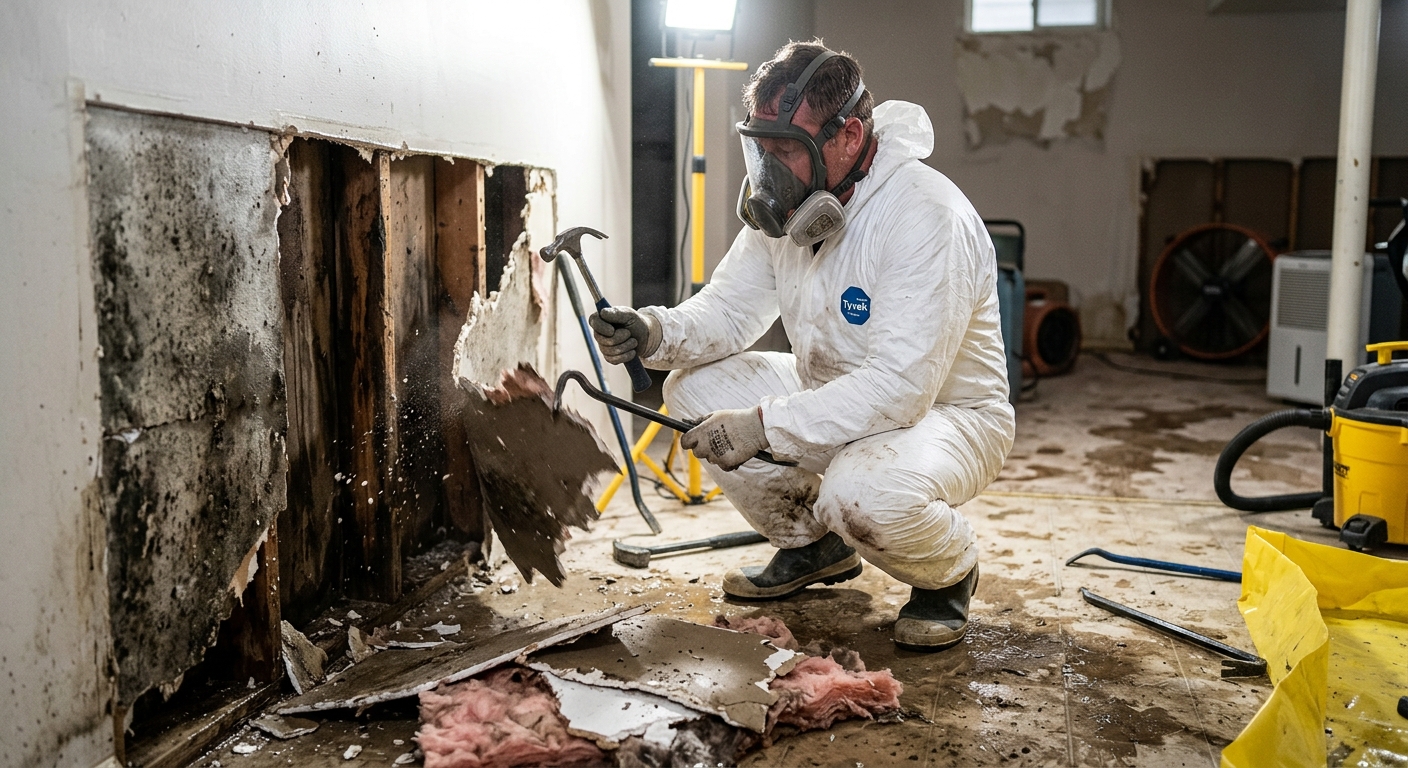
It’s standard in Montgomery County for restoration crews to perform a “flood cut” anywhere between 12 and 24 inches above the visible water line. This removes saturated drywall and insulation to stop wicking moisture and let air move through the cavity—critical in homes with full finished basements. This cut gives access behind the walls, which is needed when Category 2 or 3 water (or anything that sat more than 24–48 hours) is present. For a typical structural drying or mold remediation job, you might see a bill from $1,700–$12,000 depending on how much wall needs replacement. Proper demo also helps document loss for insurance.
How long before mold starts growing?
In Montgomery’s humid climate and especially in below-grade spaces, mold can begin to colonize within 24–48 hours of water intrusion. After 72 hours, it’s likely that porous materials are already contaminated, making cleanup more expensive—mold remediation jobs start at $1,700–$12,000. Quick response can mean the difference between simple drying and having to remove sections of wall, insulation, or flooring. Once remediation is complete, always ask for a written clearance test report that documents air and/or surface samples, as this protects both your health and future property value.
Is sewer backup a known problem in Montgomery?
Yes, sewer backups are a recognized risk in parts of Montgomery County—especially Norristown, where the municipal waste authority cites wet-weather inflow as a contributing factor. That can mean unexpected Category 3 water in basements during storms. Clean-up and restoration for sewage backups cost more than standard water losses, with jobs running from $2,800–$13,500. Consider a backflow valve if you’re in a susceptible area; it’s a one-time investment for a recurring risk.
Does wet insulation have to be replaced?
In most Montgomery homes with standard fiberglass or cellulose insulation, once material is saturated—whether from a burst pipe or groundwater—it cannot be dried in place and must be removed. Mold risk is just too high, especially in basements. Full replacement, along with any needed demolition to remove contaminated wallboard, is included in billing for Category 2 or 3 events: mold remediation with containment often lands between $1,700–$12,000. For minimal, recent clean-water events, small sections might be saved if professionally dried and verified with a moisture meter.
Why is water damage priced per square foot?
Pricing for water damage jobs in Montgomery is often quoted per square foot because it reflects both the affected surface area and the depth of material absorption. A small pool on tile is drastically less complex than water trapped behind finished basement walls or under hardwood. The more square footage involved—especially with drywall, insulation, and trim—the higher the equipment, labor, and drying time. Typical Category 1 water extraction runs $1,350–$8,500. The price isn’t arbitrary; the method allows for transparent, itemized invoicing for insurers and homeowners alike.
Do I need separate flood insurance in Montgomery?
In Montgomery, standard homeowners insurance does not cover flood damage from rising water or groundwater intrusion—such as what happens with overflows from the Schuylkill River or local creeks. If your home is in a mapped floodplain or you have a finished basement, you’ll want to price federal or private flood insurance. Restoration from floodwater is treated as Category 3, starting at $2,800–$13,500. Even if you’ve never flooded before, backflow and sump failure are real risks here due to soil saturation and older infrastructure. Double-check your policy language before you find yourself with uncovered loss.
Can a contractor waive my deductible in Pennsylvania?
No, Pennsylvania law under the Home Improvement Consumer Protection Act strictly prohibits restoration contractors from waiving your insurance deductible. This also protects you from inflated or fraudulent billing practices. A proper invoice for water damage restoration—whether it’s $1,150 or $13,500—should show your deductible subtracted and paid by you, not hidden or absorbed by the contractor. If any provider offers to “waive” your deductible, that’s a red flag and you should seek another firm. Insurers in Montgomery will deny or delay claims if they suspect this violation.