What water damage restoration costs in Northampton
If you’re dealing with unexpected water in your Northampton home right now, you probably want one thing first: a sense of what this is going to cost. Because Northampton’s housing stock—particularly in Bethlehem and Easton—skews old, with many homes from 1900–1940, restoration jobs here run differently than they do in newer markets. That older construction means original plaster, masonry basements, and frequent pipe failures drive both the likelihood and complexity of water losses. With 74.8% of local homes built before 1980 (U.S. Census Bureau, ACS 2024), expect costs to vary based on how water interacts with historic materials and the practical difficulties of working in them.
In Northampton County, restoration prices fall in several distinct brackets, depending on how extensive and contaminated the water is, and how quickly you respond. Here’s a realistic look at what you can expect to pay for the most common services:
| Service |
What it covers |
Typical duration |
Price range |
| Water extraction + emergency drying (Cat 1) |
extraction, air movers, LGR dehumidifiers, daily moisture monitoring |
3–5 days |
$1,200–$7,400 |
| Structural drying only (post-extraction) |
drying to standard after water is already out |
3–5 days |
$1,000–$6,900 |
| Mold remediation with containment |
containment, HEPA filtration, removal, antimicrobial, clearance test |
3–7 days |
$1,500–$10,500 |
| Sewage backup cleanup (Cat 3) |
biohazard protocol, disposal of porous materials, disinfection |
2–5 days |
$2,500–$12,000 |
| Emergency board-up / tarping |
stop further water entry, secure the structure |
same day |
$350–$900 |
Estimates for a typical Northampton home. Category, affected area and how long the water sat move these figures more than anything else.
Category and class: the two words that set your price
Most homeowners want to know: “How bad is it, and what will it cost?” In water damage, two factors decide that—category and class—and they work independently. CATEGORY rates how dirty or hazardous the water is: Category 1 (“clean”) from a supply line is least expensive, while Category 3 (“black”) such as a sewer backup or water left standing is most. CLASS describes how much the structure has absorbed, from a small surface event to deep saturation of walls and floors.
A small Category 3 event can easily cost more than a much larger Category 1 leak. For example, cleaning up a minor sewer backup (Category 3) in a single bathroom may run $2,500–$12,000, while an entire basement with clean water (Category 1) may cost much less. This is partly due to the biohazard procedures and materials that must be removed when water is contaminated.
Time is a huge variable: Category 1 water (clean supply line) will degrade to Category 2 within a day or two, then to Category 3 after about 72 hours, no matter how harmless the original source. So waiting to call increases both health risk and cost drastically, even if the spill started out as just a leaking pipe.
| Classification |
Source or extent |
Health risk |
Cost effect |
| Category 1 — clean |
supply line, appliance line, rainwater |
low |
baseline |
| Category 2 — grey |
washing machine, dishwasher, sump failure |
moderate |
+20–40% |
| Category 3 — black |
sewage, groundwater, water standing 72+ hrs |
biohazard |
$2,500–$12,000 |
| Class 1 |
small area, little absorption into structure |
— |
low end of $1,200–$7,400 |
| Class 2 |
whole room, water into walls and subfloor |
— |
$1,200–$7,400 |
| Class 3 |
saturation from above; insulation and walls wet |
— |
$1,000–$6,900 |
| Class 4 |
deep saturation of hardwood, plaster, concrete |
— |
upper range of $1,500–$10,500 |
Your belongings after a water loss
After a water event in a Northampton home, you will have two distinct claims: the structure (walls, floors, built-ins) and your contents—everything from sofas to keepsakes. Too often, contents are rushed out, tossed, or simply under-documented. Always photograph each room thoroughly before movers or restoration crews touch anything. An experienced Northampton contractor will inventory each item removed, note what is unsalvageable, and set aside those worth restoring for pack-out to an off-site cleaning facility.
Upholstered furniture caught in Category 3 water (sewage or flood) usually isn’t salvageable due to health risks, and neither are most mattresses or particleboard items. Solid-wood furniture, area rugs, and some electronics may be cleaned and restored—as long as they weren’t saturated for days. Most insurance policies split structure and contents, so accurate records help maximize your claim. Don’t accept a pile of discarded belongings without a photo log or line-item inventory; your insurer will want proof, and so will you if anything goes missing in transit.
Outside water, inside water
In Northampton County, location matters more than most realize. Homes along the Lehigh River or Delaware River corridors are the first hit when overbank flooding occurs—something standard homeowners’ insurance nearly always excludes. If your property is deemed in a FEMA flood zone, you typically need to purchase separate flood insurance well in advance. It takes 30 days for most new flood policies to take effect, so waiting until an event is forecast is too late.
The key distinction is that floodwater—from rising river or creek levels—is not covered by a standard policy, even though the damage is visually similar to a burst pipe. A basement trashed by Lehigh River seepage is an excluded event; a basement destroyed by a supply line break probably is not. Adjusters in Northampton are trained to distinguish the source, so document carefully and don’t disturb evidence of the entry point. For homeowners in Easton and Bethlehem, with river proximity and high historic home rates, checking your flood zone status isn’t a formality—it can mean the difference between a covered and an uncovered loss.
What a Pennsylvania restoration contractor must actually hold
Pennsylvania does not license restoration or mold contractors at the state level. That means anyone can claim to be one—so never trust a business card or a website alone. The gold standard in the industry is IICRC certification (specifically S500 for water damage and S520 for mold), which is what most insurers require. Ask to see your lead technician’s IICRC card before any work starts. There are no special state licenses for this work in Bethlehem, Easton, or surrounding Northampton municipalities.
Permits are usually required only for reconstruction—for example, when drywall or subflooring is replaced. In the City of Bethlehem, interior repairs following water loss typically need permits; in Easton, emergency extraction and drying generally proceed without one. Always verify that your contractor is registered as a Home Improvement Contractor with the Pennsylvania Office of Attorney General for work over $500, and ask for proof of workers' compensation (for employees) using the WCAIS system. Before crews arrive, get a detailed contract in writing, as required by law, and ensure it covers scope, exclusions, and your right to cancel within three business days.
Mitigation, then reconstruction: two different timelines
After a Northampton water loss, there are two jobs—not one—with very different timeframes. The first phase is mitigation: urgent extraction, drying, and stabilization. This usually takes three to five days and is often direct-billed to your insurance. Once your home is dry, the reconstruction phase starts—but this is nearly always a different contract, crew, and schedule, especially given the dense Northampton contractor market.
Here’s the sticking point: between mitigation and reconstruction, there’s often a gap. Your house feels abandoned—no equipment, no workers, and nothing visibly happening. This is normal, but can be frustrating. Drying crews move on after confirming you’re at “dry standard.” You then wait, sometimes weeks, for municipal permits and reconstruction availability, especially in a metro like Lehigh Valley. Managing expectations up front about this gap is key—you are not forgotten; it’s just part of how the restoration process works in this county.
How a Northampton crew dries a house
In Northampton, a competent drying crew starts by moisture mapping: using meters (not just judgment) to record how wet your walls, floors, and trim are, and tracking those readings daily until the “drying goal” is reached. That drying goal isn’t a guess; it’s the measured moisture content of comparable, unaffected areas or building materials—especially important with original plaster, still common in Bethlehem and Easton homes.
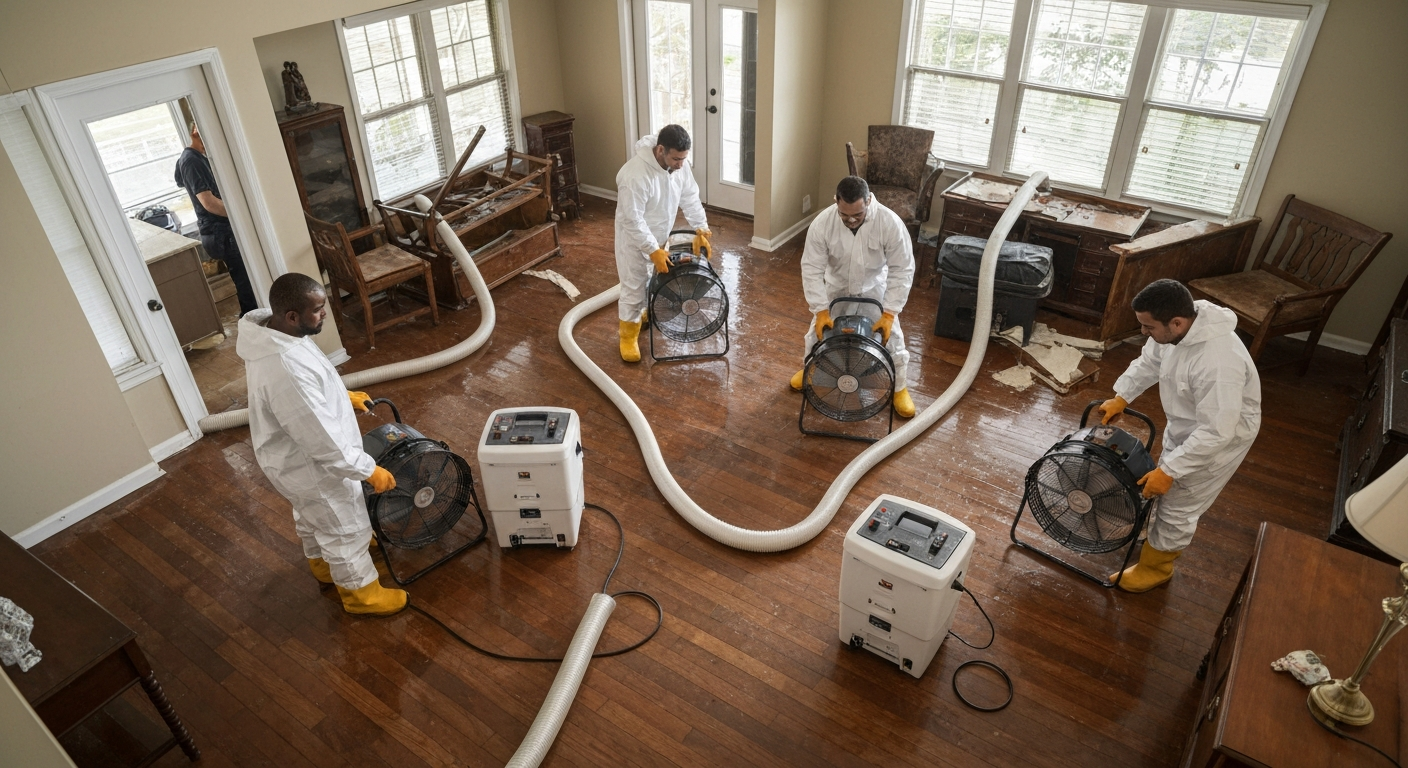
Crews use a combination of air movers (to drive evaporation) and LGR dehumidifiers (to remove moisture from the air), and the process typically runs continuously for three to five days. Don’t be tempted to shut off equipment at night; it’s designed for safe, continuous operation, and interruptions extend both risk and cost.
The best companies will show you a daily drying log: meter readings for every visit, so you can see progress toward dry standard. If a crew can’t produce those records, they were not measuring—meaning you can’t prove to an insurer or adjuster that the job was complete. Regional climate matters here: in a heating-dominant climate with 6,100 heating degree days per year, outdoor conditions may sometimes slow drying, but interior controls (fans, dehumidification) usually matter more than weather on-site.
Frequently asked questions — water damage restoration in Northampton
How long before mold starts growing?
Mold spores are everywhere, but once a surface is wet, visible growth can appear in as little as 24 to 48 hours—especially in an older Northampton home with original plaster or masonry. With our humid summers and heating-focused winters, conditions can speed up or slow down the process, but the rule is: act quickly. If water sits for more than 72 hours, you’re likely facing not only water extraction costs but also mold remediation, which can range from $1,500–$10,500 depending on area and building materials. Immediate drying is the best prevention.
How long until reconstruction starts?
In Northampton County, with its dense restoration market, mitigation crews usually finish extraction and drying within 3–5 days. Actual reconstruction—repairing drywall, floors, or cabinets—typically has a lag due to permit needs and contractor schedules. It’s not uncommon to wait one to three weeks, sometimes longer if your job needs a building permit (like in Bethlehem). This gap comes after the drying equipment is removed but before the rebuilding starts, and causes most of the confusion for homeowners. The initial mitigation may cost $1,200–$7,400, but reconstruction is almost always separately contracted and billed.
What is an assignment of benefits and should I sign one?
An assignment of benefits (AOB) is a legal document some restoration firms may ask you to sign, letting them deal directly with your insurance and get paid from your claim. In Pennsylvania, some reputable contractors may use AOBs to expedite repair, but you should read all terms carefully. Signing gives them authority to negotiate, and sometimes to dispute your claim in your name. It’s not required and can complicate things if you later disagree about scope or cost—especially on high-dollar jobs (such as $2,500–$12,000 sewage backups). Don’t sign anything under pressure; review the contract line by line and get answers in writing.
Is basement flooding covered by insurance in Pennsylvania?
For most Northampton homeowners, standard policies exclude ground or river flooding—especially in homes near the Lehigh River or Delaware River. If the water comes from inside (broken pipe, failed sump) you are usually covered. If it comes from outside (river, creek, or overland water), only a separate flood insurance policy helps—and that policy has to be purchased ahead of time, with a standard 30-day waiting period. Cleanup for a covered basement flood can run $1,200–$7,400 or more, so check your current coverage before the next storm season.
How much does a flooded basement cost to restore in Northampton?
In this county, the price to extract water and dry a basement after a clean-water incident (like a burst pipe or water heater) ranges from $1,200–$7,400, with most jobs landing around $3,900. If the water is contaminated—sewer backup or groundwater after heavy storming—the cleanup cost rises sharply, hitting $2,500–$12,000 due to the Category 3 protocols. Key cost drivers are how long the water sat, whether you have original finished walls or flooring, and the need for reconstruction after mitigation.
Does wet insulation have to be replaced?
Almost always, yes—especially in older Bethlehem and Easton homes with plaster or finished basements. Once fiberglass or cellulose insulation is saturated, it loses its insulation value and can harbor mold and bacteria within 24–48 hours. Cleanup standards (IICRC S500) generally call for removal and replacement; salvaging wet insulation isn’t practical or safe. In Northampton, insulation replacement is usually built into the overall job cost, so if you see costs at the higher end (such as $1,500–$10,500 for a significant loss), insulation is likely a factor.
Is a shop vacuum enough for standing water?
For small spills (less than a couple gallons) in a Northampton home, a shop vacuum can help with initial water removal on hard floors. But it’s not even close for wall-to-wall flooding, especially in basements or where water has gotten under floors or into walls. These local basements—often full masonry—trap water fast, and failing to fully extract and dry hidden moisture leads straight to mold and odor issues. For any real water loss, expect a professional response to start at $1,200–$7,400. A shop vac is a first step, not a solution.
What causes most water damage in Northampton homes?
In Northampton County, the largest share of losses comes from aging supply lines and appliance failures, especially in Bethlehem and Easton’s early 1900s homes. The full masonry basements and original plaster add complexity, and sump pump failures are another common culprit. Flooding from the Lehigh or Delaware Rivers is a real risk for some neighborhoods, but inside-the-home plumbing is the routine problem. Restoring these losses can cost anywhere from $1,200–$7,400 for clean water to $2,500–$12,000 for Category 3 events.
What is IICRC certification and does it matter?
IICRC certification shows that a contractor meets recognized industry standards for water and mold restoration—specifically, S500 for water damage and S520 for mold remediation. In Pennsylvania, where there’s no mandatory state license for this trade, IICRC is what insurance adjusters want to see. Always ask your lead tech for proof. If a company isn’t IICRC certified, you risk shoddy work, missed moisture, improper documentation, or denied insurance claims. The best-certified crews produce detailed moisture logs and follow protocols that can save you thousands over an untrained provider—restoration costs for a properly managed incident average $3,900 in this area.
How much does water damage restoration cost in Northampton?
Water damage costs in Northampton vary, but honest estimates for a typical clean-water loss start at $1,200–$7,400. Mold remediation is commonly $1,500–$10,500, and true sewage backups (black water) reach $2,500–$12,000. Your final bill depends more on category (contamination) and how long water sits than on sheer square footage. Older homes here tend to complicate restoration due to original materials, which means cost ranges can be wide even for similar-looking events. Get detailed estimates in writing before agreeing to any work.