What water damage restoration costs in Bloomsburg
If you’re reading this from Bloomsburg, chances are high you’re dealing with water in your basement right now. Local restoration costs here are shaped by two facts: nearly 80% of homes were built before 1980 (U.S. Census Bureau, ACS 2024), and Columbia County housing heavily includes late‑19th‑century Bloomsburg and Berwick riverfront stock with recurring basement water‑intrusion issues. These older homes mean more full basements, more porous foundations, and construction before modern waterproofing was the norm. Water events here often involve larger affected areas and sometimes require dealing with stubborn plaster or old hardwoods, which can move jobs to the higher end of the spectrum.
Based on actual claims in Bloomsburg and surrounding Columbia County, here’s what typical cost structures look like for emergency restoration services:
| Service |
What it covers |
Typical duration |
Price range |
| Water extraction + emergency drying (Cat 1) |
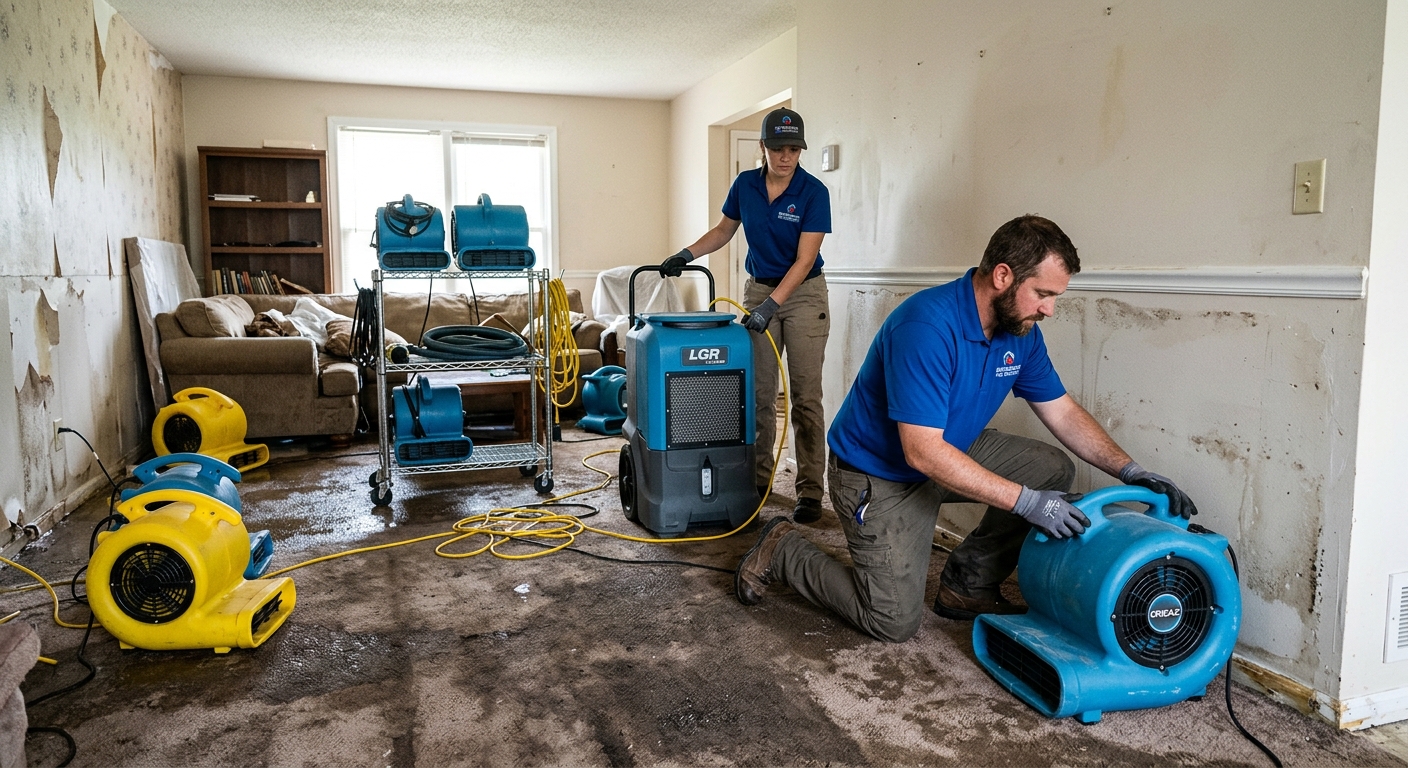
extraction, air movers, LGR dehumidifiers, daily moisture monitoring |
3–5 days |
$1,050–$6,600 |
| Structural drying only (post-extraction) |
drying to standard after water is already out |
3–5 days |
$900–$6,200 |
| Mold remediation with containment |
containment, HEPA filtration, removal, antimicrobial, clearance test |
3–7 days |
$1,300–$9,200 |
| Sewage backup cleanup (Cat 3) |
biohazard protocol, disposal of porous materials, disinfection |
2–5 days |
$2,200–$10,500 |
| Emergency board-up / tarping |
stop further water entry, secure the structure |
same day |
$350–$900 |
Estimates for a typical Bloomsburg home. Category, affected area and how long the water sat move these figures more than anything else.
What a Pennsylvania restoration contractor must actually hold
Pennsylvania does not have a state license for water damage restoration, mold remediation, or general restoration work. This means that in Bloomsburg, a business card alone is not proof of much, and any company claiming to be “licensed” in restoration is using the term loosely. The recognized industry standard is IICRC certification (S500 for water damage, S520 for mold), which means the lead technician should carry a card or digital badge—ask to see it before the first piece of equipment enters your home.
If your restoration project crosses into reconstruction—such as structural repairs, wall replacement, or major demolition—a building permit is required in Bloomsburg. For emergency extraction and drying only, permits are not typically required in surrounding communities like Berwick or Scott Township, but reconstruction shifts you back under the Pennsylvania Uniform Construction Code.
Always verify that the company is registered as a Home Improvement Contractor (HIC) with the Pennsylvania Office of Attorney General for contracts over $500. You should also ask for a certificate of liability insurance and—if they have more than themselves on staff—proof of workers’ compensation, which you can verify yourself through the WCAIS online system. Before any equipment is plugged in or a crew starts moving property, get a written contract and a charging schedule. In Pennsylvania, this is both law and your best protection.
How long the whole thing takes
Water damage restoration in Bloomsburg happens in two distinct phases. The first is mitigation: extraction, drying, and stabilization, usually wrapped up in three to seven days. This phase is urgent, handled by specialized crews, and is often billed directly to insurance. The second phase is reconstruction—when any damaged walls, insulation, or finishes are repaired or replaced. This can take weeks or even stretch into a couple of months, especially given the thin rural contractor market in Columbia County and that many crews serving the area come from outside municipalities.
The biggest surprise for many homeowners is the gap between mitigation and reconstruction. Once the house is dry and the equipment is pulled, progress appears to stall; permits may be pending, adjusters are reviewing estimates, and specialized trades aren’t immediately available. This lull, which can last from several days to several weeks, frustrates most homeowners—but it is not abandonment, just a function of market supply and permitting. In Bloomsburg, with older housing and limited local firm availability, build a cushion of patience into your expectations.
If your structure requires extensive repair, especially in a full basement common to Bloomsburg and Berwick, anticipate lead times for reconstruction and expect two contracts: one for the urgent drying, one (sometimes with a different company) for the rebuild.
What insurance covers — and the exclusion that surprises people
The most expensive surprise for Bloomsburg homeowners is the difference between covered water damage and excluded flood events. If a pipe bursts inside your home, and water is suddenly released—say, from a supply line or an appliance failure—most standard homeowners’ policies will cover both the damage and the emergency drying. By contrast, water that enters from outside—such as overbank flooding from the West Branch Susquehanna River or Fishing Creek—requires separate flood insurance you must have purchased in advance. Many discover this after a storm, when their basement fills and their claim is denied as “surface water.”
Policies also typically exclude damage from gradual leaks and maintenance failures (think: a slow drip you didn’t notice for months). Sewer backup, a growing risk near Montour Boulevard in Bloomsburg’s aging system, is usually excluded unless you’ve added a specific rider. Read your policy carefully here; otherwise, you’ll pay out of pocket—cleanup costs for Category 3 sewage typically land between $2,200–$10,500.
When you file a claim, the insurer will determine repairs using either actual cash value (depreciated) or replacement cost. Your restoration contractor should provide a detailed “scope of loss” for review and adjustment—the basis for both payment and dispute.
Assignment of benefits allows a contractor to bill the insurer directly, speeding up the process for you but surrendering some control—you’ll want a clear, written agreement. Under Pennsylvania’s Home Improvement Consumer Protection Act, every contract over $500 must be written, and you have a three business-day right to cancel. Any contractor promising to waive your deductible is breaking both the law and industry ethics—the state flatly prohibits this practice. If you’re offered this shortcut, find another provider.
What to do right now
If water is coming in—whether it’s a supply line, an overflowing fixture, or river water—move fast and take these steps in this exact order:
- Shut off the main water valve to stop any ongoing supply-side leaks.
- If the electrical panel is dry and safe to access, kill power to affected circuits (especially basement and first-floor outlets) before stepping into standing water.
- Photograph everything—damages, water lines on walls, affected belongings—before moving or touching anything. Good documentation is gold for insurance.
- If and only if it is safe to do so, lift contents—furniture, rugs, boxes—up off wet flooring to prevent further soak-in and speed drying.
- Never use a household vacuum (shop-vac or otherwise) on standing water. It is a fire and electrocution risk, especially with basement wiring in older homes common to Bloomsburg.
Call your insurance company as soon as you can—ideally while or just after you contact a restoration company. The order matters less than having documentation ready; both can move in parallel, and the first available crew is usually the right one when the clock is ticking.
The biggest error local homeowners make is waiting until the morning. In Columbia County, mold risk jumps fast with summer humidity and older, full basements. Every delay can move your cost from simple extraction (as low as $1,050) to a full mold remediation (up to $9,200).
What can be saved and what has to go
Material recovery in water-damaged Bloomsburg homes is rarely all-or-nothing. Here’s how it typically breaks down, considering that Columbia County housing heavily includes late‑19th‑century Bloomsburg and Berwick riverfront stock with recurring basement water‑intrusion issues and that most have full basements.
- Fiberglass insulation and carpet pad: Usually must go after significant soaking, especially in finished basements with river water or sewage—drying these thoroughly is impossible and mold is nearly guaranteed.
- Drywall: If water wicks up more than a few inches, best practice is cutting out 12–24 inches above the highest wet point. Old plaster walls, which are common in riverfront Bloomsburg homes, hold water much longer, so they may need more time or selective demo.
- Solid hardwood flooring: Can sometimes be saved with advanced floor drying in the first 24–48 hours. Engineered wood and laminates typically swell and delaminate—replacement is the rule here.
- Plaster: Slower to dry and more resilient, it still may require opening walls if water stands, particularly if it’s been contaminated by sewage or floodwater.
- Cabinetry: Depends on whether it’s real wood (better odds) or particleboard (swells and fails quickly). Most restoration contractors will recommend removal if the substrate is fiberboard and it’s been wet more than a day.
A reputable contractor will cut only where truly necessary—full demolition is almost never justified unless Category 3 (sewage) is involved across a wide area. On the flip side, anyone promising to dry out soaked insulation, saturated basements, or recalcitrant engineered floors in these historic Bloomsburg homes is setting up a later mold problem. Salvage is a case-by-case call, but preservation comes second to long-term safety.
Older and newer homes in Bloomsburg
The majority of Bloomsburg’s housing—nearly 80%—was built before 1980 (U.S. Census Bureau, ACS 2024), with a heavy concentration of late-19th-century riverfront stock. This has definite implications for water damage work. In these older homes, supply lines may be original or mid-century copper; cast iron drains are the norm in basements, and most wall and ceiling finishes are lath-and-plaster, not drywall. Full basements are standard, meaning larger spaces affected when there’s a water intrusion. These details matter because plaster holds water far longer than drywall, and cast iron pipes, while durable, are vulnerable to root intrusion and corrosion failures, especially near the river and in areas prone to backup.
In the minority of Columbia County homes that are newer (post-1980), you’ll encounter PVC plumbing, slab or crawlspace foundations, and near-universal drywall construction. While drying is faster here and demolition can be more targeted, these houses often use tacked-down engineered flooring and have first-generation water heaters reaching end of life, which poses different—but just as urgent—burst and leak risks.
Whether your home is standing from the 1890s or built in 2000, the construction era shapes the drying timeline, demolition scope, and restoration approach. Expect longer drying and more detailed documentation in older Bloomsburg homes—especially in that riverfront band where water fines its way in again and again.
Frequently asked questions — water damage restoration in Bloomsburg
Should I call my insurer or a restoration company first?
In Bloomsburg, the order is less important than the speed and quality of your documentation. Many insurers have 24-hour claims lines, and restoration companies serving Columbia County often dispatch crews within hours—especially when river flooding or sewer backups are happening. Take photos before moving anything, then call them both as soon as you’re able. Restoration companies can often bill your insurer directly, using assignment of benefits, but you still want your claim number and adjuster in the loop from the outset. Fast response can mean the difference between an extraction-only job (starting at $1,050) and a heavy mold remediation weeks later.
Can a contractor waive my deductible in Pennsylvania?
No, and if you’re in Bloomsburg or anywhere in Pennsylvania, any restoration contractor offering to waive your deductible is breaking state law. The Home Improvement Consumer Protection Act (HICPA) strictly forbids this practice. Insurers treat waived deductibles as fraud, and you risk claim denial, difficulty with future coverage, and possible legal consequences. If a contractor says they’ll “eat the deductible,” they either plan to cut corners or inflate the bill. This is a red flag—walk away and report them. Your share of the damage, whether it’s $1,300 for mold remediation or $2,200 for sewage cleanup, must always be paid out of pocket according to your policy.
Does wet insulation have to be replaced?
In nearly all cases in Bloomsburg, yes. With the full basements and frequent water intrusion characteristic of local housing, wet fiberglass insulation loses its R-value and can become a long-term mold risk almost immediately—especially if you’re dealing with river water or sewage backup. It’s often less expensive and much safer to remove and replace it than to risk mold remediation later (which can be as high as $9,200). Rock wool fares slightly better, but thorough drying is rare in basement situations with old walls and limited airflow.
What is an assignment of benefits and should I sign one?
An assignment of benefits (AOB) is a document you sign to let your restoration contractor bill your insurance company directly. In Bloomsburg, signing an AOB can speed up the process and keep costs moving, but you do give up some control—the contractor can negotiate and even settle on your behalf. If you trust your contractor and their contract is clear (as required by Pennsylvania law), it’s a practical solution, especially when facing jobs in the $3,400 or higher range. If you have reservations or want to control the dispute process, talk with your adjuster first.
Is basement flooding covered by insurance in Pennsylvania?
Most standard homeowners policies in Pennsylvania, including Bloomsburg, do not cover basement flooding caused by surface water—such as river overbank or rapid snowmelt flooding. You need separate flood insurance, which must be in place before the event. Internal plumbing failures (burst pipes, overflowed fixtures) are typically covered and can pay for drying and repairs (sometimes as much as $6,600 for major water extraction and drying). But for major events linked to the West Branch Susquehanna or Fishing Creek, flood-specific coverage is the only route to a successful claim.
How much does water damage restoration cost in Bloomsburg?
Restoration costs here depend on the type and extent of damage. For Bloomsburg homes, expect water extraction and emergency drying (Category 1) to run between $1,050–$6,600, with the most common scenario being around $3,400. Costs rise with the amount of water, time standing, presence of mold, and if sewage or river water is involved. Delays can quickly escalate your bill, especially in full basements typical of local homes where porous foundations let water in and hold it.
Is sewer backup a known problem in Bloomsburg?
Yes, particularly near Montour Boulevard, where Bloomsburg Municipal Authority’s aging sanitary system has documented wet‑weather inflow and basement backup complaints. Water restoration companies see this often, and proper cleanup following a Category 3 (sewage) event can reach $10,500 if a full basement and contents are affected. Insurance usually only covers these losses if you have added a specific sewer backup rider to your policy.
What water damage can I safely handle alone?
In Bloomsburg, minor surface water in limited areas—such as a mop-able spill on tile or concrete in a dry part of your full basement—can sometimes be dried using box fans and dehumidifiers. However, most basement and wall intrusions in Columbia County involve old finishes, insulation, or porous wood that cannot be fully dried with household tools. Anything that has soaked carpet, insulation, wallboard, or flooring, or involves sewage (Category 3 cleanup runs up to $10,500), should be handled professionally both for safety and to avoid denied claims and mold risk.
What does mold remediation cost in Bloomsburg?
For Bloomsburg homeowners, professional mold remediation—including containment, removal, HEPA filtration, and post-remediation testing—typically costs between $1,300–$9,200. The most common jobs land around $5,300, especially in older homes with recurring basement water issues and lath-and-plaster walls. Mold can spread quickly in Columbia County’s climate and housing stock, so do not hold off on remediation if you notice musty odors or visible growth—delays lead to gut-rehab price tags.
What equipment should a restoration crew bring?
In Bloomsburg, a credible restoration firm should arrive with commercial extractors, air movers, and low-grain refrigerant (LGR) dehumidifiers as a baseline—these are needed for full-basement drying after major intrusion. They should also have moisture meters, infrared cameras for hidden leaks, and PPE (personal protective equipment) for anything involving sewage or mold (work that regularly costs up to $9,200 for mold remediation in the area). Older homes require gear for careful demolition and debris containment, including HEPA vacuums and zipwall barriers.