What water damage restoration costs in Radnor
If you're searching for water damage restoration costs in Radnor, there's a good chance you're dealing with a crisis in real time. Most jobs in Radnor fall between $1,350–$13,500, with the biggest factor being how much space was hit and how long the water was left to sit. Two things drive costs here: first, 78% of local homes were built before 1980 (U.S. Census Bureau, ACS 2024)—so materials often don’t handle water well and mechanicals like cast-iron drains are past their prime. Inner-ring suburbs, especially spots like Upper Darby and Lansdowne, see frequent cast-iron drain failures and hidden leaks, which can turn a small issue into a multi-room restoration. Second, the high rate of single-family houses in Radnor (55.1%) means there’s more finished square footage per claim, especially below grade where basements flood, not just the carpet but drywall, insulation, and contents.
| Service |
What it covers |
Typical duration |
Price range |
| Water extraction + emergency drying (Cat 1) |
extraction, air movers, LGR dehumidifiers, daily moisture monitoring |
3–5 days |
$1,350–$8,500 |
| Structural drying only (post-extraction) |
drying to standard after water is already out |
3–5 days |
$1,150–$7,900 |
| Mold remediation with containment |
containment, HEPA filtration, removal, antimicrobial, clearance test |
3–7 days |
$1,700–$12,000 |
| Sewage backup cleanup (Cat 3) |
biohazard protocol, disposal of porous materials, disinfection |
2–5 days |
$2,800–$13,500 |
| Emergency board-up / tarping |
stop further water entry, secure the structure |
same day |
$350–$900 |
Estimates for a typical Radnor home. Category, affected area and how long the water sat move these figures more than anything else.
Regulation, certification and verification in Radnor
Pennsylvania does not issue a dedicated license for water damage restoration or mold remediation contractors. In Radnor and the rest of Delaware County, an “IICRC” badge on a business card does not mean your technician is licensed by the state—it signals voluntary training and adherence to industry consensus standards. Specifically, IICRC S500 covers water damage, while S520 is the benchmark for mold jobs. For best local practice, ask to see the lead technician’s IICRC card before work begins.
Most restoration work is considered mitigation, which usually does not trigger a building permit. The exception: if water damage leads to drywall demo, interior demolition or re-construction, certain Radnor-area municipalities (like Upper Darby) may require a permit once the project moves beyond drying and becomes actual reconstruction. Always check with your township’s code office for those details.
Contractors are required to register as Home Improvement Contractors for jobs over $500, and you can verify this at the official registration site. All employers must carry valid workers’ compensation insurance—use WCAIS (wcais.pa.gov) to confirm coverage. Before extraction starts, require a written contract that spells out scope, price, and that you’ll have a three-day right to cancel. This protects you under the Home Improvement Consumer Protection Act and stops unqualified crews from cutting corners in your home.
Why below-grade water is its own problem
Much of Delaware County—especially older neighborhoods—relies on full basements as the foundation of choice. In Radnor’s pre-1980 homes, below-grade spaces are especially tricky: water doesn’t have a gravity-assisted exit and instead pools along the slab or soaks into the footing. Add our region’s moderate freeze-thaw cycles and a frost depth of 30 inches, and you get shifting cracks and pathways for moisture that won’t dry on its own. Basement humidity is already elevated, so after an incident, evaporation lags behind upper floors—meaning more risk for lingering dampness and mold.
Sump pump failures are the leading single cause of Radnor basement emergencies. With older equipment or a missing battery backup, one power outage can mean inches of standing water. If your basement is finished—with drywall, insulation, and flooring—restoration costs usually double for a given flood volume. Water wicks up wall cavities, and a seemingly small surface area can translate to major demolition. Finished basements hide moisture behind walls and beneath floors, so what looks cosmetic often runs deeper. In contrast, unfinished spaces are faster and less expensive to dry, but even these require pro-grade extraction and dehumidification due to the lack of drainage.
The upshot: below-grade water in Delaware County is rarely a “just dry it out” situation. The combination of our construction era and climate means a slower fix and a larger bill if handled lightly.
What proper drying actually looks like
Competent drying in Radnor isn’t about running loud fans and hoping for the best. The process starts with moisture mapping—using professional meters to scan and log readings across surfaces, from floors to wall studs. This isn’t optional: a reputable crew produces a daily log of these meter readings. If you’re not handed a logbook or electronic report, ask why. Crews that do not document moisture aren’t proving actual progress.
Drying relies on two pieces of equipment: air movers (to push water vapor off surfaces) and LGR dehumidifiers (which condense and remove the moisture from the air). For southeastern Pennsylvania, with its humid summers and significant heating days, outdoor air is seldom dry enough. Professional equipment needs to keep running 24/7—especially overnight—until meter readings reach a set “drying goal.” This is not a guess: the goal is a specific target moisture content just like unaffected building materials nearby, not simply “feels dry.”
Daily site visits are non-negotiable. The crew should check and log surface and air moisture—not just move equipment around. In a region where summer humidity and moderate freeze-thaw cycles impact how fast materials release water, amateur efforts leave hidden damp spots behind, particularly in basements. Always ask to see the moisture logs before crews demob; if they weren’t recording, your home wasn’t truly monitored.
Filing a water damage claim in Pennsylvania
The most expensive mistake Radnor homeowners make is not knowing what their policy actually covers. If the water damage is from a sudden, internal source (like a burst supply line or water heater), that's typically a covered loss on your regular homeowners policy. But surface water flooding—a storm pushing in from outside—will almost never be covered under a standard policy. Those situations call for a separate flood policy, which many people only realize when they’re already facing repairs in the $4,400 range and up.
Be aware: gradual issues, such as slow pipe leaks or old cast-iron drain failures (very common in Delaware County’s 1920–1950 stock), are often excluded as maintenance issues. Sewer backup is another curveball—it’s not covered by default, and requires purchasing a special rider. Actual cash value coverage will pay less for old flooring or walls than full replacement cost, so check your limits.
After a loss, your restoration contractor will create a “scope of loss” document—basically a line-by-line estimate of the damage and needed work. Some restoration companies in Radnor offer direct billing or take an assignment of benefits (AOB), which lets them get paid by your insurer directly but also gives them legal control of the claim. Only agree to this if you fully trust the contractor. Never accept an offer to waive your deductible; it’s illegal under Pennsylvania law and a signal that the provider might cut corners or submit inflated invoices. State consumer protection law guarantees you get a written contract (over $500) and a three-business-day right to cancel. If you don’t see those documents, walk away.
What can be saved and what has to go
In Radnor’s housing stock—much of it built between 1920 and 1950—homeowners regularly face failures in cast-iron drains and full-basement leaks. When water enters, some building materials cannot be salvaged safely:
- Fiberglass insulation: Once saturated, it loses R-value and harbors mold. Removal and replacement are nearly always required.
- Carpet pad: Like a sponge for dirty water. Usually removed and disposed of, especially after sewage events.
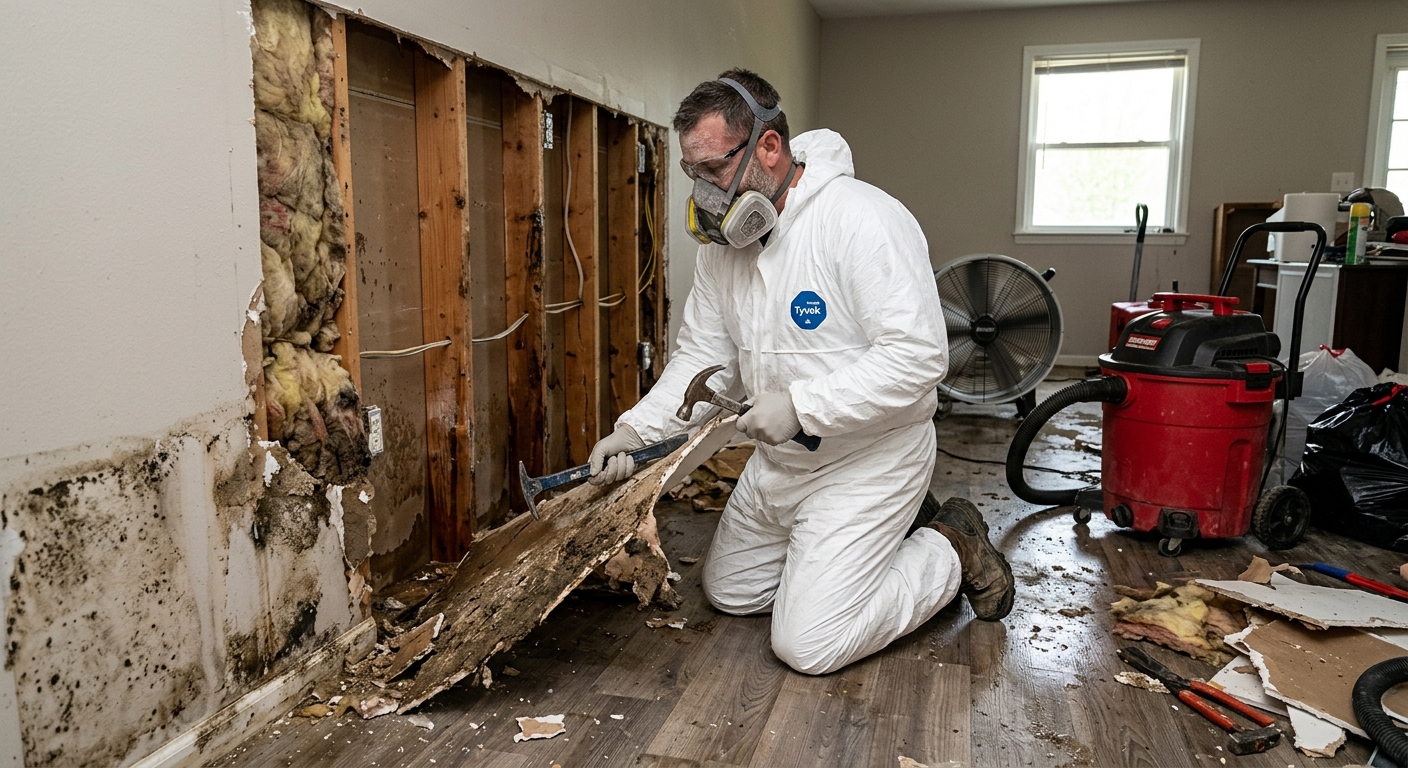
- Drywall: If water wicks up more than an inch or two, standard practice is to cut 1–2 feet above the visible line. This exposes cavities to proper drying and avoids concealed mold.
- Solid hardwood: Can sometimes be rescued with specialty drying mats if handled immediately and moisture is not extreme. Engineered floors and laminate, common in newer rooms, rarely survive full saturation.
- Plaster walls: Common in older Radnor homes. They dry much slower than drywall, and, if soggy, may require partial removal but can sometimes be salvaged if moisture levels are promptly brought down.
- Cabinets: Solid wood frames sometimes survive clean water incidents. Particleboard substrates swell and crumble; replacement is likely.
Beware the extremes: contractors pushing total demolition after a clean-water leak may be overreaching; their job is to stabilize and dry first, not flatten everything. On the flip side, a provider promising to save every surface—especially after sewage or with extended standing water—is risking concealed mold and a later, bigger claim. The right call weighs material, exposure time, and local build type.
How fast mold starts after a leak in Radnor
In Radnor, with our humid summers and many finished basements, mold can begin to colonize 24–48 hours after water loss if drying hasn’t started. Time isn’t just a service variable—it’s the price variable. If a leak is caught early, “dry-in-place” with controlled demolition can keep costs in the $1,350–$8,500 bracket. Wait even a weekend and the job can shift: drywall and insulation may need to go, pushing you toward wider removal and a higher price band.
Once visible mold colonies develop along baseboards or in wall cavities, the project typically becomes mold remediation under containment—with the potential for costs in the $1,700–$12,000 range, depending on spread. At that point, work must comply with IICRC S520, which sets standards for containment barriers, HEPA filtration, and safe disposal methodology. During remediation, a “clearance test” is standard: this is a third-party air quality test to verify that spores in affected areas are back to normal levels. Insist on written clearance results before moving on to repairs; it’s your documentation that the job was finished competently.
Delaware County’s humid climate and basement-prone homes mean the mold clock runs especially fast here. Every hour counts: rapid response is not just about customer service, but about limiting how big—and expensive—the job will get.
Frequently asked questions — water damage restoration in Radnor
Does insurance cover mold after water damage?
Insurance policies in Pennsylvania often won’t cover mold unless it results directly from a covered water loss that was reported and handled swiftly. For instance, if a pipe bursts in your Radnor home and you immediately notify your insurer, associated mold removal might be eligible—sometimes up to a capped dollar amount. However, if water sits undetected and you delay the claim, most insurers will deny mold remediation costs as “maintenance neglect.” Mold-specific riders are sometimes offered, but coverage is far less common than for direct water damage. Professional remediation with containment typically runs $1,700–$12,000 locally, so it’s wise to check your policy and act quickly after any leak. Always clarify up front with your adjuster how mold is handled under your coverage.
Why did the crew cut my drywall two feet up?
In Radnor’s pre-1980 homes, water tends to wick up drywall—not just at the floor seam but well up the wall. Restoration companies routinely make a “flood cut” around 12–24 inches above the visible waterline to ensure all saturated and potentially contaminated material is removed. This space also allows airflow for faster, more complete drying behind the remaining wall. It’s not about being excessive; it’s about preventing hidden mold and ensuring the structure under the drywall (like wall studs or insulation) dries to standard. Partial demolition may feel aggressive, but it often means you’re less likely to need full wall replacement or face a future remediation bill of $1,700–$12,000.
Can a contractor waive my deductible in Pennsylvania?
In Pennsylvania—including Radnor—it’s illegal for restoration or mitigation contractors to waive your insurance deductible. Any offer to “take care of your deductible” or “cover your out-of-pocket portion” is a red flag. State law prohibits this to combat fraud and cost inflation; insurers flag such jobs for extra scrutiny. If a company is willing to break the law on your deductible, they might also inflate your bill or cut corners elsewhere on the project—jeopardizing the quality of repairs and your settlement. Expect to see your deductible subtracted from any insurance direct payment, whether your job is $2,800–$13,500 for sewage backup or a simple dry-out.
How much does sewage backup cleanup cost in Radnor?
Sewage backup cleanup is a specialized job—radically different from clear-water extraction—because of the health risks and disposal challenges. In Radnor and through the Delaware County area, typical residential jobs range from $2,800–$13,500, depending on affected area and time before response. Costs rise for finished basements, older homes (plaster, cast-iron pipes), and projects requiring full decontamination and rebuilding. This category (Category 3) involves strict biohazard protocols, removal of porous materials like carpet and pad, and often professional clearance testing before repairs can begin. Insurance may cover this—but only if you’ve added sewer backup coverage to your policy.
Does wet insulation have to be replaced?
In almost all water losses in Radnor, fiberglass batt insulation that gets fully wet should be replaced, not dried in place. It holds moisture against wood framing, even if the surface feels dry later, and becomes a mold risk—especially in our humid, basement-heavy area. Attempting to salvage it can trap water in wall cavities and drive up long-term costs. Replacement is standard practice in professional remediation and is often required for proper drying per IICRC S520 guidelines. This adds to the scope, but is far less than the price of full mold remediation, which can reach $12,000 in multi-room jobs.
Is it safe to stay in the house during drying?
Most Radnor-area homeowners can remain in their house during clean-water drying, especially when proper equipment is used and affected areas are contained. The biggest discomfort is often noise and airflow from industrial air movers and dehumidifiers, which must run day and night—sometimes raising interior temperatures and lowering humidity. For sewage or extensive mold (Category 3 events), it’s best to relocate until clearance testing shows a safe environment. Short-term stays elsewhere are rare for jobs up to $8,500, but always listen to your contractor if they recommend it, particularly with kids, elderly, or immunocompromised residents.
Is emergency after-hours service more expensive in Radnor?
Emergency water mitigation services in Radnor—especially late at night or on weekends—sometimes incur an extra dispatch or after-hours fee, but most companies build these costs into their price bands. With a saturated local market (many firms serving Delaware County and crews on call), actual job prices for extraction and drying tend to stay in the $1,350–$8,500 range. You pay for speed and availability, but competitive pressure limits wild markups. Ask the company for a transparent quote before authorizing work; reputable contractors will disclose all charges in writing up front as required by state consumer law.
Are Radnor basements especially prone to flooding?
Yes—Radnor basements are at elevated risk due to two main factors: the prevalence of full basements in area homes and local stormwater drainage patterns. Most houses dating to the 1920–1950 era rest on full basement foundations, which means a larger volume can be affected when a sump pump fails or heavy rain coincides with a sewer backup. Fluvial flooding from the Chester Creek and Delaware River also affects areas across the county, and with older cast-iron drains, leaks or water entry are more likely. Basement floods in Radnor routinely appear in calls for both clean water and Category 3 (sewage), ranging up to $13,500 for severe multi-room claims.
Will my premium go up after a water damage claim?
Filing a claim for water damage in Pennsylvania—including Radnor—may affect your insurance premium when you renew, particularly if the payout is large ($4,400 and above) or if you have multiple recent claims. Each insurer sets their own rates and risk models, but water claims are considered “high frequency, high severity” in many zip codes across Delaware County. Reporting small losses you could pay for yourself might not be in your best interest, since a small check now can mean costlier premiums for years. Before filing, confirm with your adjuster the likely impact on your record—sometimes paying out of pocket on jobs closer to $1,350 is smarter long-term.
Can I rent dehumidifiers instead of hiring a company?
Renting consumer-grade dehumidifiers from a hardware store in Radnor might help keep small damp areas dry, but it’s no substitute for professional drying after real water damage. Restoration-grade equipment delivers many times the moisture removal per day. Plus, the process requires careful moisture measurement, mapping, and daily monitoring—none of which are included in a simple rental. For anything more than minor fresh water on a hard floor (and especially for basement or wall cavity drying), a pro is needed. Mishandled drying can mean hidden mold, opening you up to remediation costs of up to $12,000. For small, contained leaks, rental might add value, but know the limitations and when not to gamble on DIY.