What water damage restoration costs in Upper Southampton
If you’re dealing with water damage in Upper Southampton, you’re not alone—aging homes are a big part of this township’s landscape. With 78.8% of all homes built before 1980 (U.S. Census Bureau, ACS 2024) and a dominant share built in Levittown-era subdivisions of the 1950s–1960s, Bucks County sees a steady drumbeat of plumbing failures and repeat water losses. Add our local basement culture—full basements being the norm—and you can see why mitigation crews work year-round here.
Restoration costs vary by the source and scale of damage. For a standard water extraction and drying job (think clean, indoor supply-line break) in a typical Upper Southampton home, expect a bill in the $1,300–$8,100 range. Structural drying once the water is out (such as after a plumber fixes the cause) may run $1,100–$7,600. If mold has started or water sat a few days, remediation with containment and clearance testing jumps to $1,600–$11,500. Sewage backup—a recurring risk here because of documented sanitary sewer inflow issues in Lower Bucks—requires biohazard work, with costs from $2,700–$13,000. Simple board-ups or tarping, which buy time in storm season or after break-ins, cost less but are rarely part of internal water work.
| Service |
What it covers |
Typical duration |
Price range |
| Water extraction + emergency drying (Cat 1) |
extraction, air movers, LGR dehumidifiers, daily moisture monitoring |
3–5 days |
$1,300–$8,100 |
| Structural drying only (post-extraction) |
drying to standard after water is already out |
3–5 days |
$1,100–$7,600 |
| Mold remediation with containment |
containment, HEPA filtration, removal, antimicrobial, clearance test |
3–7 days |
$1,600–$11,500 |
| Sewage backup cleanup (Cat 3) |
biohazard protocol, disposal of porous materials, disinfection |
2–5 days |
$2,700–$13,000 |
| Emergency board-up / tarping |
stop further water entry, secure the structure |
same day |
$350–$900 |
Estimates for a typical Upper Southampton home. Category, affected area and how long the water sat move these figures more than anything else.
Who pays for water damage in Upper Southampton
For Upper Southampton homeowners, the harshest lesson often comes down to what your insurance covers—and what it does not. If a supply line bursts or a washing machine lets go suddenly, most Bucks County homeowners policies treat that as a covered peril and will respond, minus your deductible. But if water comes from overbank flooding—say, the Delaware River or Neshaminy Creek breaches its banks—that’s “surface flooding,” which standard homeowners policies specifically exclude. Separate flood insurance, commonly through the NFIP, is required for any floodplain or creekside property, and it cannot be bought after a storm is imminent.
Other gaps routinely shock homeowners: most policies exclude gradual-leak and long-term maintenance issues. Even if your finished basement was soaked, insurers often deny claims if the water “seeped” over time rather than arrived all at once.
Sewer backup is not included by default; it requires an explicit policy rider, which is worth weighing in Lower Bucks due to chronic municipal inflow/infiltration problems. When payout does occur, make sure you understand actual cash value (ACV)—depreciated—vs. replacement cost coverage, which pays full cost to restore.
Every insurer will require a scope of loss, a formal line-item estimate. For repairs over $500 in Pennsylvania, HICPA mandates a written contract and a three-business-day right of cancellation. Never sign away those rights. Waiving an insurance deductible is prohibited here; offers to “eat” the deductible are illegal and a signal the contractor may cut corners or bill fraudulently.
Direct billing means the restoration company bills your insurer instead of you, but you are still responsible for non-covered amounts and the deductible. Assignment of benefits (AOB) means your contractor can act on your behalf with the insurer—but you lose some control over how things are handled, so ask questions before you sign.
Regulation, certification and verification in Upper Southampton
Pennsylvania does not license restoration or mold contractors at the state level—there is no official badge or number that guarantees quality in water damage or mold cleanup here. The only statutory requirement is that any job over $500 must be under a written contract with a contractor registered under the state Home Improvement Contractor program. You can check this status at the verification site. For mold, no state license exists, but insurance carriers and industry peers generally look for certification under IICRC S520, and for water damage IICRC S500. Ask to see the IICRC card of your crew leader—not just any tech on the job.
Permits are only triggered if structural framing or load-bearing elements are being replaced, such as after major demolition during repairs. This is enforced municipally; for example, Bensalem Township requires a permit for such work, not for typical water extraction or drying. Emergency water mitigation (extraction, drying) is not permit-controlled in most neighboring jurisdictions, including Bristol Township.
Before extraction starts, see proof of current insurance and workers' compensation coverage. Pennsylvania has a verification system (WCAIS) to confirm if a firm insures its crew—don’t just take their word for it. Insist on a full, itemized scope of work in writing before equipment is placed—this protects your rights under state consumer law and clarifies what you’re paying for.
Flooding vs plumbing failure in Upper Southampton
If your home in Upper Southampton is along Neshaminy Creek, Pennypack Creek, or the Delaware River, you’re in a part of Bucks County where “flooding” means something specific on insurance forms. Water coming from these named sources—especially during flash floods or overbank events—is considered surface water, not an internal plumbing event. Standard homeowners insurance will not pay for this: a separate flood insurance policy is required, and it nearly always comes with a 30-day waiting period. If you wait until heavy rains are forecast, it’s too late.
A flooded basement and a burst washing machine line may look the same when you’re ankle-deep in water, but insurance adjusters and restoration contractors treat them very differently. Flood zone maps (used for mortgage and coverage requirements) dictate which addresses must purchase flood coverage, and these maps follow the watersheds that shape risk in Upper Southampton.
Surface floods—from creeks or the Delaware River—trigger specific policy requirements and exclusions. Only a handful of restoration companies locally are experienced in documenting flood- vs. plumbing-related damage for insurance, so clarify your water source right away when talking to adjusters or contractors.
The key is simple: only water that “originates inside the structure” is considered for standard policy coverage unless you’ve bought and maintained flood insurance. Don’t trust a promise of coverage—verify in writing whether your property is in a designated flood zone and what perils your policy actually addresses.
How a Upper Southampton crew dries a house
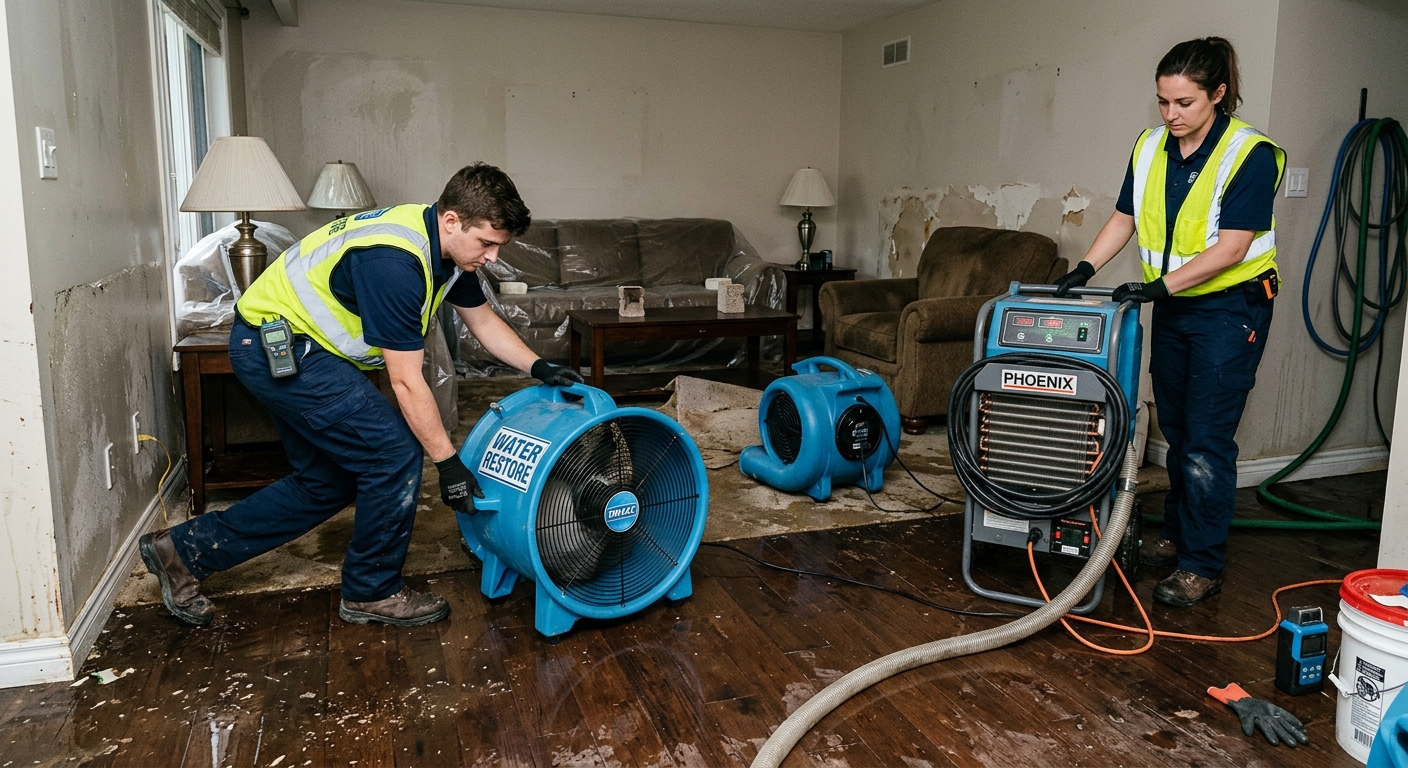
In Upper Southampton, real drying isn’t a matter of pointing fans at wet floors and calling it done. First, a crew will assess the full spread of moisture using non-invasive meters and thermal imaging. Every qualified firm maintains daily moisture mapping logs with objective readings, not just guesswork. If your technician can’t show you a log of meter readings (typically in % for wood or points for drywall) from each day, they’re not documenting properly.
Air movers—a fan made for high-velocity airflow—get positioned to disrupt the boundary layer of water at wet surfaces. LGR (low-grain refrigerant) dehumidifiers then pull vapor out of the air, making it possible for more water to evaporate from building materials. In southeastern Pennsylvania’s humid summers (design temp: 14 °F in winter, cooling degree days: 1,450), the outside air can work against you, so most firms seal off the drying zone and keep windows fully closed.
Expect the equipment to run 24 hours a day, typically for 3–5 days. Shutting it off at night resets progress and risks mold. Each morning, a tech records new readings. The goal: get every affected surface below a set “drying standard”—usually matching an unaffected area of the house or a regional baseline for material type.
Ask for the printed daily moisture logs at the end. If your crew can’t produce them, you can’t be sure drying was complete—and neither can your adjuster.
What a sewage loss requires
When a sewage backup happens in Upper Southampton, it isn’t just dirty water—it’s a Category 3 biohazard event. Cleanup requires full personal protective equipment, immediate containment of the affected zone, and mandatory removal of all porous materials (think carpet, pad, drywall, insulation) regardless of how “clean” they look. This is non-negotiable under current industry practice.
In Lower Bucks communities near Levittown, the Bucks County Water & Sewer Authority manages documented inflow and infiltration challenges. That means sewage backups can be a municipal infrastructure problem, not just a freak occurrence in your house. Preventive work like backflow prevention valves may be available, but at present, there is no stated cost-sharing for these upgrades.
After the gutting, every exposed surface undergoes disinfection with hospital-grade agents, followed by deodorization. Occupants and pets must stay clear of the area—Bioaerosols and pathogens present immediate risks. Professional sewage cleanup for a standard event runs $2,700–$13,000, but cutting corners leads to persistent odors or health hazards, so avoid “budget” bids in this category.
Category and class: the two words that set your price
Most Upper Southampton homeowners mix up “category” and “class,” but these two axes drive your cost. Category describes the water’s contamination level. Class describes how deeply the house has absorbed it. It’s entirely possible for a small Category 3 sewage backup to cost more than a widespread supply-line break.
For example, a small bathroom backup (Category 3) may run $2,700–$13,000, while a large, clean Category 1 event in the basement may start at $1,300–$8,100. The big kicker: time changes everything. Clean Category 1 water turns into grey (Category 2) in 24–48 hours and black (Category 3) in 72+ hours, especially in our humid climate. Delay dramatically increases risk, cost, and demolition.
| Classification |
Source or extent |
Health risk |
Cost effect |
| Category 1 — clean |
supply line, appliance line, rainwater |
low |
baseline |
| Category 2 — grey |
washing machine, dishwasher, sump failure |
moderate |
+20–40% |
| Category 3 — black |
sewage, groundwater, water standing 72+ hrs |
biohazard |
$2,700–$13,000 |
| Class 1 |
small area, little absorption into structure |
— |
low end of $1,300–$8,100 |
| Class 2 |
whole room, water into walls and subfloor |
— |
$1,300–$8,100 |
| Class 3 |
saturation from above; insulation and walls wet |
— |
$1,100–$7,600 |
| Class 4 |
deep saturation of hardwood, plaster, concrete |
— |
service2 upper range |
So when calling a restoration contractor, give as much detail as possible up front: what kind of water, how long it’s been there, and how much of the house is involved. It’s the most reliable way to get a realistic quote—and to move before costs climb.
Frequently asked questions — water damage restoration in Upper Southampton
How much does sewage backup cleanup cost in Upper Southampton?
For a standard single-family home in Upper Southampton, professional sewage backup cleanup typically falls between $2,700–$13,000. The final price depends most on how far the water spread, how long it stood, and how many porous materials must be removed (like carpet, drywall, and insulation). Bucks County’s older housing stock and recurring sewer issues mean local firms see a lot of these jobs, and cutting out corners isn’t worth the risk of lingering contamination. This is not a job for ordinary cleaners or handymen: a Category 3 biohazard loss requires PPE, containment, disposal protocols, and full disinfection, mandated by the industry standard. Confirm that any contractor you call carries both general liability and current workers’ compensation coverage; these are required in Pennsylvania and can be checked via WCAIS. If you’re quoted far lower than market, there’s a reason—and it usually means steps are being skipped.
Why is water damage priced per square foot?
Water damage restoration in Upper Southampton is almost always priced “per square foot” because the total affected area determines equipment needs, how long crews will be on site, and how much demolition or removal is necessary. For example, the difference between a small laundry room ($1,300 on the low end for Category 1) and a finished basement or full-floor event ($8,100 or more) is dramatic: more fans, increased electricity, more daily monitoring and—when the situation is prolonged—demolition and material disposal costs. Square footage also helps insurance adjusters estimate and approve claims quickly. Always insist on a written scope that spells out actual affected areas—not just a “ballpark” number—so you can check that you’re not being charged for more square feet than actually got wet.
What is Category 3 black water?
Category 3, or “black water,” is a technical term in the restoration industry that refers to water contaminated with sewage, pathogens, or other dangerous substances. In Upper Southampton, this means any loss involving toilet overflows, raw sewer backups (a known risk given Lower Bucks County’s infrastructure issues), and any water that’s stood undisturbed for more than 72 hours. Exposure is a serious health hazard: standard procedure demands removal of every porous material it touches, industrial disinfection, and complete isolation from the rest of the house. Cleanup costs reflect the risk, with typical bills running from $2,700–$13,000. No legitimate contractor will try to “save” soaked carpet or drywall after a Category 3 loss—reputable firms gut, clean, test, and document for your safety (and for insurance compliance).
How does southeastern Pennsylvania's climate affect drying times?
Southeastern Pennsylvania’s climate—humid summers and cool, damp winters—makes effective drying a challenge in places like Upper Southampton. High humidity (with regional cooling degree days at 1,450) means water vapor doesn’t leave your home easily, so industrial-grade LGR dehumidifiers are a must. Restoration firms keep drying equipment running 24 hours a day for up to 3–5 days for a typical extraction job ($1,300–$8,100) to ensure all trapped moisture is drawn out. Whether it’s a cold snap in January or a muggy August, outside air is rarely helpful. That’s why windows stay closed and rooms may be sectioned off with plastic. Monitoring with moisture meters allows crews to record when each area reaches its drying target—something backyard contractors often skip. Don’t let anyone shortcut equipment run-time or daily check-ins because “it feels dry.”
How do I know the house is actually dry?
In Upper Southampton, the only reliable way to know your house is fully dry after a water loss is to review the restoration crew’s daily moisture logs. A proper restoration job means the team has taken and recorded meter readings (in % or points) each day — not just at the start and end. Ask to see these records for every materially affected area. The “drying goal” should match readings from unaffected parts of your home, or be benchmarked to regional construction standards for materials like subfloor, studs, and drywall. No guesswork: if they can’t provide logs, the job may not be finished. This documentation is also what your insurance adjuster wants before approving mold remediation or reconstruction costs, which often start around $1,600 even on minor claims.
How fast do restoration companies respond in Upper Southampton?
Most reputable water damage restoration firms serving Upper Southampton, including regional crews from Philadelphia and other Bucks County townships, advertise 24/7 emergency response and can usually have technicians on site within 2–4 hours of your call. The competition in the Greater Philadelphia metro means homeowners almost never wait until the next day for help. Immediate action is crucial: clean water (Category 1) left alone can become a Category 3 biohazard in as little as 72 hours, jumping your costs from $1,300–$8,100 to as high as $13,000 for a full Category 3 cleanup. That’s why quick response is both an insurance and safety issue—not just a sales pitch.
Will my premium go up after a water damage claim?
In Pennsylvania, filing a water damage claim can lead to higher premiums at renewal, but the specific increase depends on your insurer’s policies and the nature of the loss. A single, sudden incident (like a burst supply line for $4,200) might result in a moderate rate bump or just a non-renewal warning, while chronic claims—especially for preventable leaks or sewer backups—may cost far more and even make coverage unaffordable over time. In Upper Southampton, where aging homes and municipal sewer issues make repeat losses a reality, local agents advise discussing “minor” repairs with your contractor before filing a claim, especially if the out-of-pocket cost doesn’t dramatically exceed your deductible. Always confirm with your carrier before starting the claim process if future coverage is a big concern.
Do I need a permit for water damage repairs in Upper Southampton?
In most cases, Upper Southampton homeowners won’t need a permit for basic emergency water extraction and drying—these services are considered mitigation, not reconstruction, similar to what Bristol Township allows. However, if the water damage was extensive enough to require replacement of structural framing or load-bearing elements (such as after a ceiling collapse or wall tear-out), permits are required in surrounding Bucks County municipalities like Bensalem Township. The threshold is usually met only after major demolition. Typical drying and extraction jobs ($1,300–$8,100) won’t trigger permit rules, but always check with your local building department if demolition or reconstruction goes beyond the surface. Nothing delays repairs faster than an unpermitted structural job.
Is basement flooding covered by insurance in Pennsylvania?
Most basement flooding in Upper Southampton—from heavy rain, river overbanking, or seepage via cracks—will not be covered by a standard Pennsylvania homeowners policy. Events involving Neshaminy Creek or the Delaware River are classed as “flood” losses, requiring a separate flood insurance policy. Only clean water from internal plumbing failures (like burst pipes or failed water heaters) is usually paid for under the standard policy, which might cover a loss between $1,300–$8,100 for restoration. Insurance adjusters look closely at where the water entered and what caused it before authorizing payment. Never assume a claim will be covered: confirm with your agent if your property sits in a mapped flood zone and verify your actual policy language before disaster hits.
Is a shop vacuum enough for standing water?
For small, shallow clean-water spills—a tipped-over washing machine or minor sink overflow—a shop vacuum can get you past the initial panic in an Upper Southampton home. But once water soaks into drywall, laminate, subfloor, or insulation (even in just a few square feet), those materials will trap moisture and mold quickly in our climate. Professional extraction and drying (starting around $1,300) uses heavy-duty vacuums, industrial air movers, and LGR dehumidifiers to draw out water you can’t see or reach with a store-bought vac. More importantly, restoration firms track moisture levels daily and keep logs for insurance. For anything deeper than the surface or where you can’t fully see or feel dry, it’s better not to gamble: mold remediation is far costlier if you guess wrong.