Canton water damage pricing by scope — 2026
If you live in Canton and are scrambling to handle water in the basement right now, know you’re hardly alone — with 76.2% of local homes built before 1980 and most of Canton’s 8,236 residents owning single-family houses (U.S. Census Bureau, ACS 2024), water loss is a known risk here, especially in finished and unfinished basements. Canton’s postwar split-level and two-story homes mean sump pump failures and basement seepage are routine service calls. Almost any emergency water event here will fall into one of the price bands below:
| Service |
What it covers |
Typical duration |
Price range |
| Water extraction + emergency drying (Cat 1) |
extraction, air movers, LGR dehumidifiers, daily moisture monitoring |
3–5 days |
$1,150–$7,200 |
| Structural drying only (post-extraction) |
drying to standard after water is already out |
3–5 days |
$950–$6,800 |
| Mold remediation with containment |
containment, HEPA filtration, removal, antimicrobial, clearance test |
3–7 days |
$1,450–$10,000 |
| Sewage backup cleanup (Cat 3) |
biohazard protocol, disposal of porous materials, disinfection |
2–5 days |
$2,400–$11,500 |
| Emergency board-up / tarping |
stop further water entry, secure the structure |
same day |
$350–$900 |
Estimates for a typical Canton home. Category, affected area and how long the water sat move these figures more than anything else.
Choosing a restoration company in twenty minutes
In Washington County, and especially Canton, you’re not short on options—regional firms out of Pittsburgh regularly service this area, so someone is usually available fast. But with a soaked basement or sewage backup, you’ll have minutes, not days, to decide who gets your key. Here are the three questions to cover by phone before a truck is rolling:
- Are you registered as a Pennsylvania Home Improvement Contractor (HIC), and can I verify your number at hic.attorneygeneral.gov?
- Will your insurance certificate list my address as certificate holder, not just “on request”?
- Is your crew IICRC-certified for water restoration (S500) and mold (S520) work?
When they arrive but before any tool comes off the truck, have these documents in hand:
- Written contract meeting Pennsylvania's Home Improvement Consumer Protection Act (HICPA) — you must receive and sign before work over $500 starts
- Copy of current insurance certificate, showing workers’ compensation verified at wcais.pa.gov
- Valid photo ID for the lead technician, with IICRC certification card if mold or water is involved
- Ask about permit needs if any framing or drywall will be replaced
- Clarify if Category 3 (sewage) protocols are being followed
- Ask for a full scope of work before the team enters with equipment
- Record photos of exterior trucks and personnel as they arrive
- Require a completion (or stop-work) sign-off before any payment clears
Common sales pressure: Look out for work authorizations with blank lines, or crews hauling in dryers before paperwork. Don’t let anyone start without all signatures and scope defined. If a provider balks at any of this, move on—even in a crunch, you have real choices in Canton.
What construction era means for a water loss here
Most Canton homes fall in the 1950s–1970s suburban boom, with over three-quarters built before 1980. This means your kitchen and bathroom supply lines could easily be original copper or even early plastic, which are now well past typical life expectancy. You’re likely to have plaster walls in pre-1960 sections and drywall in later additions. Cast iron drains are common in earlier houses, while PVC started showing up in the 1970s.
Nearly every home has a full basement, thanks to hilly ground and split-level designs across Washington County. Basements are ground zero for sump pump failures and seepage—especially after heavy freeze-thaw cycles and with our clay/shale subgrade, which doesn’t drain quickly. This type of construction means water can wick up into baseplates or wall cavities, pushing up both drying time and demolition if moisture isn’t handled early. Postwar homes often have below-grade finished areas, so you may face carpet pad and paneling removal whether it’s clean water or not.
If you’re dealing with original copper supplies or galvanized drains, hidden slow leaks may have started mold before you even spotted surface moisture. Old-style foundation drain systems rarely have backflow prevention. All of this feeds into why a typical water loss here can quickly go from a minor cost to a full extraction and mold remediation—justifying that mid-range $3,800 restoration estimate for even “average” basement jobs in Canton.
The first hour: what to do before anyone arrives
If water is flowing, your first move is to shut off the supply at the main—usually found at the basement wall nearest the street. If the electrical panel is safely accessible and dry, shut off only the circuits serving wet areas; don’t cross standing water to do this. Before moving a couch or pulling up a rug, use your phone to photograph every room and every angle. Insurers and contractors will want evidence of both damage and undisturbed conditions.
Next, get any portable items—furniture, books, small electronics—off wet floors and onto dry surfaces. Don’t use a shop vac or household vacuum unless you’re certain the water is clean (never for sewage or groundwater). Flooded carpets may look salvageable, but professional extraction is usually required to prevent mold and more costly demolition later.
If safe, get in touch with your insurance company as soon as you’re done controlling the immediate situation. You can call the restoration company next (or even simultaneously). Don't wait for an insurance adjuster to inspect before you begin extraction—the clock is running, especially on mold. Every hour a finished basement stays wet here, risks escalate toward both structural and health hazards.
The most costly mistake in Canton: waiting “until morning” to act. In the time it takes for morning to arrive, a Category 1 water event can cross into mold territory, turning a $3,800 job into a $10,000 remediation.
Flooding vs plumbing failure in Canton
In Canton and the greater Washington County area, basement flooding doesn’t just mean a failed pipe—it’s often Chartiers Creek or its tributaries putting water where it shouldn’t be. Floodwater from overbank events is not covered by standard homeowner’s insurance; instead, you need a separate flood policy, which you can’t buy at the last minute when flooding is already forecast. These policies also come with a waiting period, typically 30 days, so planning ahead is critical if your address is in a mapped flood zone or near Little Chartiers Creek.
When a pipe bursts in your wall or a washing machine supply fails, coverage is usually straightforward with a standard policy—if you act quickly to control and document the loss. With rising groundwater or surface water intrusion, even experienced adjusters may treat two water-soaked homes differently: one will fall under your homeowner policy, the other strictly under the terms of the Flood Insurance Program (if you have it at all). The interior destruction may look identical to you, but be prepared for very different claim outcomes—and possibly out-of-pocket costs up to $7,200 or more unless you have the right policy in place.
Credentials and permits for restoration work in Canton
Pennsylvania does not license restoration or mold remediation contractors, so any business card saying “licensed” is not a guarantee of anything related to restoration. Instead, IICRC S500 and S520 certifications have become the default industry standards—ask to see the lead technician’s active IICRC card before any work starts. For contracts over $500, the company must be registered as a Home Improvement Contractor (HIC) with the Attorney General, and you can verify the number online.
If your job involves only extraction, drying, or containment (not wall removal or framing rebuild), you typically won’t need a municipal permit in Canton or Peters Township. Reconstruction that touches structural framing will require a building permit from your local code office. If your home was built before 1978, ask for their EPA Lead Renovation certification, especially if demolition or sanding is expected.
Never let a crew begin extracting water without giving you a written, signed contract that meets state law, a copy of current insurance, and proof of workers’ compensation (which can be checked at wcais.pa.gov). If these aren’t in your hand before the truck door opens, don’t feel pressured into “emergency” authorizations—your protection matters more than their timeline.
What a sewage loss requires
When sewage enters your basement in Canton, it’s not just “dirty water with a smell.” This is Category 3 black water: everything it touches (carpet pad, paneling, drywall, cardboard boxes, insulation) must be considered unsalvageable and disposed of—no exceptions. Crews must suit up with full PPE and set up HEPA-filtered containment to prevent aerosolized contamination throughout the home. Professional-grade disinfection and deodorization follow, but even the best techs cannot guarantee safety if contaminated materials remain.
You should not remain in the impacted area, and for major losses, temporary relocation may be needed until clear post-cleanup testing. In the City of Washington, aging sanitary sewers combine with stormwater, driving recurring backups not because you did anything wrong, but because municipal pipes are past their prime. That means even careful homeowners can get hit repeatedly unless a backwater prevention valve is installed—a hardware addition that some municipalities will offer partial cost relief for, but often you’re on your own in post-war suburbs outside city limits.
Sewage cleanups are the most expensive water restoration jobs—expect costs in the $2,400–$11,500 range. If anyone proposes saving and cleaning porous contents exposed to Category 3 waste, find another contractor.
Frequently asked questions — water damage restoration in Canton
How much does water damage restoration cost in Canton?
The cost of water damage restoration in Canton can range considerably depending on the classification and scale of the incident. For a straightforward water extraction and drying after a clean water leak, you’re likely looking at $1,150–$7,200 per incident (with most typical losses in finished basements ending up around $3,800). Sewage backup cleanups or advanced mold remediation will run higher—sometimes over $10,000 if demolition and environmental clearance are required. Since most Canton homes have basements and older finishes, small delays can push a repair from the low to the upper end of these bands. Always insist on a detailed, written estimate before work starts.
Why is water damage priced per square foot?
Water damage is often priced by square footage because material removal, drying, and restoration scale directly with the size of the affected area. In Canton’s typical split-level and two-story homes, water loss can quickly crawl under walls or into multiple rooms—making response more labor intensive. The larger the footprint, the more equipment hours, containment barriers, and replaced finishes, which all drive up the bill. Even a 200 sq. ft. patch of wet carpet can generate a charge in the $1,150–$2,000 neighborhood. For larger basement floods, expect estimates closer to $3,800–$7,200 if specialty drying is needed throughout.
Does homeowner's insurance cover water damage in Canton?
Homeowner’s insurance in Canton will typically cover sudden plumbing failures—burst pipes, overflowing tubs, appliance leaks—if you act quickly to limit the damage. What your policy won’t touch is water entering from outside the home, like from Chartiers Creek flooding; flood coverage is a separate policy you must purchase in advance. Some Canton policies feature exclusions for sewer backup or require extra riders—always check, since restoring Category 3 events can cost $2,400–$11,500. If you have questions, call your insurer’s claim number as soon as you notice the loss—not after cleanup has already started.
What equipment should a restoration crew bring?
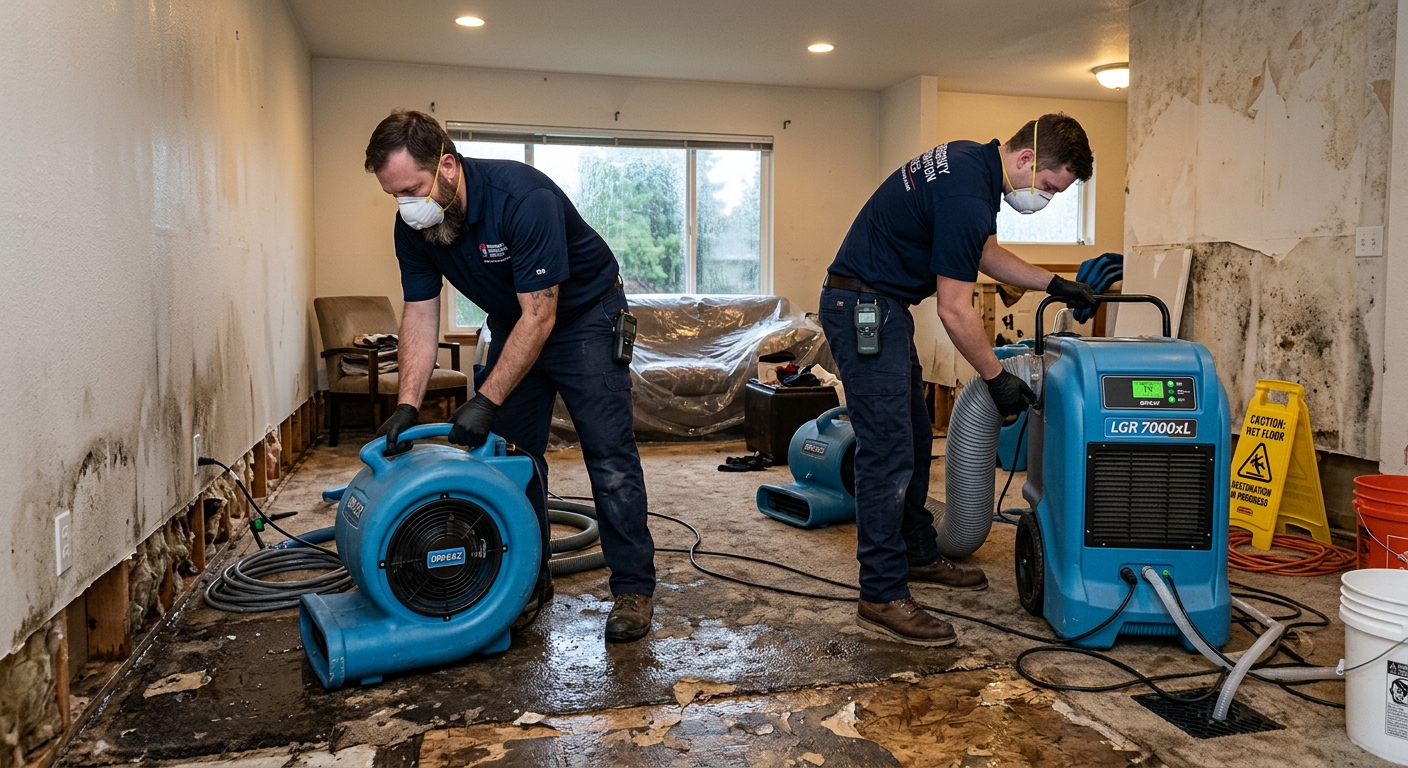
In Canton, expect a legitimate water mitigation crew to arrive with professional-grade extractors, commercial air movers, and low-grain refrigerant (LGR) dehumidifiers in sufficient quantity to match your home’s footprint. For any wall or cavity drying, look for non-invasive moisture meters and, if mold is suspected, HEPA air scrubbers. If the loss involves contaminated water, such as a sewer backup, they should also have full PPE, containment barriers, and disinfectant approved for biohazard cleanup. All major tools should be listed in your written contract estimate—any proper job in Washington County, for the typical $3,800–$7,200 cost, is going to use equipment beyond hardware store rental grade.
Should I call my insurer or a restoration company first?
The order isn’t critical—but don’t delay either. In Canton, you want to stop ongoing damage and document everything before anything gets moved. Call your insurer to meet your policy’s notification requirement, but you don’t need to wait on an adjuster if water is spreading. Restoration companies are accustomed to working with all major insurers and can often provide more thorough documentation than a homeowner could alone. If you think the job will exceed $1,150 (nearly any basement event here), call both contacts back-to-back, then photograph everything and save receipts from any supplies you purchase.
Is bleach effective against mold?
Bleach isn’t a reliable solution for mold on porous materials (like drywall, carpet, or wood framing) in Canton homes. Surface cleaning with bleach may lighten stains, but it doesn’t kill roots or spores embedded below. IICRC S520, the industry standard, calls for HEPA filtration with physical removal of affected materials—especially since most older houses here are prone to recurring leaks and moisture buildup. If mold remediation is needed, expect to spend at least $1,450–$10,000, depending on spread and whether wall assemblies need to be opened.
What is Category 3 black water?
Category 3 (“black water”) refers to water that is grossly contaminated, such as sewage from a basement backup—an occasional issue in Canton’s older neighborhoods due to the aging sanitary sewer system. Anything touched must be discarded, and special PPE, containment, and biohazard procedures are mandatory. Restoration costs for Category 3 events average $6,300, sometimes going higher if a large basement or several rooms are involved. Do not attempt cleanup yourself or allow a contractor to cut corners on disposal for these jobs.
Are Canton basements especially prone to flooding?
Yes—Canton’s hilly topography and majority postwar full-basement construction make basement flooding more common here than in many similarly sized towns elsewhere in Pennsylvania. Sump pump failures, surface water runoff, and overflows from Chartiers Creek and Little Chartiers Creek all add to local risk. In fact, a significant portion of losses reported in Washington County involve below-grade seepage or backflow, pushing basement cleanup charges well into the $3,800–$10,000 zone. If you haven’t already, consider adding or upgrading a sump system and backwater valve before the next heavy storm.
Is sewer backup covered under a standard policy?
Sewer backup coverage is often excluded from standard homeowner’s insurance policies in Canton unless you’ve purchased an explicit “water backup and sump overflow” rider. With the City of Washington’s documented inflow and infiltration issues causing periodic backups, it’s worth asking your insurer directly if you’re protected. Cleanup from these losses is never cheap—expect to pay $2,400–$11,500 without coverage. If you’re not covered, investing in a backflow prevention valve can help reduce future risk, though you’ll likely have to pay for installation out of pocket.
Does Pennsylvania license mold remediation contractors?
No, Pennsylvania has no mold remediation license statute. In Canton and throughout the county, there is no licensing board for mold work—anyone can legally advertise as a remediator. That makes it all the more important to ask for IICRC S520 certification, proof of insurance, and a Home Improvement Contractor registration number for any project exceeding $500. Only hire firms willing to present credentials and references in writing before a single wall is opened or containment is set up.