water damage restoration costs in Horsham — 2026
Many Horsham residents facing water damage—often from aging copper supply lines or a wet basement—want to know what it will cost to dry out and fix their home before they make a single call. With nearly half of local homes built before 1980 and a high homeownership rate (U.S. Census Bureau, ACS 2024), repairs and restoration often mean dealing with older construction and the quirks of mid-century basements. Most water loss costs in Horsham reflect these realities: water from hidden plumbing leaks or minor flooding tends to get into below-grade spaces and finish materials. The typical job price changes more by how quickly you respond, how much water got in, and how long it sat, than by anything else.
| Service |
What it covers |
Typical duration |
Price range |
| Water extraction + emergency drying (Cat 1) |
extraction, air movers, LGR dehumidifiers, daily moisture monitoring |
3–5 days |
$1,350–$8,400 |
| Structural drying only (post-extraction) |
drying to standard after water is already out |
3–5 days |
$1,100–$7,800 |
| Mold remediation with containment |
containment, HEPA filtration, removal, antimicrobial, clearance test |
3–7 days |
$1,700–$11,500 |
| Sewage backup cleanup (Cat 3) |
biohazard protocol, disposal of porous materials, disinfection |
2–5 days |
$2,800–$13,500 |
| Emergency board-up / tarping |
stop further water entry, secure the structure |
same day |
$350–$900 |
Estimates for a typical Horsham home. Category, affected area and how long the water sat move these figures more than anything else.
Salvage decisions after a water loss
Once a water loss happens in a Horsham home, the next step is a level-headed decision on what can be saved and what cannot. Because most houses here have full basements—a result of Montgomery County’s post-1945 suburban tract housing boom—water from hidden copper pipe leaks often ends up below grade, saturating insulation in rim joists or wall cavities. In these cases, fiberglass insulation and carpet pad almost never make sense to save; both trap moisture, rot quickly, and are cheap to replace.
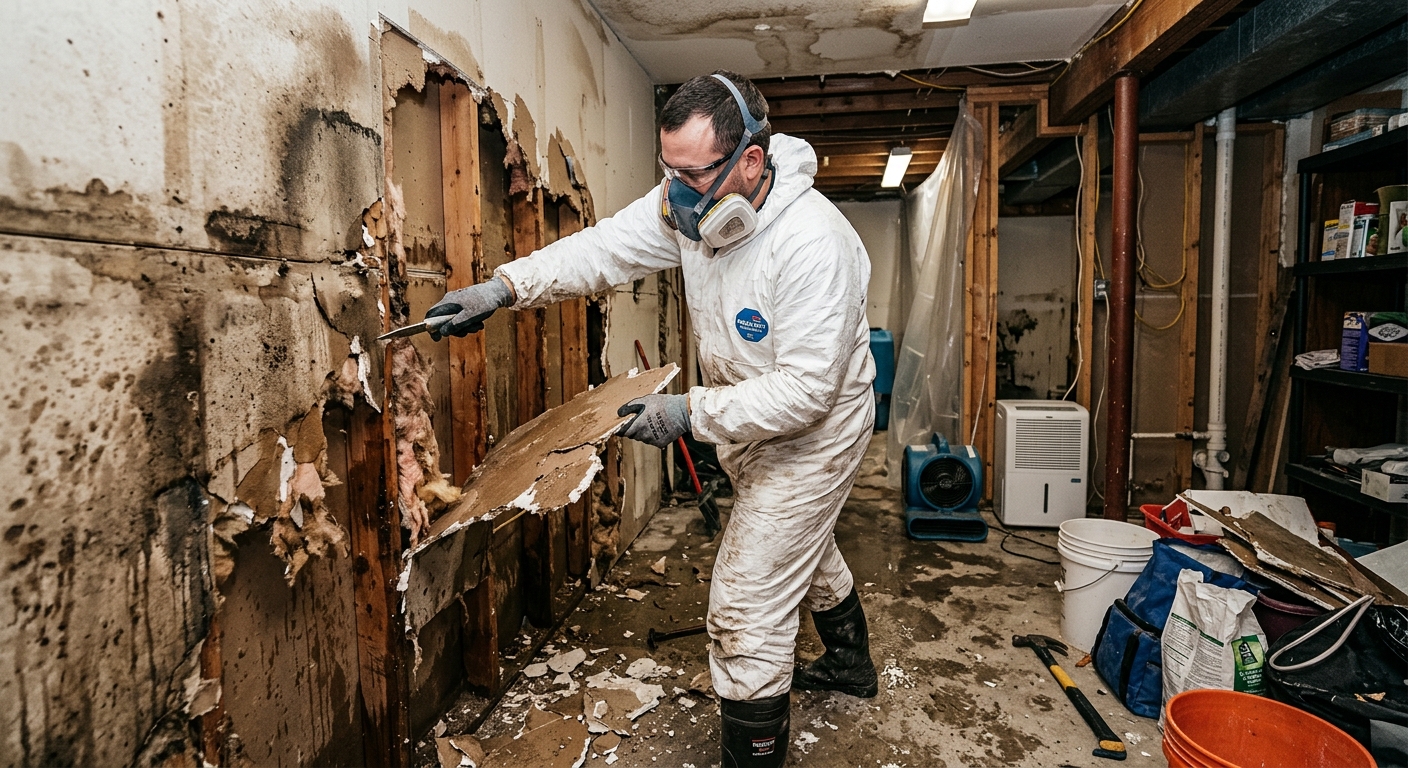
Drywall that’s absorbed water (below the “waterline”) is usually cut out in a process called “flood cut,” typically two feet up, to prevent hidden mold. Plaster, common in some older homes, stays wet internally much longer and may not look damaged on day one—so time since loss really matters. Solid strip hardwood flooring has a small salvage window using specialty drying mats; however, once boards start to cup or separate, or if the subfloor swells, replacement is the reality. Engineered flooring and most laminate swells and delaminates quickly—they rarely survive a full soaking.
Cabinets might be saved if they’re solid plywood construction, but particleboard sides or toe kicks usually spell the end. Don’t let a contractor talk you into tearing out everything “just in case”—fast, targeted drying saves more than you think. But, anyone who promises to leave everything in place after the insulation or subfloor has spent days in water is setting you up for expensive mold remediation later. Ask your adjuster and restorer for clear moisture readings and photos before you agree to cut or keep any material.
How fast mold starts after a leak in Horsham
Mold begins to colonize wet building materials in as little as 24 to 48 hours after a water loss, especially in the humid summers we see in southeastern Pennsylvania. If your Horsham basement or wall cavity stays damp even a day or two—common due to slow leaks from those mid-century copper lines—active mold growth moves your job into a pricier category almost overnight. Early on, you have a shot at “dry-in-place” structural drying, which stays in the $1,100–$7,800 range. But if microbial growth takes hold, expect containment, selective demolition, and HEPA-filtered air scrubbers, with mold remediation costs falling between $1,700–$11,500 depending on area and severity.
Selective demolition involves removing only the truly saturated or affected materials, rather than gutting everything. In these cases, you’ll want a clearance test: after mold remediation but before reconstruction, an independent tech uses spore traps or swabs to check that surfaces and air are back to normal. Make sure you get written results, not just a verbal “all clear.” This documentation can matter for future buyers or insurance. Delaying your call-out means each day tends to add steps and dollars—starting with water extraction, turning into full containment and post-remediation testing if you wait too long in Horsham’s climate and construction type.
Horsham's flood exposure and what it means for coverage
Parts of Horsham are affected by surface water flooding after major storms, with the Schuylkill River and Wissahickon Creek being the main sources for out-of-bank events in Montgomery County. If your property is in or near these flood-prone areas, you’ll need to know that standard homeowners insurance almost never pays for flood damage from overland water or creek overflow. Federal flood zone designations determine if your mortgage company will require flood insurance—but even outside official zones, you can still flood, and the standard policy won’t respond. Flood coverage is always a separate policy, usually through the National Flood Insurance Program or a private insurer, and it comes with a 30-day waiting period—so you can’t buy it when the forecast names the creek down the street.
It’s critical to understand: a flooded finished basement from rising creek water and a basement full of water from a burst pipe often look the same to the homeowner, but they are handled entirely differently by your adjuster. Pipe breaks and sewer backups can be covered by your standard policy (with endorsements), but flood water entering from outside is most often excluded without a specific flood policy. Confirm your address against flood zone maps and don’t assume coverage—and if you want to add it, don’t wait until hurricane season.
What a Pennsylvania restoration contractor must actually hold
Pennsylvania does not license restoration or mold remediation contractors—anyone can print a business card, so credentials and paperwork matter more than a label. The industry standard is IICRC certification, which means a lead technician has taken formal courses in water damage (S500) and, for mold, follows S520 protocols. Always ask to see the actual IICRC card for the tech running your Horsham job. In Norristown and other Montgomery County municipalities, significant structural repairs after Category 3 water (like a major sewer backup) typically require a building permit. However, simple like-for-like carpet replacement and most mitigation work do not need permits.
Contractors must carry a Home Improvement Contractor (HIC) registration if your job is over $500—always check this before you sign. Legally, they also need workers’ compensation for any crew, which you can verify using the state’s WCAIS website. Before extraction starts, get a written contract with clear scope, schedule, and price ranges. Pennsylvania’s law gives you three business days to cancel a contract over $500. If someone offers to “waive your deductible,” walk away—it’s not allowed under state consumer rules.
Sewage backup: a different job entirely
Sewage (Category 3) backups are not just advanced water damage—they are a biohazard job from start to finish. Norristown’s municipal wet-weather inflow issues make these losses less of a “freak accident” and more of a recurring threat for many Montgomery County homes with full basements connected to aging sewer lines. All affected crews must wear full PPE: coveralls, gloves, boots, and full-face protection. Porous materials like carpet, drywall, and insulation are not evaluated for salvage; they are removed and disposed of per regulated waste protocols, no exceptions. The process includes setup of containment barriers, negative air pressure, thorough disinfection, and odor removal using hospital-grade products—occupants should not enter these areas until full clearance is given.
Costs reflect this higher level of equipment and labor, running between $2,800–$13,500 for sewage backup cleanup in this area. Backflow prevention devices can help reduce future risk; however, in Montgomery County, homeowners are typically responsible for their installation, with no municipal cost-share program reported. If sewer backups are recurring in your Horsham home, ask about the practical steps for prevention and document each event for insurance or municipal records.
Documenting and recovering contents in Horsham
Contents—your furniture, electronics, clothing, and keepsakes—often matter as much as the structure after a water or sewage loss. Homeowners in Horsham frequently under-document what’s lost, especially after a rushed cleanup. Before moving a single item, take clear photos and make a room-by-room inventory. Insurance requires documentation for what’s being claimed. A professional pack-out crew removes salvageable items for off-site drying and restoration, then returns and inventories everything for your review. This protects both your belongings and your claim.
Contents and structure are handled under different sections of your insurance—damaged furniture or clothes won’t be covered under the structural repair budget. In Category 3 events (sewage), upholstered furniture, mattresses, paper-based items, and most particleboard or MDF furniture usually cannot be decontaminated safely and are discarded. Solid wood, some electronics, and hard plastic or metal goods can often be cleaned, restored, and returned at a fraction of replacement cost if addressed promptly. The more you thoroughly inventory and photograph from the start, the more straightforward your contents claim will be with your adjuster.
Frequently asked questions — water damage restoration in Horsham
How much does a flooded basement cost to restore in Horsham?
The price to restore a flooded basement in Horsham depends on the amount of water, how long it sat, and whether sewage was involved. For clean water from a pipe, extraction and drying typically range from $1,350–$8,400 for a finished basement. If mold has begun to spread—which can happen quickly in the region’s humid climate—remediation can add another $1,700–$11,500, especially if walls or finished ceilings need selective demolition. Sewage-contaminated losses are more costly, starting around $2,800. Older homes with below-grade living space, a common construction style here, often require “flood cuts” and replacement of finishes, which impacts the scope and cost.
Do I need separate flood insurance in Horsham?
Yes, you do—standard homeowner policies in Horsham and across Pennsylvania do not cover overland flood damage from sources like the Schuylkill River or Wissahickon Creek. Even if your property isn’t in an official floodplain, local surface water can still be excluded from your main policy. Flood insurance is a separate product that must be purchased ahead of time, often with a 30-day waiting period before it takes effect. If you experience a flood from outside water, the cost of restoration (for example, water extraction and drying, which runs $1,350–$8,400 locally) would fall entirely on you if you lack this coverage. Don’t wait until a storm is forecasted—by then, it’s too late to add this protection.
Why is water damage priced per square foot?
Water damage restoration in Horsham is often priced per square foot because labor, equipment, and drying times scale directly with the affected area. The more floor and wall space impacted, the more extraction, tear-out, drying, and monitoring is required. For example, drying a 300-square-foot basement corner costs less (usually on the lower end of $1,350–$8,400) than handling a fully finished 1,200-square-foot lower level where water spread everywhere. The contractor needs to plan dehumidifier and air mover loads for the square footage and material types involved, which means larger jobs—not just deeper water—cost more.
How do I verify a restoration contractor's insurance?
In Pennsylvania, you can and should ask any restoration contractor in Horsham to provide a Certificate of Insurance naming you and your property address as certificate holder. For workers’ compensation, check documentation against the state’s WCAIS online system—legitimate contractors will provide policy numbers for quick lookup. General liability and any pollution liability (important for mold or Category 3 sewage jobs) should be shown before crews arrive. Don’t start work based on a handshake; a proper contract and proof of insurance shield you if something goes wrong during the project, which could run from $1,350–$13,500 depending on severity.
Do I need mold testing or just remediation?
In most cases, visible mold growth in your Horsham home after a water leak means you can skip initial air sample testing and move straight to remediation—especially if you see black, green, or fuzzy stains on walls, floors, or joists. Testing is most useful after remediation, as part of a clearance test, to ensure the job succeeded and that the area meets normal spore levels before rebuild. Mold remediation in this market typically falls between $1,700–$11,500, and reputable contractors will include at least one clearance test in that cost. Remember, repeated testing before action can add days and costs without changing the need to clean and remove affected materials.
What causes most water damage in Horsham homes?
The most common causes of water damage in Horsham are hidden leaks from aging copper supply lines—especially in homes built during Montgomery County’s post-1945 suburban boom—and occasional localized flooding from basement seepage or heavy storms. These hidden pipe leaks can fill below-grade spaces over time, leading to mold issues that drive restoration costs into the $1,700–$11,500 range if not caught early. While dramatic storm flooding dominates headlines, steady, unnoticed drips under kitchens or in walls are more frequent in local claims and often go undetected until enough material has been saturated to show visible damage.
Is sewer backup covered under a standard policy?
Sewer backup coverage is usually not included in a standard homeowners policy in Horsham, but it’s widely offered as an optional endorsement for a small additional premium. Given Norristown’s documented municipal inflow issues, residents in the area with full basements and older plumbing should confirm that this add-on is in place. If you don’t have the endorsement, you’re responsible for all cleanup and restoration costs, which can range from $2,800–$13,500 for Category 3 events. Always check with your insurer before you need the coverage—add-ons cannot be purchased retroactively during or after a loss.
What should I do in the first hour of a water leak?
In Horsham, if you find an active water leak, your first step is to stop the water at the main shut-off if it’s safe to do so. Unplug or power down electrical circuits if water is near outlets. Move valuables and important papers to a dry area, and take photos of everything as you find it—insurance loves documentation. Call your insurer to start a claim, then contact a qualified restoration contractor for emergency extraction. The faster you start, the more likely you are to stay within the lower price range ($1,350–$8,400) for drying instead of moving into full mold remediation territory. Never wade into standing water unless you’re sure power is off, and avoid the area entirely if sewage is present.
Is bleach effective against mold?
Using household bleach on moldy surfaces in Pennsylvania, including Horsham, is not recommended as a remediation solution. Bleach loses effectiveness quickly on porous materials like drywall or wood, only treating surface staining while letting roots survive underneath. Professional remediation involves removal and proper disposal of affected materials, cleaning with EPA-registered antimicrobials, HEPA vacuuming, and air scrubbing—not just spraying and wiping. If you’re facing visible or suspected mold after a water loss, mold remediation costs in Horsham typically range from $1,700–$11,500, but this reflects the higher standard required to pass clearance testing and keep your home safe long-term.
Why did the crew cut my drywall two feet up?
Cutting drywall two feet above the floor—known as a “flood cut”—is standard practice in water damage restoration throughout Horsham and Montgomery County. This method removes all drywall and insulation that wicked moisture up from the floor so hidden mold doesn’t form behind walls. It also gives crews easy access to evaluate and dry wood framing. In local homes with full basements, especially those with finished walls, trapped water may not show until it’s too late, and going up to an even two feet makes reinstallation faster and often less costly. Cutting higher or lower can complicate repairs or miss pockets that lead to further remediation and costs in the $1,100–$7,800 range if done wrong.