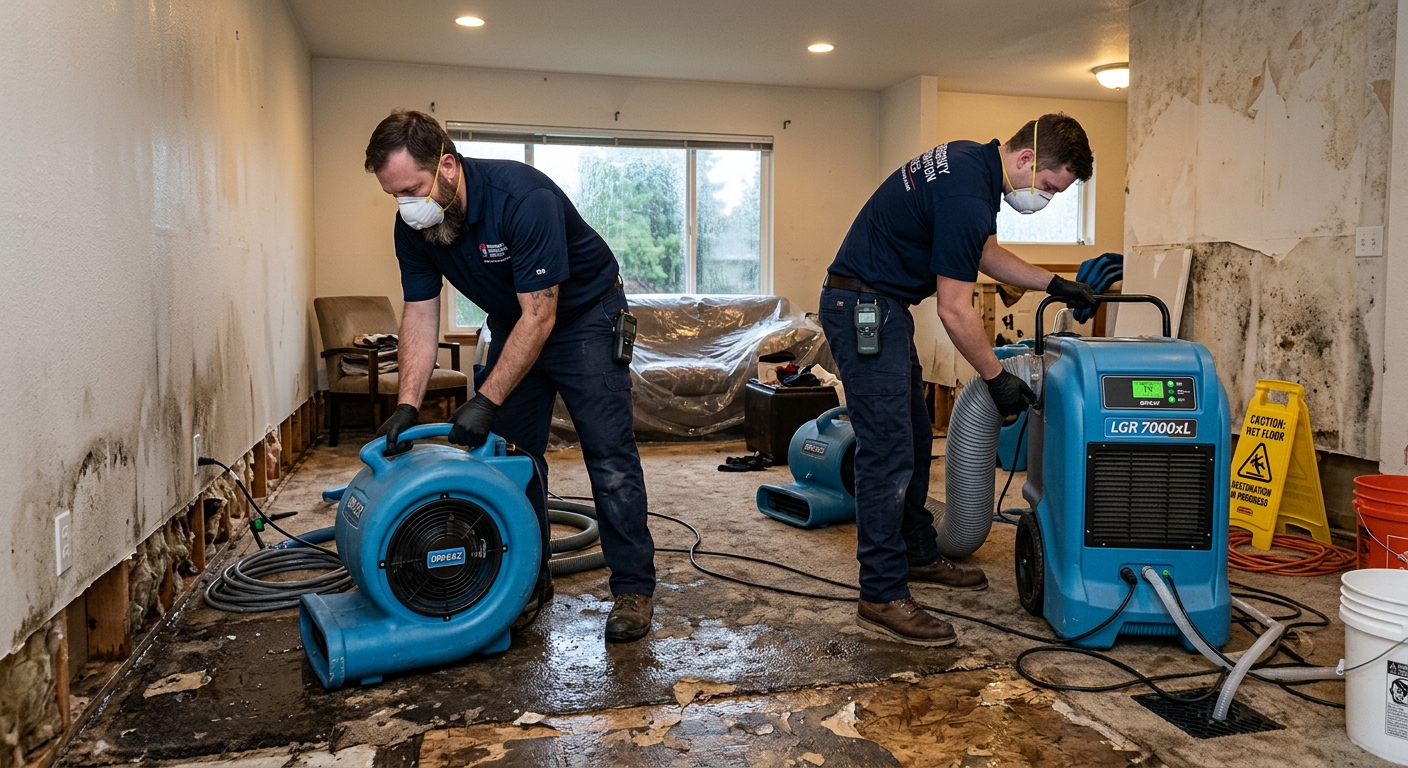
Shillington water damage pricing by scope — 2026
If you’re in Shillington and the basement's just flooded, you’re not alone: almost every home here was built before 1980 (U.S. Census Bureau, ACS 2024), and aging foundations plus older plumbing make sudden leaks and seepage common, especially in our full-basement setups. When water intrudes here, prices move fast—more because of home age, what materials got soaked, and how long it sat than anything else.
Berks County, including Reading and adjacent townships, has a large stock of homes from 1940–1970, many with cast iron drains and original supply lines. That means basement intrusions from heavy rain or a failing main are frequent, and water rarely stays just on the surface. From extraction through complete drying, here’s what water damage services cost in 2026 for a typical Shillington home:
| Service |
What it covers |
Typical duration |
Price range |
| Water extraction + emergency drying (Cat 1) |
extraction, air movers, LGR dehumidifiers, daily moisture monitoring |
3–5 days |
$1,200–$7,400 |
| Structural drying only (post-extraction) |
drying to standard after water is already out |
3–5 days |
$1,000–$6,900 |
| Mold remediation with containment |
containment, HEPA filtration, removal, antimicrobial, clearance test |
3–7 days |
$1,450–$10,500 |
| Sewage backup cleanup (Cat 3) |
biohazard protocol, disposal of porous materials, disinfection |
2–5 days |
$2,500–$12,000 |
| Emergency board-up / tarping |
stop further water entry, secure the structure |
same day |
$350–$900 |
Estimates for a typical Shillington home. Category, affected area and how long the water sat move these figures more than anything else.
Older and newer homes in Shillington
Nearly all houses in Shillington were built before 1980, with a hefty share dating from the 1940 to 1970 period (U.S. Census Bureau, ACS 2024). This housing wave shaped the risks—and the cleanup process—when water gets loose. If your place predates 1970, it probably has original plaster walls on wood lath downstairs and early drywall upstairs; both soak up water but require different drying and demolition choices. On these older homes, cast iron drain pipes and galvanized or copper supply lines are typical. After decades, rusted threads and failing joints often mean hidden leaks that go undetected until walls or basements get wet.
Full basements are the rule in Shillington—no crawl spaces, seldom slab-on-grade. So water tends to accumulate instead of quickly running off, especially when an old foundation or a perimeter drain gives up during heavy rain. Drying those basements takes longer than a shallow crawl or new build, with more air movers and dehumidifier hours. Homes with newer PVC waste lines or PEX supplies—more common only in recent renovations—tend to leak less but can still fail if a water heater or washing machine on the main floor lets go, dumping gallons straight down to the basement.
Demolition scope always comes down to how long the water sat, how much is behind the walls, and whether you’re dealing with plaster (often salvageable if dried fast) or drywall (usually needs a flood cut at 12–24 inches). Old homes with plaster and hardwood can sometimes be dried in place, while finished basements with 1970s-era drywall take more teardown. It adds up to more variability—and more need to check what you actually have before cutting.
Who pays for water damage in Shillington
In Shillington, the biggest swing in your out-of-pocket cost is whether the damage was sudden and internal, or came from surface flooding. If a supply line suddenly bursts and soaks your carpet, most standard Pennsylvania homeowners policies cover the loss—minus your deductible. But if the Schuylkill or its tributaries flood and water enters from outside, that’s excluded under standard policies, requiring separate flood coverage few hold proactively. Many Berks County homeowners only learn this when a storm loss isn’t paid.
Gradual leaks, like a slow drip from a fridge line behind a wall, often fall under maintenance exclusions. If the leak's been ongoing and the carrier suspects you missed signs or delayed response, that can mean no coverage. With sewer backups—a known risk in Reading and nearby townships—coverage usually requires a special rider added on, not standard. Every year, homeowners are caught by surprise when sewage pushes into a basement and their base policy doesn’t cover a bill in the $2,500–$12,000 range.
Your claim is settled either at actual cash value (depreciated) or replacement cost (full repair value), as defined in your contract. The "scope of loss" is the main document listing what work the insurer approves and what they’ll pay.
Most local restoration firms can direct-bill your insurer after you sign an assignment of benefits—meaning they get paid by the insurer, not you—though you give up some rights to negotiate later. Pennsylvania’s Home Improvement Consumer Protection Act (HICPA) requires a written contract for jobs over $500 and gives you three business days to cancel. Waiving your deductible is prohibited; if a contractor offers, it’s a red flag as it breaks state law and can nullify your policy.
Regulation, certification and verification in Shillington
Pennsylvania does not license water damage restoration, mold remediation, or drying contractors—there’s simply no state credential beyond the required Home Improvement Contractor (HIC) registration for work over $500. That means a logo and a business card don’t ensure competence; you’ll see everything from national franchises to local owner-operators in Berks County. The industry standard here is IICRC S500 for water and IICRC S520 for mold—ask for your lead technician’s IICRC card at the door, not just training claims on a website.
Permits for emergency water extraction and drying aren’t required in Berks County townships (including Shillington) unless the loss leads directly to major reconstruction that affects structural framing—then, in Reading, for example, a permit is needed from the city’s codes office. For most drying and mitigation jobs, work proceeds without a permit. Always verify valid insurance and check for workers’ compensation using Pennsylvania’s WCAIS system. Never take “we’re insured” on faith—ask for current certificates naming your address as an additionally insured location.
Before extraction starts, insist on a clear written contract—per Pennsylvania law—for all jobs over $500, a defined scope of work, and documentation of the provider’s HIC registration number. This paperwork matters more than any sales pitch.
Vetting a contractor when you have no time
No one plans for a water loss, and the normal advice—three quotes, site meetings, days to decide—doesn’t work in a basement full of water at 9 PM. In Berks County, you’re in a moderately saturated market: several reputable contractors, especially those based in Reading or Muhlenberg, can be on scene within an hour. That’s good news, but under stress, you need to confirm a few key points before anyone steps in the door.
Bare minimum: (1) Confirm the firm’s HIC registration number on the spot; (2) Ask for workers’ compensation insurance covering their crew; (3) Get a plain-English description of what work will be done on day one. Before any equipment is unloaded, you should have in hand: (a) a signed written contract (not just a work order); (b) a project scope with line items, not blank spaces; (c) proof of insurance naming your address.
- Verify HIC registration via hic.attorneygeneral.gov while on the call.
- Request their IICRC certification for the work type.
- Confirm direct contact info for the crew leader—not just a dispatcher.
- Check workers’ comp status at wcais.pa.gov, even for small crews.
- Request a copy of their liability insurance, not just a verbal assurance.
- Insist on a start-to-finish written scope, with costs broken down.
- Avoid any contract with broad blank spaces or “TBD” for price.
- Ask what demolition (if any) is proposed and why—this avoids unnecessary tear-out.
- Stay wary if the crew shows up and opens equipment without paperwork first.
- Demand written confirmation of your three-day cancellation right, as required by HICPA.
Watch for pressure tactics: a handshake or verbal nod is not agreement. Sometimes a crew will start unloading or prepping before a contract is signed, counting on urgency. Decline any job where the contract scope is left blank or the company refuses written insurance verification. It’s your home—pause any job until the basics are locked in.
Category 3 cleanup in Shillington
Sewage backups in Shillington—especially in older Reading-area neighborhoods—are a municipal reality, not just a “bad luck” event. When main sewers overflow, the cleanup is fundamentally different from clean water damage: you’re dealing with a Category 3 biohazard. This means full PPE (respirators, suits, gloves); containment to prevent cross-contamination; and mandatory removal of any porous materials within reach of the sewage, no exceptions. Even if your carpet “looks” clean after drying, it cannot be salvaged—you are required to dispose of any affected drywall, insulation or soft goods under accepted protocols.
Decontamination goes beyond visible surfaces. Disinfection and deodorization are done with commercial agents and HEPA air scrubbers, and nobody—especially children or anyone with a respiratory condition—should remain in the house during active remediation. For this level of response, cleanup costs in Shillington routinely run $2,500–$12,000 depending on size and materials affected.
Backflow prevention valves can stop some future sewer backups, but no local cost-share program is provided at the municipal level in Berks County. If your home has repeated issues, discuss valve retrofits with your plumber, but don’t expect the borough to pay for installation. Once sewage enters your basement, standard cleaning or a home wet-vac is not enough—hire a contractor with proven Category 3 experience to meet code and insurance standards.
The mold clock: 24, 48 and 72 hours
In Shillington’s climate, the clock literally starts the moment water gets loose. Once drywall or framing is wet, mold colonization can begin within 24–48 hours—especially in basements or closed-up spaces where humidity stays high. This isn’t just theory; the odds go up in Berks County because most basements here are full-depth below grade, staying cooler and damper after a loss, making fast action matter more than it would in a slab-on-grade home.
Within the first 24 hours, salvage is mostly possible: “dry in place” strategies, where drywall and trim can be saved, keep costs on the lower end of $1,200–$7,400 for water extraction and drying. Hit that 48–72 hour mark, and you’re into selective demolition—drywall needs a flood cut, some insulation is out, and the risk for hidden damage goes up. If 72 hours pass before drying starts, or if water wicks behind cabinets in a finished basement, full containment is needed and mold remediation costs jump to the $1,450–$10,500 bracket, including post-clearance testing.
A “clearance test” means a third party checks moisture and airborne mold spore levels and certifies that remediation actually worked. Always ask for this in writing in Shillington—insurers and future homebuyers both care. Delays add hundreds to thousands of dollars, and in southern Pennsylvania’s freeze-thaw cycles, damp walls linger, so acting quickly isn’t just about convenience—it’s real money avoided or spent.
Frequently asked questions — water damage restoration in Shillington
Do I need mold testing or just remediation?
Mold testing isn’t always necessary in Shillington homes if you already see visible growth in the affected area—remediation (removal under proper containment) is what insurers and realtors expect. However, if you’re unsure how far it has spread behind walls or you have allergic occupants, air or swab testing can clarify the scope. A professional company will include clearance testing (air or surface sampling after remediation is complete) at the higher project end, often bringing the total cost into the $1,450–$10,500 range for full remediation. Always request a written report with before/after readings: it acts as insurance against future buyer concerns and supports any claim submitted to your carrier. In Shillington, clearance is often recommended after a basement loss because older homes frequently hide mold behind layers of plaster or paneling.
Why did the crew cut my drywall two feet up?
In Shillington’s older homes, when water wicks up drywall—even a few inches—the industry standard is to remove all affected wallboard about 12 to 24 inches above the highest water line. That’s called a “flood cut.” This exposes the full cavity for targeted drying in basements, which are typical in our region. Even minor flooding can cause hidden moisture to reach insulation, framing, or wiring. Removing just what appears wet isn’t reliable—moisture meters may not read dampness hiding behind vapor barriers or old batt insulation. By cutting higher, crews ensure that drying reaches every layer, and this limits the spread of mold. For many Berks County jobs, this brings the project into the mid-range of $1,200–$7,400, but saves on deeper demolition and costlier repairs later. It’s preventive, not arbitrary.
Does Pennsylvania license mold remediation contractors?
Pennsylvania does not license mold remediation contractors. There’s no mold-specific state licence, so anyone can advertise mold removal in Shillington or anywhere else in Berks County. This puts the responsibility on you to confirm credentials. The industry’s expected standard is IICRC S520, so always ask for the company’s IICRC number and ideally see the lead technician’s card before you agree to work. Larger, reputable firms in Reading and Muhlenberg generally abide by this, and full mold remediation costs range from $1,450–$10,500, depending on size and scope. But always check their Home Improvement Contractor (HIC) registration as well—required by law for contracts over $500. When in doubt, check references and reviews, and don’t be afraid to ask for proof of actual training in S520.
Is emergency after-hours service more expensive in Shillington?
After-hours or weekend water damage response often does run toward the higher end of the range in Shillington, especially if local firms are busy or need to pull staff off other jobs to respond quickly. In Berks County, multiple firms serve the metro, so response times are quick but there’s no price cap—labor and equipment charges can reach the higher end of $7,400 for a complex evening extraction and drying. Some companies bill a flat emergency fee, others just higher hourly rates. Always ask if the quoted price includes after-hours premiums, and get it in writing. If your loss is not actively spreading (like standing water already stopped), you may save by waiting until the following business day. For active leaks or sewage, however, delays increase both health risks and costs.
Will my premium go up after a water damage claim?
In Shillington and across Pennsylvania, filing a claim for water damage—especially for larger losses or repeated incidents—can raise your homeowner’s premium at the next renewal. Insurers treat water claims as signals of risk: a one-off supply line burst may have minimal effect, but recurring basement flooding or past claims on the record can jump rates or even trigger non-renewal. For a standard water extraction and drying claim in the typical $3,800 bracket, expect a written notice of the claim on your CLUE report. It’s rarely worth making a claim for small losses close to your deductible; paying out-of-pocket for less than two thousand can sometimes keep your premiums steadier. Always consult your agent before you file, as policy terms and local claim histories can shape their response.
How long before mold starts growing?
Mold growth can start in a Shillington home within 24 to 48 hours of water exposure if temperatures and humidity are favorable—this speed is accelerated in Berks County’s older, lower-lying basements where airflow is limited and dampness lingers. Once colonization begins, remediation costs escalate quickly, from the baseline of $1,200 for rapid extraction up to $10,500 or more if extensive demolition and containment become necessary. Prompt drying within 24 hours makes full removal unnecessary in many cases. After 48 hours, however, you’re usually facing some material removal and possibly a clearance test. These timelines are why the first call should be made as soon as water is discovered, not “in the morning.”
How does south-central Pennsylvania's climate affect drying times?
South-central Pennsylvania’s climate, especially the pronounced freeze-thaw cycles and moderate snowfall in Berks County, impacts how water soaks into and leaves your home. In Shillington, basements stay cooler and damper in winter, slowing evaporation. High summer humidity can also slow drying above grade, keeping materials damp for longer—even with dehumidifiers running. This means it often takes the full 3–5 day window for professional drying, as priced at $1,000–$6,900 for structural drying only. Rapid response is especially important when daytime temperatures swing: condensation forms in wall cavities, and stubborn spots remain damp. Experienced local contractors monitor progress daily and adjust airflow and humidity—and if things aren’t drying in 72 hours, the solution usually shifts to demolition.
Do I need separate flood insurance in Shillington?
Yes, if you want coverage for water entering your home from outside—like overbank flooding from the Schuylkill River or Tulpehocken Creek—you’ll need a separate flood insurance policy. Standard Pennsylvania homeowners insurance policies won’t pay for surface water intrusion, even if it comes from heavy storms that regularly hit Shillington and nearby townships. Many find this out only after a weather event causes thousands in damage in a full basement, with restoration costs often landing between $1,200–$7,400 for Category 1 water, or much more for contaminated floodwater. If your lender requires coverage, maintain it; if not, weigh the cost against your property’s specific flood risk, which is higher near river and creek floodplains. You can’t buy flood insurance after a weather event is forecast, so choose before the next storm season.
Can I clean up water damage myself in Shillington?
For small spills confined to tile or vinyl flooring—and if you catch it immediately—DIY cleanup can work in Shillington, especially with a shop vac and fans. But the moment water wicks into walls, insulation, or gets into your basement’s finished areas, it shifts quickly into a job best handled by trained contractors. Berks County homes built before 1980 often have layered finishes or plaster, making hidden moisture harder to spot and dry. Delays can multiply costs from the lower end of $1,200 for prompt extraction up to $10,500 when mold remediation is needed. If the area affected is larger than 10 square feet, there’s sewage, or you can’t be certain it’s fully dry, call a professional. Insurers expect documentation of drying and repairs—even for claims—so leave bigger jobs to the pros.
Why is water damage priced per square foot?
Pricing water damage work per square foot in Shillington allows restoration contractors to estimate labor, drying equipment, and material costs more precisely based on the scale of the affected area. Full-basement flooding in older Berks County homes often means a lot of surface area gets saturated, from walls to subfloor to trim. The bigger the wet area, the more air movers, dehumidifiers, and demolition work required—which is why a 400-square-foot loss can run far less than a 1,200-square-foot basement, even if both look equally messy at first glance. Typical extraction and drying projects range from $1,200–$7,400, scaling up as footage—and water depth—increase. Charging by the square foot also ensures fair pricing for smaller jobs, where minimums might otherwise force you to overpay for a quick fix.