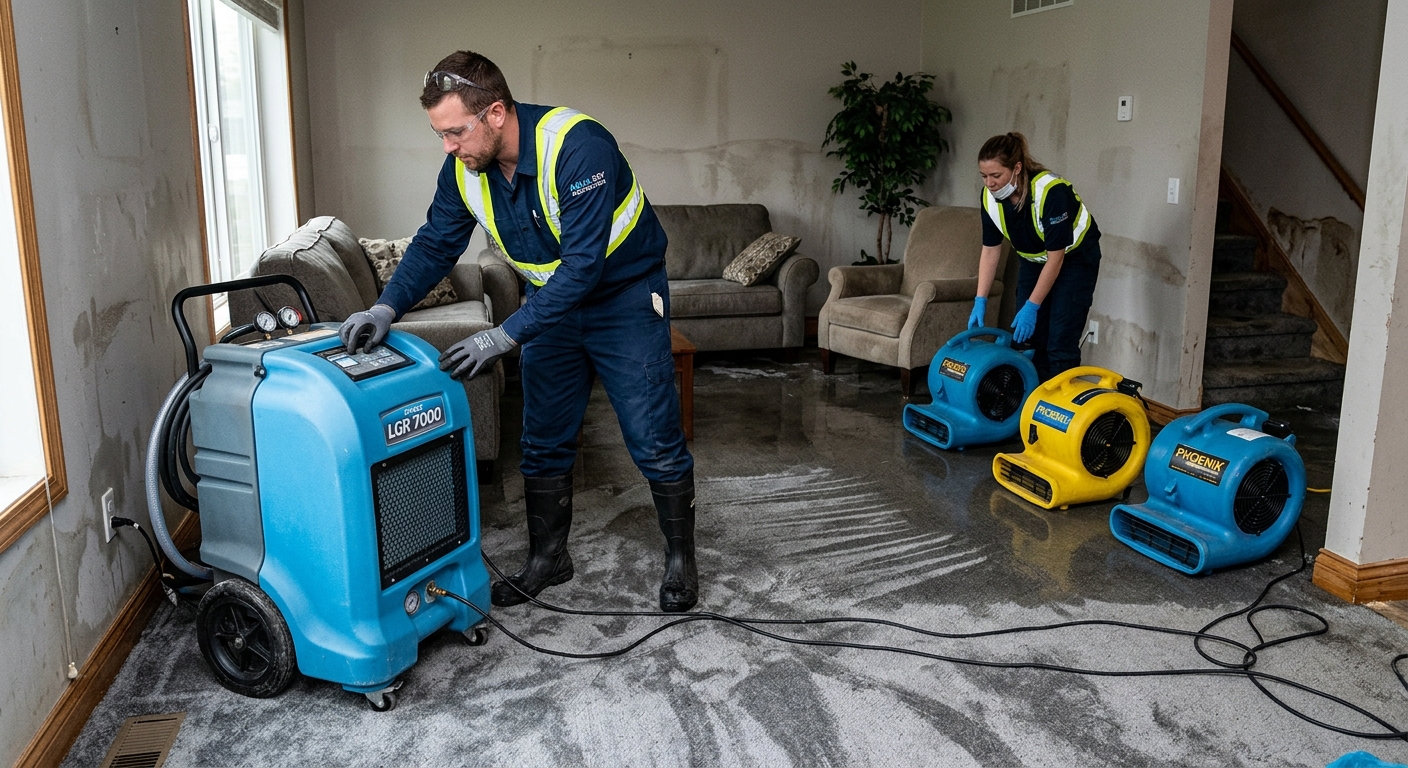
What water damage restoration costs in Harborcreek
If you’re reading this from Harborcreek with water in your basement or living room, you probably care more about what it’ll cost and how quickly someone can respond than any sales pitch. Here’s what to expect, based on local numbers and the way losses play out in Erie County homes.
Over half the homes in Harborcreek were built before 1980, and most are single-family structures (U.S. Census Bureau, ACS 2024). This older housing stock—especially in nearby Erie and Millcreek—means restoration costs here are driven up by failing cast-iron drains and clay sewer lines buried decades ago. Sewer backup and basement seepage are constant issues wherever those systems haven’t been updated. Since most homes have full basements for freeze protection, water likes to go everywhere, increasing both damage and the bill.
| Service |
What it covers |
Typical duration |
Price range |
| Water extraction + emergency drying (Cat 1) |
extraction, air movers, LGR dehumidifiers, daily moisture monitoring |
3–5 days |
$1,150–$7,300 |
| Structural drying only (post-extraction) |
drying to standard after water is already out |
3–5 days |
$1,000–$6,900 |
| Mold remediation with containment |
containment, HEPA filtration, removal, antimicrobial, clearance test |
3–7 days |
$1,450–$10,500 |
| Sewage backup cleanup (Cat 3) |
biohazard protocol, disposal of porous materials, disinfection |
2–5 days |
$2,400–$11,500 |
| Emergency board-up / tarping |
stop further water entry, secure the structure |
same day |
$350–$900 |
Estimates for a typical Harborcreek home. Category, affected area and how long the water sat move these figures more than anything else.
Outside water, inside water
In Harborcreek, flood risk mainly comes from Lake Erie’s shoreline, Presque Isle Bay, and localized creek events from Mill Creek and Fourmile Creek. These are not the same as a water loss from a broken pipe or sump backup. If outside water travels overland and enters your home—even just a few inches—it’s considered a “flood,” and your standard homeowners policy will not cover it. Flood coverage has to be purchased as a separate policy, and it usually takes effect after a waiting period (often 30 days), so it’s not something you can pick up when the lake or creeks are already rising.
This gets confusing when the cleanup looks identical: water everywhere, the same musty drywall, the same fans and dehumidifiers running in your basement. But insurance adjusters draw a hard line based on the source—coverage depends entirely on whether the water touched the ground outside before entering. If it’s a burst washing machine line or a failed sump pump, your policy may help; if it’s lake or creek flooding pushing through a window well, those repairs are almost always on the flood insurance rider.
Flood risk maps designate certain Harborcreek addresses as high-risk, especially the areas close to Fourmile Creek. It’s always worth checking your zone before assuming you’re covered for every kind of water incursion.
Mitigation, then reconstruction: two different timelines
Most people expect one contractor to handle everything, but water damage restoration in Harborcreek is a two-phase process. Mitigation—the urgent part—happens first. Crews extract water, set up drying equipment, maybe remove unsalvageable drywall and flooring, and ensure the structure is left safe and dry. This happens over a few days and is often direct-billed to your insurer or paid up front. Then there’s a pause while the claim is adjusted, scopes are written, and permits are pulled if necessary.
Reconstruction—putting your home back together, repainting, reinstalling cabinets—follows. This can stretch weeks, sometimes months, depending on schedules and material availability. In Erie County, the contractor market includes more than 15 restoration firms, but for full rebuild work, there may still be a waiting list, especially if multiple homes are affected after a big storm or freeze. The days after mitigation can feel like the job has stalled, but this “dead time” is normal—it’s when approvals and inspections move through the system.
Documenting and recovering contents in Harborcreek
Structural drying and mold remediation are only half the claim. In Harborcreek, where many basements double as living space, personal property—contents—can be as big a hit as the home itself. Contents pack-out means moving salvageable items off-site so they aren’t exposed to ongoing moisture or mold. Restoration crews inventory every item they remove, and the more you document with photos before anything moves, the smoother your claim will be. Insurers require proof: pictures of the damage, make/model and condition, and value if you have receipts.
Structure (your walls and floors) and contents (furniture, electronics, clothing) are two entirely different coverage areas. Most policies cover replacement cost for contents, but there are limits for categories like electronics or collectibles. Upholstered furniture exposed to Category 3 (sewage) water, particleboard shelving, and mattresses are almost never salvaged—it’s safer (and usually required) that these be disposed of. Solid wood furniture, many electronics, and rugs not directly in the wet zone often can be restored. Don’t toss anything before your adjuster has seen it and you’ve taken documentation photos.
Vetting a contractor when you have no time
Most homeowner advice says "get three quotes,” but water moves fast and so do restoration crews. In Harborcreek and Erie County, the market is busy, but there are enough firms that you have some choice. Here’s a quick triage: Confirm the company is local or routinely works in the county, that they’re registered under Pennsylvania’s Home Improvement Contractor act for jobs over $500, and that they carry workers’ compensation on everyone entering your home.
When a crew arrives, have three documents in hand before they unload equipment: their HIC registration, certificate of insurance, and a written work authorization that spells out the scope and pricing.
- Confirm HIC registration number and verify at the attorney general site
- Ask for a certificate of insurance showing liability and workers’ comp
- Demand a clear, written scope before equipment enters
- Clarify payment terms—direct billing, deposit, deductible handling
- Ask who the crew lead is and their experience level
- Request an estimate of how long mitigation will take
- Inquire about after-hours or emergency service premiums
- Know who your point of contact is for the project
- Read the contract cancellation policy (3-day right under PA law)
- Never sign a blank or open-ended work order
Be cautious of pressure tactics: some crews will try to start unloading gear before you’ve gotten paperwork. Never allow anyone to begin without documentation and a signature. Avoid “we’ll deal with insurance later” promises—Pennsylvania law requires a contract for any job over $500, and the scope must match what’s actually being performed.
Preventing the next one
If you’ve been through a cleanup, you’re probably thinking about how to prevent the next loss. In Erie County’s deep-freeze climate (36-inch frost depth, 5°F winter design), frozen pipes and sump failures are the biggest repeat offenders. The cheapest, most effective steps:
- Automatic leak sensors: Place electronic sensors near water heaters, sump pits, washing machines. About $40–$140 per sensor. Highly recommended.
- Washing machine and ice maker lines: Upgrade to steel-braided hoses. Parts and labor typically come to $90–$250.
- Sump pump with battery backup: If you rely on pumping to keep the basement dry, a backup system is worth it at $700–$1,200 installed. Outages happen during heavy storms here.
- Automatic water shutoff valve: For older plumbing, these can limit major losses, but at $400–$1,200 installed, they only make sense if your plumbing is prone to failure or you leave the house for long periods.
- Backflow valve on main drain: For those on combined sewers, especially closer to Erie city’s troubled mains. Expect $1,400–$2,800 installed (not needed unless your area floods from the street).
- Simple water heater pan and drain: Around $120–$340. Worth it if your tank sits above finished area.
Don’t bother with expensive “whole-home waterproofing” unless you have repeated groundwater entry and have already addressed above. Target the likely failure points first.
What a Pennsylvania restoration contractor must actually hold
Pennsylvania does not license water damage restoration or mold remediation contractors at the state level. This means you cannot rely on a state license, board, or registry to confirm competence or insurance—anyone can have a business card printed. However, credible providers in Harborcreek follow the insurance industry standard: the IICRC S500 for water work and S520 for mold. Ask to see the lead technician’s IICRC certification card at arrival.
Permits are not required for mitigation (drying, extraction, removal of wet materials), but if drywall, flooring, or structural components are being replaced as part of reconstruction, then the municipality will require building permits under the Pennsylvania Uniform Construction Code. Each township in Erie County runs its own code office for this.
For contracts over $500, all companies must be registered as a Home Improvement Contractor (HIC) with the Pennsylvania Office of Attorney General. You can verify this registration online. Workers’ compensation is mandatory for any crew with employees—you verify via the WCAIS system.
Before work starts, you should have in writing: their HIC registration, a certificate of insurance naming you as certificate holder, and a signed contract detailing scope and pricing. Do not let them unload equipment without these in hand.
Frequently asked questions — water damage restoration in Harborcreek
What is a clearance test and do I need one?
A clearance test is an air or surface sample conducted after mold remediation to verify that mold levels in your Harborcreek home meet industry standards. This test helps prove to both you and your insurer that remediation was successful and the home is safe to reoccupy. Clearance tests are not always mandatory, but are highly recommended when extensive mold work is performed, especially if anyone in the home has respiratory issues or if the loss is being covered by insurance. Many insurers require documentation for claims involving $1,450–$10,500 in mold remediation. For small, single-room jobs you might skip it, but if containment barriers, HEPA air scrubbers, or extensive demolition were needed, a clearance test is your best assurance that the work is truly finished and safe.
Can I clean up water damage myself in Harborcreek?
Small “clean water” spills can be tackled yourself if you start right away, but most water damage jobs in Harborcreek involve more than a couple of towels can manage. Basements here tend to flood fast and deep, and moisture can hide under floors and behind walls, especially in homes built before 1980. For losses bigger than a few gallons, or any time the water sat more than 24 hours, professional extraction and drying service—in the $1,150–$7,300 range for emergency drying—prevents mold and long-term issues. Anything involving sewer backup or visible mold is best left to professionals both for safety and insurance coverage.
Do older Harborcreek homes need different treatment?
Yes. Most homes in Harborcreek were built before 1980, and even more so in Erie and Millcreek, where aging cast iron and clay drains often fail, causing hidden and repeated water damage. Older homes have plaster or multiple wall layers that dry much slower than modern drywall, making proper drying more complicated and sometimes more expensive. Often, emergency drying costs in these structures run toward the higher end of the $1,150–$7,300 range. Add in the possibility of lead paint for pre-1978 homes, and you want a contractor who recognizes these conditions and can provide EPA-certified technicians if needed.
Why does plaster take longer to dry than drywall?
In Harborcreek, many older homes have plaster walls, especially those built before the 1960s. Plaster is denser and holds more moisture than drywall, which means it takes much longer to dry out after water damage. Standard emergency drying that might take three days with drywall can easily take six or more when plaster is involved, pushing actual costs well above those for a typical $1,150–$7,300 Category 1 dry-out. If plaster sits wet too long, it’s more likely to detach or develop mold behind the lath, so it’s important to get professional help quickly.
Is sewer backup covered under a standard policy?
Most standard homeowners policies in Harborcreek exclude coverage for sewer backup unless you’ve added a specific “sewer and drain” endorsement. Areas close to Erie City, especially along older mains near East 26th Street, have the highest backup risk. If you have this added coverage, your policy may pay for Category 3 cleanup, which typically falls in the $2,400–$11,500 range. Always check your policy and don’t assume—many homeowners only learn about this exclusion after a claim is denied. If your backup was caused by general flooding rather than a plumbing failure, flood insurance is a separate purchase and has its own rules.
How much does sewage backup cleanup cost in Harborcreek?
Sewage backup cleanup—classified as Category 3 due to biohazard protocols—costs between $2,400–$11,500 for a typical home in Harborcreek. The final price depends on the footage affected, how long waste sat, and what materials must be removed (carpet, drywall, base trim, even cabinets in the worst cases). Older homes with full Erie County basements may see higher charges if water traveled up interior walls or compromised finished spaces. This service covers more than simple drying: proper disposal, full disinfection, and sometimes air scrubbing are required to meet safety standards.
Can I wait until morning to call?
For a minor leak that hasn’t spread, you may be okay waiting a few hours, but in Harborcreek’s climate and basement layouts, water moves fast and wicks into structural materials. A few hours delay can mean the difference between a straightforward extraction and a full-blown mold remediation or sewer backup scenario costing over $5,900. If there’s standing water or it’s a possible sewage loss, calling right away—day or night—is your best shot at keeping damage, mold risk, and cost manageable. Remember, the first 24–48 hours are critical for insurance coverage and health.
Does insurance cover mold after water damage?
In Harborcreek, whether mold is covered depends on your policy and the cause of the water damage. Most home policies here exclude ongoing or long-term mold, but will cover sudden events if you report them immediately and take reasonable steps to prevent further damage. Mold remediation itself can run $1,450–$10,500. Coverage may be capped at a certain dollar amount unless you’ve purchased a broader mold endorsement. If the insurer believes you waited too long or neglected to dry things properly, your claim could be denied.
Is emergency after-hours service more expensive in Harborcreek?
Most local restoration firms around Harborcreek charge a premium for after-hours or same-day emergency response, especially if a crew has to travel from Erie or Edinboro late at night. This can add $150–$600 to the service call, on top of the normal project range ($1,150–$7,300 for water extraction and drying). The extra cost covers labor overtime and rapid response, but it’s sometimes absorbed by insurance if your policy covers emergency mitigation. Always clarify up front whether after-hours premiums apply and ensure the cost is clear in writing.
Do I need a permit for water damage repairs in Harborcreek?
You do not need a permit for the emergency drying or extraction phase—a contractor in Harborcreek can start mitigation as soon as you sign a written agreement. However, if repairs include new drywall, electrical, or other reconstruction, then building permits are required under the Pennsylvania Uniform Construction Code. Each township enforces permits separately. Legitimate firms will handle permitting for you during reconstruction and this may extend the timeline. Expect urgency up front (mitigation in days), and permitting delays once rebuild starts—especially after a large-scale local event.