water damage restoration costs in Folcroft — 2026
If you live in Folcroft and are dealing with water damage right now, you want numbers right away—not a runaround. Here’s the reality: in 2024, over 91% of Folcroft homes were built before 1980 (U.S. Census Bureau, ACS 2024). Add to that the dominance of 1920–1950 era houses in local suburbs like Upper Darby and Lansdowne, and you get frequent failures of old cast-iron drains, hidden leaks, and a lot of full basements that never see a truly dry season. Older pipes and basements mean that losses here tend to hit larger areas and often need real structural drying, not just a few fans.
Here’s what these jobs actually run in Folcroft—if you just had a tub overflow or a burst pipe, expect to land near the middle. Bigger hits from sewage backups, or anything with mold in an old basement, will run toward the higher end.
| Service |
What it covers |
Typical duration |
Price range |
| Water extraction + emergency drying (Cat 1) |
extraction, air movers, LGR dehumidifiers, daily moisture monitoring |
3–5 days |
$1,150–$7,200 |
| Structural drying only (post-extraction) |
drying to standard after water is already out |
3–5 days |
$950–$6,800 |
| Mold remediation with containment |
containment, HEPA filtration, removal, antimicrobial, clearance test |
3–7 days |
$1,450–$10,000 |
| Sewage backup cleanup (Cat 3) |
biohazard protocol, disposal of porous materials, disinfection |
2–5 days |
$2,400–$11,500 |
| Emergency board-up / tarping |
stop further water entry, secure the structure |
same day |
$350–$900 |
Estimates for a typical Folcroft home. Category, affected area and how long the water sat move these figures more than anything else.
Regulation, certification and verification in Folcroft
Pennsylvania does not license restoration or mold remediation contractors. In Folcroft, this means that just about anyone can hand you a business card and call themselves an expert—so you need to look deeper. Insurers expect adherence to the IICRC S500 (for water) and S520 (for mold) standards, not a state-issued license. Ask to see your lead technician’s personal IICRC certification card before any extraction or removal work starts.
A building permit comes into play if you’re doing interior demolition that involves drywall removal after water damage—especially in Upper Darby Township. But for emergency mitigation (the immediate cleanup and drying), you usually won’t need a permit unless it crosses into reconstruction.
Every contractor should have a valid Home Improvement Contractor (HIC) registration from the Pennsylvania Office of Attorney General for jobs over $500. You can verify this at hic.attorneygeneral.gov. For insurance and workers' compensation, ask for a certificate naming your property and check the Pennsylvania WCAIS system (wcais.pa.gov) for active coverage, not just a generic policy in a folder.
Before work starts, get a written and signed contract (required by law over $500). It should detail scope, estimated cost, and your right to cancel within three business days under the Home Improvement Consumer Protection Act. If your home was built before 1978, make sure their proposal covers all EPA Lead RRP Rule requirements for safe disturbance of painted surfaces.
Choosing a restoration company in twenty minutes
If your basement is filling now and you’re in Folcroft, waiting three days for quotes just isn’t realistic. Delaware County is metro-dense—restoration firms from Media to Springfield have crews in-county, and it’s normal to have someone at your door in under an hour. This speed is great for emergencies, but it also means aggressive firms, mixed quality, and pressure to sign immediately.
In a rush, confirm these three key things by phone before anyone rolls a hose out of the truck:
- They have a current Pennsylvania Home Improvement Contractor (HIC) registration (look up at hic.attorneygeneral.gov)
- The technician leading your job has IICRC certification and can show their card on arrival
- They have valid general liability and workers’ compensation insurance—ask for a certificate naming your address, not just a photo of a binder
Then, when they arrive, do not let them unload equipment until you have these three documents in your hand:
- Written, signed contract (required over $500 in Pennsylvania, with 3-day cancellation window)
- Clear, written scope of work (not just “emergency water extraction”) and an estimate or agreed price range—no blank spaces
- A copy of their insurance certificate, naming your property for this loss
- Proof of IICRC certification for the lead tech
- EPA Lead RRP credentials for pre-1978 homes
- Written statement on how they’ll document moisture readings and drying progress
- A contact you can reach day or night
- Who is responsible for contents and furniture (pack-out, storage)
- How after-hours work or extra drying days will be charged
- The process for add-ons if demo or mold is discovered mid-job
Watch out for a crew that starts bringing equipment in before you see paperwork, a contract that leaves behind “TBD” or “see attached” on the scope, or any push to sign an open-ended authorization “just to start.” Pressure to skip steps up front is a red flag. Fast response is good, but don’t let your need for speed cost you dearly.
Folcroft's flood exposure and what it means for coverage
The Delaware River and Chester Creek both pass through our part of Delaware County. If you live near these waterways, you face a real flood risk—one that standard homeowner’s insurance doesn’t cover, no matter how good your policy seems. Flood coverage is only available through a separate, specifically purchased flood policy, and enrolling in that coverage comes with a typical 30-day waiting period. You cannot add it after a storm warning appears or after water is already rising.
If your basement fills from an overland rush or creek overflow, your insurer will treat it as “flood”—even if it looks exactly like your neighbor’s burst-pipe disaster. The outcome, adjuster-wise, is total denial for most of the damage unless you’d secured the extra policy in advance. This matters in Folcroft: Chester Creek and the river both drive fluvial risk for several block-wide areas. Ask your agent if your address is mapped in a federally designated flood zone (that’s the data mortgage lenders use), or reference FIRM maps online.
Burst pipes, leaking appliances, and any event originating from within your home are typically covered by standard homeowner’s insurance—if reported and acted on quickly. But surface flooding is a carve-out everywhere in this county, no matter how the water came in. Don’t ever count on retroactive coverage for floodwater. The two can look identical at 2 a.m.—but only one is covered.
What actually reduces water loss risk in Folcroft
If you want to lower your odds of water loss, a few investments pay back much more than others—especially in towns like Folcroft, where the 30-inch frost depth and 14°F design winter temp mean freeze-breaks happen even in later winters. Here’s what works, ranked by bang for your buck:
- Replace old supply lines (especially braided lines on washer, ice maker): under $120–$250 per fixture, can prevent thousands in claims.
- Automatic water shutoff valve: detects leaks and shuts main valve; full install with sensor array $700–$2,400. Worth it if you travel or own a rental.
- Sump pump with battery backup: crucial for full basements, $650–$1,200 installed. Power loss during storms is common here.
- Backflow valve (main drain): above all if you live in Chester City’s combined sewer area. Permit and install $850–$2,000. If your street regularly backups, absolutely worth it.
- Water heater pan and floor drain: for homes with heaters above finished space, $100–$380. Cheap protection if there’s room.
- Smart leak sensors: place under washers, water heaters, and below-grade windows. $20–$60 each, DIY install; alerts to your phone on drip.
Don’t spend on whole-house pipe insulation unless your plumbing is actually in exterior walls. In our climate, maintenance and quick detection beat expensive “miracle” gadgets every time.
Equipment, monitoring and drying standards
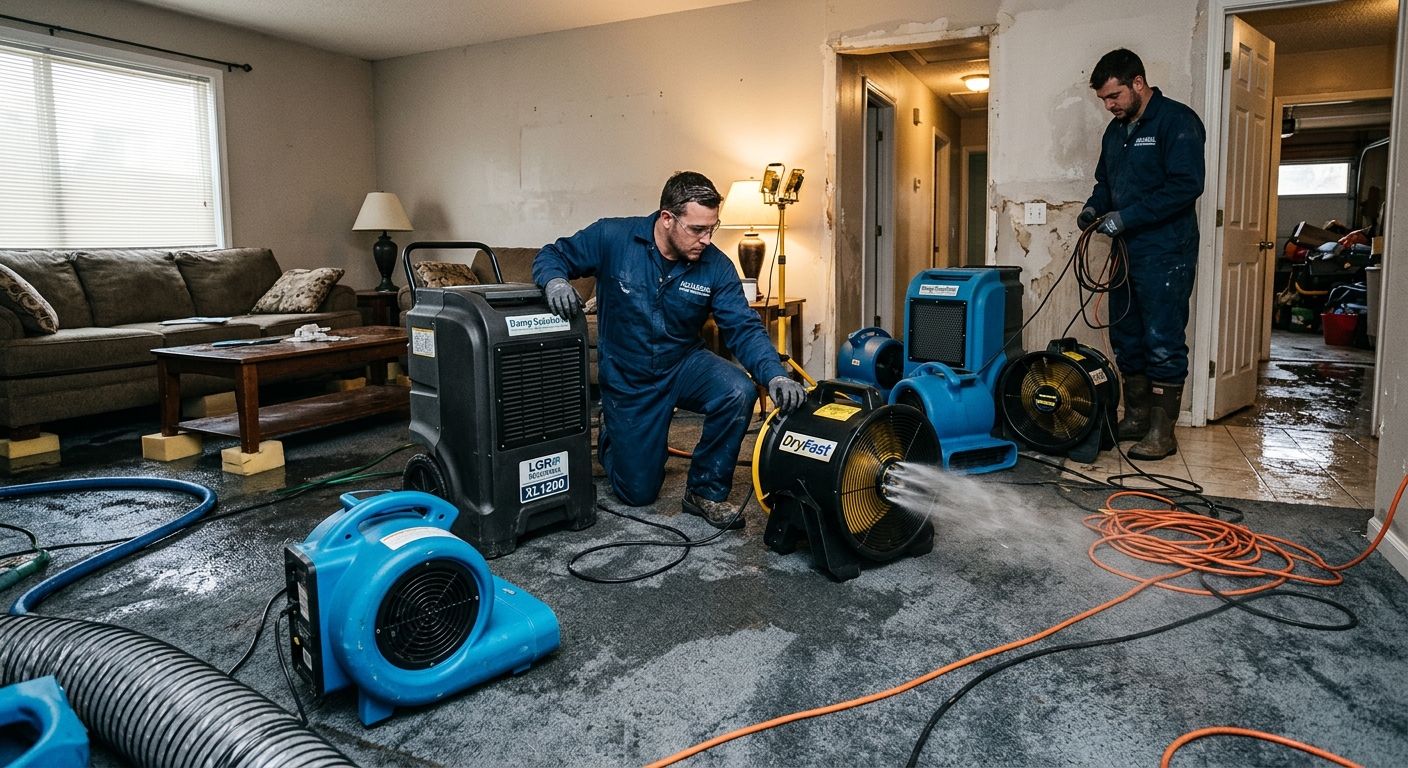
Once extraction is done in a Folcroft home, true restoration begins with the science of drying. Crews should use moisture meters—not just intuition—to map all affected areas, then log readings for each room and material every day. These written logs are your record that things are drying to standard and that mold conditions aren’t present.
Air movers (which look like sideways fans) are placed to move water out of surfaces. Low-Grain Refrigerant (LGR) dehumidifiers then pull the vapor out of the air—essential in our humid Delaware County summers and during spring storms when outside air is saturated. Equipment runs 24/7 for three to five days because even a few hours off overnight lets wet walls and floors rebound, especially with our 4,800 heating degree days and sticky July nights.
Crew visits are daily, not just on drop-off and pick-up. They’re there to check equipment placement, record new moisture readings using calibrated meters, and adjust if progress stalls—if not, you’re “hoping to dry,” not drying to target.
Your practical check: Ask for the daily moisture logs. Any Folcroft crew unable to show logged numbers probably didn’t measure, and you can’t trust a drying job you can’t document. The real finish line is not just time—the drying goal is a specific, accepted moisture content for each material. Insist on proof, not just a feel or “it seems dry.”
Category 3 cleanup in Folcroft
Sewage backups—known in the industry as Category 3 water events—aren’t just smelly water. They are biohazard incidents, requiring head-to-toe PPE, full containment to isolate the affected space, and legal disposal of anything porous (carpet, drywall, padding), regardless of whether it feels salvageable. Nothing soft can be “just sprayed.” Everything gets treated, removed, bagged, and documented for your records and insurer.
In Chester City and some Folcroft addresses, combined sewer overflow is a chronic risk due to documented issues under the Delaware County Regional Water Quality Control Authority (DELCORA). That makes this a community-wide public health threat, not a rare accident. If you’re in a backup-prone area, install a main drain backflow valve ($850–$2,000); cost-sharing for this isn’t standard with local utilities, so it’s homeowner’s responsibility to pay for installation.
If sewage has entered any living area, everyone should be out until the space is cleaned and ventilated. Cleanup with full protocol (demolition, disinfection, deodorization, and clearance) in Folcroft costs $2,400–$11,500, depending on area and finish level. Don’t risk safety—or your claim—by skimping with general cleaning instead of a certified crew.
Frequently asked questions — water damage restoration in Folcroft
Will my premium go up after a water damage claim?
Insurance in Folcroft—and Pennsylvania broadly—almost always tracks paid water loss claims, especially those over $3,800 for typical extraction jobs. If this is your first homeowner claim, you may not see a change, but multiple or repeated water damage claims from the same property usually result in premium hikes or even non-renewal. Since Delaware County has old plumbing stock, insurers watch for homes with frequent interior leaks. Don’t hide honest losses, but do invest in preventative work (new supply lines and leak sensors) after any claim to show your insurer you’re lowering future risk. In some cases, water loss claims will stay on your property’s record (CLUE report) for up to five years.
What water damage can I safely handle alone?
In Folcroft, if you catch a clean water spill early—like a small supply line drip on hard flooring—immediate mopping and running fans is usually enough. Removing wet area rugs or minor carpet patches is common and doesn’t require a permit in Springfield Township for small, contained incidents. But if water seeps into drywall, insulation, or any finished basement area (as common with our 1920–1950 stock), or if anything smells musty or covers more than 10 square feet, it’s safer to call for help. Mold, Category 2 or 3 water, and anything that soaked in for more than 24–36 hours should be left to certified pros. If you’re unsure, call for professional moisture mapping (typical $950–$6,800 for drying only) rather than miss damage in wall cavities.
Should I call my insurer or a restoration company first?
In Folcroft, with local crews based in-county, you’re better off calling a restoration company as soon as you detect damage—especially after hours or on weekends. Each hour matters for both drying and safeguarding your insurance claim; most policies expect “reasonable and timely mitigation.” Make sure to document everything—photos, receipts, technician names—and then contact your insurer with this evidence as soon as practicable. Restoration bills commonly fall between $1,150–$7,200 for extraction and drying, so front-line crews know what documentation adjusters want to see. However, if you have a preferred or required vendor through your insurer (ask when you call), it may affect claims processing. Act fast but document every interaction.
What does mold remediation cost in Folcroft?
Mold remediation in Folcroft runs from $1,450–$10,000, with most jobs landing around $5,800 for typical removal with containment and clearance testing. Older homes here—over 91.9% built before 1980—tend to have hidden pockets of growth behind paneling or plaster, especially if leaks went undetected after a basement incident. Remediation pricing reflects not just removal but setup of contained negative-pressure work zones, HEPA filtration, and air quality clearance tests before re-occupancy. Don’t pay extra for “sealing sprays” or ozone treatments; those are cosmetic and don’t address the source. Get a firm written scope before any removal, and make sure you see a clearance report at the end.
Why is water damage priced per square foot?
In practice, most restoration companies in Delaware County, including Folcroft, estimate drying and removal costs based on the affected square footage and material type. A larger wet area takes more equipment (air movers, dehumidifiers), more crew labor, and more time to monitor and log daily readings. For example, restoring a 1,200-square-foot finished basement with waterlogged drywall is a different scale (and cost: up to $6,800 for structural drying only) compared to a 40-square-foot laundry leak. Per-foot costs make it easier to compare bids and justify equipment counts to your insurer. That said, line-item charges should match the total scope you see in the proposal, not just a flat rate with no explanation.
How do I verify a restoration contractor's insurance?
Before you let any crew start work in Folcroft, always ask for a certificate of insurance that lists both general liability and workers’ compensation—for both the company and any subcontractors. The policy should specifically name your property address; “in-hand” means more than a generic photo on a phone. Pennsylvania maintains workers’ comp records in the WCAIS system (wcais.pa.gov), which anyone can access to confirm active coverage. HIC registration is a separate requirement, but it does not guarantee insurance is in effect. For losses over $1,150, it’s not enough to trust a business card. If you have questions, call the number on the policy for direct confirmation.
Does homeowner's insurance cover water damage in Folcroft?
Typical homeowner’s policies in Folcroft cover sudden, internal water events—burst pipes, supply line failures, and even failed water heaters, assuming you report and mitigate quickly (extraction and drying: $1,150–$7,200). What’s not covered is “flood” water that enters from the outside, such as through basement windows following Delaware River or Chester Creek overflow. Flood insurance is a separate purchase with a waiting period and is not included in most policies. Any damage reported as a result of overland water or sewer backup from public lines may only be covered under extra endorsements or rider coverage. It pays to check your policy and understand where exclusions apply before a storm season begins.
How does southeastern Pennsylvania's climate affect drying times?
In southeast Pennsylvania—and Folcroft in particular—a mix of humid summers and moderate freeze-thaw cycles means drying times can swing based on the time of year. Our area logs around 4,800 heating degree days (cold) and 1,450 cooling degree days (humid), so moisture removal is typically harder in July, August, and after coastal remnants. Outside humidity slows vapor removal, forcing dehumidifiers and air movers to work harder for those 3–5 day restoration cycles ($950–$7,200). In winter, unheated spaces slow to dry but may avoid some secondary mold if well ventilated. Ask your technician how local dew point and temperature readings affect the current cycle’s timeline.
How long does water damage drying take in Folcroft?
The typical water extraction and structural drying process in Folcroft runs 3 to 5 days, although more extensive jobs—especially in below-grade basements or with widespread drywall—can stretch beyond a week ($950–$7,200 for drying phase). Equipment stays in place and running around the clock; stopping it at night or unplugging units (even if noise is annoying) allows moisture to rebound in old framing and plaster. Daily professional monitoring is not just a best practice, it’s the standard your insurance adjuster expects. If conditions are especially humid or cold, your technician may add extra days to hit a safe “dry standard” that they’ll document in writing before equipment is removed.
What is the difference between water damage class and category?
In Folcroft and across Pennsylvania, “class” refers to how much of the area and material is wet—Class 1 is small and minimal, while Class 4 covers wetness in dense or complex assemblies (think saturated masonry basement walls). “Category,” on the other hand, means the type and source of water: Category 1 is clean (supply line bursts), Category 2 is mildly contaminated (dishwasher or washing machine leaks), while Category 3—common with sewer backups in Chester City’s combined system—is grossly contaminated and poses health risks. Pricing follows category: Category 1 extraction and drying might run $1,150–$7,200, while full Category 3 sewage cleanup can land at $2,400–$11,500. Know this distinction to judge both risk and cost.