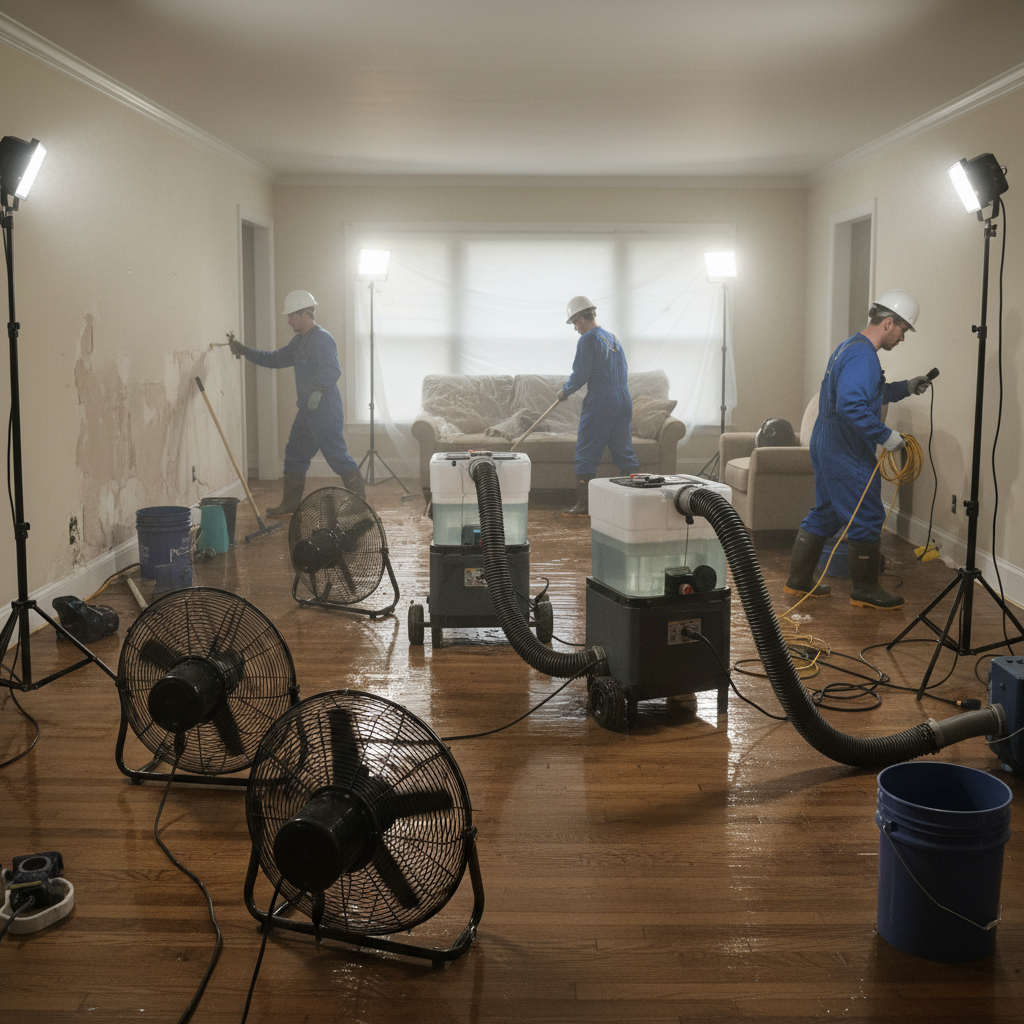
Dingman water damage pricing by scope — 2026
If you’re reading this from Dingman with water underfoot, you need realistic pricing, not marketing. Pike County’s homeownership rate is high and the vast majority of homes are single-family (U.S. Census Bureau, ACS 2024), meaning the water loss usually affects significant square footage, not just a small corner. Much of Dingman Township’s housing stock comes from the Poconos boom years of the 1970s through 1990s. Many of these homes rely on older well systems and pumps—prime candidates for failures that lead directly to flooded basements or crawlspaces.
This combination shapes how restoration jobs run here. Finished basements are common and water intrusion below grade is rarely a quick mop-up. Common scopes include emergency extraction (for clean water events like burst pipes or failed pumps), structural drying (if water sat for days), and full mold remediation if the problem lingered or began in July’s humidity. If sewage is involved, protocols are stricter and disposal costs drive the price up. Here’s what you can expect in Dingman:
| Service |
What it covers |
Typical duration |
Price range |
| Water extraction + emergency drying (Cat 1) |
extraction, air movers, LGR dehumidifiers, daily moisture monitoring |
3–5 days |
$1,250–$7,900 |
| Structural drying only (post-extraction) |
drying to standard after water is already out |
3–5 days |
$1,050–$7,400 |
| Mold remediation with containment |
containment, HEPA filtration, removal, antimicrobial, clearance test |
3–7 days |
$1,600–$11,000 |
| Sewage backup cleanup (Cat 3) |
biohazard protocol, disposal of porous materials, disinfection |
2–5 days |
$2,600–$12,500 |
| Emergency board-up / tarping |
stop further water entry, secure the structure |
same day |
$350–$900 |
Estimates for a typical Dingman home. Category, affected area and how long the water sat move these figures more than anything else.
Equipment, monitoring and drying standards
Professional water damage drying in Dingman means more than plugging in fans. It starts with moisture mapping: locating all affected areas using moisture meters, not just what feels damp by hand. Each day, those readings should be logged—by room, by material, including baseboards and wall interiors. If a crew can’t show you their daily moisture logs, they may not be measuring at all.
The real work is done by air movers, which circulate air to evaporate water from surfaces, and low-grain refrigerant (LGR) dehumidifiers, which remove moisture from the air. Both must run non-stop: shutting them down at night slows or reverses drying, especially with Dingman’s high heating degree days and ample indoor/outdoor temperature swings. The region’s long winters (design temp: 4 °F) can hinder evaporation, so contractors adjust equipment and monitor dew points accordingly for maximum effect.
A drying goal isn’t a guess—it's a documented target, usually matching unaffected material moisture content (often 10–15% for wood subfloor or under 16 points for drywall). Equipment stays until those readings are met across the affected areas. Don’t be swayed by drama: ask to see the documented logs, especially for basements with multiple materials and hidden cavities. Competence displays in clear data, not how many machines they drag in your door.
Finished basements and water damage in Dingman
In Dingman and the surrounding Pike County townships, full basements are nearly standard due to the Poconos slope. This means most water losses run below grade, where the physics change—a finished basement has no gravity drainage, except for a working sump, and faces higher hydrostatic pressure against its walls, particularly with Northeast Pennsylvania’s 40 psf snow load and deep 36-inch frost depth locking water against the foundation in spring.
The chief cause here is sump pump failure—either from power cuts, an overwhelmed unit, or an aging well system that just gives out. I always recommend a battery backup sump if your main living space is even partly below grade. In a finished basement, even a few inches of standing water can double the restoration scope: drywall must be cut and removed (at least two feet up), insulation and baseboards disposed, and behind every wall, framing must be checked with a moisture meter, not assumed dry by touch. Unfinished basements are simply faster and cheaper to remediate, since exposed surfaces and lack of insulation remove demolition from the equation. If you have carpet, tack strip, or built-in shelving, those materials act as hidden reservoirs long after visible pooling is gone.
Mitigation, then reconstruction: two different timelines
It’s common in Dingman for homeowners to feel abandoned after the fans and dehumidifiers leave. This gap isn’t neglect—it's that water mitigation and reconstruction are entirely separate phases. The mitigation crew deals with extraction, drying, and immediate mold or sewage threats, often direct-billed to insurance and finished within a week. But reconstruction (replacing drywall, flooring, or electrical) is subject to permits, material sourcing, and contractor availability.
Pike County is a thin rural market; most firms are dispatched from Scranton–Wilkes-Barre or East Stroudsburg. Once mitigation ends and containment is removed, weeks—sometimes longer—can pass before a reconstruction team is scheduled, especially during widespread flooding. Reconstruction is a separate contract and often a different crew altogether. Prepare for this lull; use the time to select your rebuild contractor, review estimates, and confirm permitting if you’re in Milford Borough or planning structural repairs.
What a Pennsylvania restoration contractor must actually hold
Pennsylvania does not license water damage restoration or mold remediation contractors at the state level. An impressive card or logo can mask the absence of any real oversight. The de facto industry standards are IICRC S500 for water restoration and IICRC S520 for mold; ask your lead technician to show you their personal IICRC certification card—not just a company logo. For contracts over $500, contractors must hold Pennsylvania Home Improvement Contractor registration (verify at hic.attorneygeneral.gov) and provide a written contract under the Home Improvement Consumer Protection Act (HICPA), including a 3-day right of cancellation. It is illegal for contractors to waive a homeowner’s insurance deductible.
No permit is required for basic water extraction and drying in most Pike County townships, but if demolition opens walls, touches electrical or structural elements, expect a permit in Milford Borough and for larger structural jobs elsewhere. All employers in Pennsylvania must carry workers' compensation insurance—verify via WCAIS (wcais.pa.gov). Before work starts, insist on a written scope, price, valid HIC registration number, and proof of insurance. A handshake isn’t enough protection here.
Dingman's housing and its water damage profile
Dingman Township’s homes largely stem from the 1970s–1990s Poconos growth wave, with just under a third built pre-1980. That means drywall is the rule, not plaster, and most drains will be PVC, not cast iron. Water supply lines from this era—especially first-generation plastic like polybutylene or older copper—are reaching typical end-of-life, and failures increasingly start inside the walls, not at exposed joints. Water heaters from the late 1990s are well past due; ruptured tanks cause large losses with little warning.
Demolition in newer stock is usually faster since materials are uniform, but drying can be slowed by foil-backed insulation and tight finishes common in 1990s basements. Full basements prevail, so water events rarely end at the floor—they wick into baseboards, drywall, and framing. In a 1970s house, you may also find partial or full slab-on-grade portions, which dry slower and trap water beneath flooring. If your home falls in that late-20th-century wave, you’re not at less risk—just facing a different breed of failures and scope of needed restoration.
Dingman's flood exposure and what it means for coverage
Dingman sits amid rivers like the Delaware, Lackawaxen, and Shohola Creek—these aren’t just scenic, they’re the source of most regional flood risk. If your address is anywhere near these waterways, you could be in a designated flood zone, which matters for your coverage: standard homeowners policies do not cover flooding from surface water or rising river levels, no matter how similar the damage looks to a burst pipe.
Flood insurance is a separate purchase, with typical 30-day waiting periods before activation, so you cannot buy coverage after a flood warning is announced. The house and basement may appear identical whether they’re full of river water or burst-pipe blue, but the claims adjuster will treat them as night and day. Flood losses often require proof of flood zone status and different documentation; adjusters look for soil lines and other markers, not just extent of damage. If your property is even on the edge of the mapped floodplain, talk to your agent about your actual risk—waiting until you see the river rise is too late.
Frequently asked questions — water damage restoration in Dingman
Does insurance cover mold after water damage?
Insurance coverage for mold in Dingman typically depends on how the mold formed. If the mold results from a covered water loss—like a sudden pipe burst or washing machine line failure—most homeowners’ policies provide some level of coverage for mold remediation, though caps are common and exclusions may apply if the homeowner delayed reporting or addressing the water. If mold develops over weeks or is tied to a maintenance issue (like chronic sump pump failure), insurance will often exclude it. Additionally, if your home has history of water intrusion from the Delaware River or local creeks—sources not covered under standard homeowners insurance—mold resulting from that type of flood loss is also excluded unless you have a separate flood policy. If covered, mold remediation with containment here typically runs $1,600–$11,000, depending on scope.
How much does a flooded basement cost to restore in Dingman?
In Dingman, with full basements being common, a typical dry-out after a basement water event (Category 1 clean water, with moderate finishes affected) lands between $1,250–$7,900. If water sat for days and mold emerged, remediation can climb to $1,600–$11,000. Sewage-affected losses (Category 3) cost more due to required demo and disposal, with typical jobs at $2,600–$12,500. Finished basements with drywall, insulation, and built-ins push up both labor and drying time—so the same inch of water in a finished versus unfinished space can double your costs. If your basement doubles as living or bedroom space, assume on the higher end.
Why does plaster take longer to dry than drywall?
Plaster, found in a minority of Dingman homes built before 1980, is much denser than drywall—holding more water per square inch and releasing it much more slowly. Drying plaster requires both more time and larger-capacity dehumidifiers, especially in Poconos basements with high humidity and limited air movement. Plaster walls may look and feel dry on the surface but remain saturated inside, prolonging the process and raising risk of mold behind the walls. Drywall, by contrast, can often dry in 3–5 days if caught quickly. Treating walls correctly by material saves money—most jobs here end up $1,250–$7,900 if demolition is avoided, but stubborn plaster can prolong drying and increase the scope.
What is an assignment of benefits and should I sign one?
An assignment of benefits (AOB) is a legal agreement giving your restoration contractor the right to deal directly with your insurance company and receive payment on your behalf. In Dingman, and all of Pennsylvania, AOBs are less common than in hurricane-prone states, but some contractors may push for them, especially for larger water or mold losses in the $2,600–$11,000 range. While this can speed up payment, it also means you give up direct control over some decisions and claim communications. Only sign an AOB if you fully trust the firm, understand the contract, and verify their registration and insurance. There are legitimate uses, but never sign under pressure or before reading all terms.
How long does water damage drying take in Dingman?
Most water loss drying jobs in Dingman wrap up in 3–5 days, provided the contractor uses enough air movers and dehumidifiers and property access is not an issue. Structural drying alone for less saturated materials falls between $1,050–$7,400 and also typically takes 3–5 days. Basements with insulation, behind drywall or paneling, and losses that sit for more than 48 hours extend this window—mold remediation then adds several more days. Cold seasons stretch drying times further, as evaporation slows when outside dew points drop. Your best indicator: if your contractor provides daily moisture logs showing steady readings trending down, things are on track.
Why is water damage priced per square foot?
While many restoration contractors in Dingman present flat-range estimates, the actual work—extraction, drying, demolition, monitoring—is usually calculated by affected square footage. More square feet means more equipment needs, labor, and materials (think baseboard, drywall replacement, insulation removal). Each increment multiplies costs: a 500-square-foot finished basement costs less than drying 1,100 square feet with multiple rooms. That’s why estimates in this region range from $1,250–$11,000 for water and mold jobs. Per-square-foot pricing ties the estimate directly to your loss’s reality, so avoid anyone whose quote is vague about the area covered.
How long before mold starts growing?
In Dingman, with moderate to high summer humidity, mold growth can begin in as little as 24–48 hours after water intrusion—especially in below-grade spaces with limited airflow. Even a small leak behind drywall or near a sump can quickly escalate if left unaddressed. Repairing or extracting within this window keeps jobs in the lower $1,250–$7,900 range. If the water isn’t mitigated inside two days, costs rise rapidly due to the need for containment and removal. Fast action is the difference between simple dry-out and full-scale mold remediation.
How does northeastern Pennsylvania's climate affect drying times?
Dingman sits in a climate with 6,100 heating degree days and an outdoor winter design temperature of 4°F. This means your interior spaces are often far drier in winter, but the temperature differential and condensation risks demand careful monitoring for secondary damage. Evaporation is slower in colder weather, and snow load against foundations keeps groundwater pressing in. In summer, high humidity can stretch the timeline. Expect the average 3–5 day window to edge longer for below-grade and cold weather events; using the proper ratio of air movers to square footage keeps costs within a typical $1,050–$7,400 range for drying.
Can a contractor waive my deductible in Pennsylvania?
No, and be wary of anyone who offers this in Dingman or anywhere in Pennsylvania. The Home Improvement Consumer Protection Act (HICPA) is clear: waiving an insurance deductible is prohibited and can put your claim and contractor both at legal risk. It may sound like a deal, but the risk is on you. A legitimate contractor will clearly present the deductible as your responsibility and write it into the contract. For lawful, covered water extraction and drying, expect your share to range from $1,250–$7,900, less your deductible—not eliminated by the contractor.
Is a shop vacuum enough for standing water?
For small, clean spills in open areas, a wet-dry shop vacuum can work—but Dingman losses often involve full basements, carpet, padding, or water behind finished walls, especially from pump failures or aging wells. These materials trap water that a shop vac can’t reach. Professional extraction uses truck-mounted or high-capacity portable units, then LGR dehumidifiers and air movers to remove trapped moisture. Relying on home tools may save money on small jobs, but when the scale moves past a couple gallons, professional service—which starts at $1,250–$7,900—prevents long-term damage and mold. If you try DIY, monitor for musty smells and visible mold; if in doubt, call a pro for a free or low-cost assessment.