What water damage restoration costs in Bensalem
If you’re searching for water damage restoration prices in Bensalem, there’s a serious chance you’re facing an active water emergency in your home right now. Costs here are shaped by the area’s unique housing stock and the age of its infrastructure. Over 65% of homes in Bensalem were built before 1980 (U.S. Census Bureau, ACS 2024), and many are part of the Levittown-era subdivisions that dominate lower Bucks. These homes see higher rates of aging plumbing failures and basement water intrusions—recurring issues that push water damage rates above what’s typical in newer developments.
In Bensalem, water restoration isn’t a one-size-fits-all affair. Pricing depends on whether your problem is clean supply-line water, a sump pump failure in the basement, or a full sewage backup. Local companies are equipped to provide fast extraction, controlled drying, and content restoration, but factors like the duration of standing water and the area affected make a major difference in price. Sewage backups and visible mold will move you into higher restoration categories fast. Below you’ll find typical ranges for common services in Bucks County:
| Service |
What it covers |
Typical duration |
Price range |
| Water extraction + emergency drying (Cat 1) |
extraction, air movers, LGR dehumidifiers, daily moisture monitoring |
3–5 days |
$1,300–$8,100 |
| Structural drying only (post-extraction) |
drying to standard after water is already out |
3–5 days |
$1,100–$7,600 |
| Mold remediation with containment |
containment, HEPA filtration, removal, antimicrobial, clearance test |
3–7 days |
$1,600–$11,500 |
| Sewage backup cleanup (Cat 3) |
biohazard protocol, disposal of porous materials, disinfection |
2–5 days |
$2,700–$13,000 |
| Emergency board-up / tarping |
stop further water entry, secure the structure |
same day |
$350–$900 |
Estimates for a typical Bensalem home. Category, affected area and how long the water sat move these figures more than anything else.
Filing a water damage claim in Pennsylvania
The way your water loss started shapes everything about your insurance claim. In Pennsylvania—including Bensalem—standard homeowners policies generally cover sudden and accidental water events, such as a burst supply line. However, damage from flooding that enters from outside (like overbank flooding from the Delaware River or Neshaminy Creek) is usually excluded unless you’ve purchased a separate flood insurance policy. Many Bensalem residents discover this gap only after a disaster, so it pays to know your coverage in advance.
Gradual leaks and long-term maintenance issues, such as slow plumbing drips or inadequate sump pumps, are often excluded from coverage. For sewer backups—an issue documented in lower Bucks—coverage typically requires adding a “sewer backup rider” to your policy, which a fair number of households don’t have until it’s too late.
Your payout will depend on whether your policy covers replacement cost (pays for full repair or replacement) or actual cash value (subtracts depreciation). Restoration contractors should offer a scope of loss—an itemized document detailing materials, tasks, and pricing. This is what your insurance adjuster uses to determine payout.
For payment, many Bensalem firms can direct-bill your insurer, or you can sign an “assignment of benefits” so the contractor receives your claim payment directly. If you do this, you grant them the right to negotiate with your insurer on your behalf. Always get a written contract (required by the Home Improvement Consumer Protection Act for any job over $500). Pennsylvania law prohibits waiving your insurance deductible—if a contractor offers this, take it as a red flag, not a deal. It’s a sign they’re operating outside consumer protection statutes, putting your claim and coverage at risk.
The mold clock: 24, 48 and 72 hours
Mold matters more in southeastern Pennsylvania than many homeowners think. Our humid summers and common basement conditions in Bensalem create ideal mold growth environments when water sits, especially in the Levittown-era homes where basements are often finished but lightly sealed. Mold can begin colonizing surfaces within 24–48 hours after water exposure, especially below grade or in areas with poor airflow. Drying quickly isn’t only about salvaging the carpet—it can be the difference between a straightforward dry-out and a full containment job.
If you call for help within that first day, you’re usually in “dry-in-place” territory, and the job may stay in the $1,300–$8,100 band for extraction and drying. Wait past 48 hours, and moisture trapped in walls or beneath flooring may force selective demolition, putting you closer to the $1,600–$11,500 range for mold remediation. After three days of high humidity, mold is often visible and has penetrated materials, so containment, HEPA filtration, and even clearance testing (a documented test proving the area is safe) become necessary. Good firms will provide clearance test results in writing; this protects you when selling or refinancing a property later and prevents disputes over lingering contamination.
Delaying the call is the single biggest factor that multiplies cost in Bensalem—more than the size of the wet area or even the water source itself.
Your belongings after a water loss
Contents are often the “forgotten claim” in Bensalem water losses. Homeowners focus on the structure, but your insurance policy covers contents separately—and you’ll need detailed documentation to get what you’re owed. Restoration firms offer “pack-out” services to remove, inventory, and clean salvageable belongings off-site. Before anything is touched, insist on detailed photographs and inventories. This is your proof for both the insurance adjuster and your own peace of mind.
Typical unsalvageables in Bensalem jobs: any upholstered or particleboard furniture involved in a Category 3 loss (like sewage backup), most mattresses, and lower-end carpets that fully saturated. Hardwoods and heavy solid-wood furniture may be restored if the water was clean and quickly removed. Electronics, artwork, and area rugs are usually evaluated case-by-case; don’t junk high-value items without review.
Take special care distinguishing between contents (your belongings) and structure (walls, floors, cabinets). They’re paid under different policy sections, and adjusters look for clear photos and line-item lists. Even if you’re only budgeting for professional extraction ($1,300–$8,100), invest 30 minutes documenting possessions before crews move anything.
Credentials and permits for restoration work in Bensalem
Pennsylvania does not issue a specific state license for water restoration or mold remediation. In Bensalem, what matters most is proper training and reputable insurance. IICRC certification (specifically S500 for water damage and S520 for mold) is considered the national standard, and you should always ask to see the lead technician’s IICRC card before work starts. Restoration companies must be registered as a Home Improvement Contractor (HIC) with the Pennsylvania Office of Attorney General for any contract over $500—you can verify this directly online.
Permits in Bensalem Township are required if your restoration project involves replacing structural framing or load-bearing elements, not for basic water extraction and drying. If your job is limited to drying and cleanup, no permit is needed; for larger rebuilds, your contractor should pull the necessary permits through the Bensalem Township Building and Planning Department. Always ask for written proof of workers' compensation (checkable through the WCAIS system) and liability insurance before the crew touches anything in your home.
Get a written contract as required by the Home Improvement Consumer Protection Act. A reputable Bensalem restoration contractor will not balk at these requests and will provide all documentation before a single hose is rolled out.
Why below-grade water is its own problem
Full basements are the default in Bensalem and the surrounding Bucks County communities. While they increase storage and living space, they also create the region's most frequent and expensive water damage headaches. Below-grade spaces handle water differently than your main living level: hydrostatic pressure pushes water through cracks and seams, sump pump failures allow rapid inundation, and water doesn’t drain away by gravity—it just sits and soaks.
High soil humidity and our 30-inch frost depth mean that Bensalem basements rarely have dry, ventilated walls in warm seasons. When a sump pump fails (often during a power outage or big summer storm), water can fill a finished basement in minutes. If drywall, insulation, and flooring are involved, the effort and time required to cut, remove, dry and rebuild can easily double compared to an unfinished basement with concrete floors and open joists. Finished rooms hide water behind walls and under flooring, delaying discovery and multiplication of costs. Battery backups for sump pumps are one of the smartest investments for this region’s homes, but still not as common as they should be in Levittown-era stock.
If you can see standing water across carpet or laminate, expect costs to start at $1,300–$8,100, but reach toward the high end if hidden cavities or saturated wall systems are found during demolition.
Mitigation, then reconstruction: two different timelines
The restoration process in Bensalem is really two jobs—one urgent, one not. Mitigation is the emergency phase: extraction, drying, demolition, and cleaning, completed over 2–7 days and often direct-billed to insurance. Reconstruction is everything after the property is dry: repairs, permitting, and rebuilding floors or walls, which can stretch over weeks or even months.
Bucks County is part of a saturated restoration market with crews from Philadelphia and Montgomery County competing for work, which keeps wait times reasonable for mitigation—expect a same-day or next-day response from most firms. But reconstruction is a different story. Permitting, busy trades, and a flood of seasonal claims create a gap between “dry and clean” and “finished repairs.” Homeowners often feel abandoned when the drying equipment is gone and nothing is being rebuilt for a week or more. That lag is routine, not a cause for concern; your file is in line for scheduling, material order, and permit approval. Plan two separate conversations: one for water removal ($1,300–$8,100), another for repair specs and timeline.
Frequently asked questions — water damage restoration in Bensalem
What water damage can I safely handle alone?
If you catch a water leak within the first hour in Bensalem—think a minor overflow in the kitchen or laundry—you can often manage it yourself if it only covers a small, cleanable area on a non-porous surface. Use a wet/dry shop vacuum, fans, and towels to get visible water up, then run a box fan and open windows if outdoor humidity is low. However, older Bensalem homes with finished basements and aging plumbing can hide moisture behind walls and under floors, especially if the incident is larger than a couple square feet or soaking into drywall and wood. Professional extraction and drying start at about $1,300–$8,100. If water touched the electrical system or you think it may be contaminated (like a sewer backup), do not risk a DIY approach in this area—call for help immediately.
Can hardwood floors be saved after flooding?
Whether hardwood floors in your Bensalem home can be saved depends on how quickly you act and the amount of water involved. In many cases, rapid response (within the first 24 hours) makes it possible for professional restorers to dry, dehumidify, and salvage solid hardwood using specialized drying mats. Anticipate the job to run in the $1,100–$7,600 range for structural drying, depending on coverage. If the water sits past 48 hours, or if you've got engineered floors or subfloor swelling (common in Levittown-era builds), removal and replacement become likely. Always insist that the techs check for hidden water under baseboards and between boards—they’ll use moisture meters to confirm. With Bensalem’s variable humidity and older construction, checking under the surface matters as much as drying what you see.
How much does sewage backup cleanup cost in Bensalem?
Cleanup after a sewage backup (Category 3 water) is always more complex and costly than a clean water event in Bensalem. Expect restoration to run from $2,700–$13,000, with the average job coming in around $7,000. That covers extraction, removal of soaked and contaminated materials (often drywall, carpet, and baseboard), disinfection, and negative air containment to control biohazard risks. In lower Bucks, aging infrastructure and documented sewer inflow issues make backup incidents more common—don’t cut corners here. Insist on detailed documentation and a written clearance report before restoring the area to living space.
How much does a flooded basement cost to restore in Bensalem?
Restoration costs for a flooded basement in Bensalem vary—unfinished basements with concrete floors typically start near $1,300, while finished basements, especially those with saturated drywall, insulation, and flooring, can approach $8,100 or higher. The biggest factors: whether your sump pump failed (a common situation in this area’s full-basement homes), how long the water sat, and whether mold or sewage is present. Because most Bensalem homes have finished spaces below grade, even a couple of inches of water can require demolition and full rebuild of walls and floors to eliminate trapped moisture and prevent future mold.
How do I verify a restoration contractor's insurance?
In Pennsylvania—and specifically in Bensalem—ask your restoration contractor for their certificate of insurance before any work begins. This should detail both general liability and workers' compensation coverage. You can independently confirm workers’ comp using the WCAIS system provided by the state. For contracts over $500, Home Improvement Contractor (HIC) registration is also required by law. Never rely solely on a business card or verbal assurance, since neither restoration nor mold remediation require a state license here. This paperwork, plus written proof of IICRC certification, should always be provided alongside your estimate—especially for jobs in the $1,300–$8,100 or higher range.
Are Bensalem basements especially prone to flooding?
Yes—Bensalem and much of lower Bucks County are built atop Levittown-era subdivisions featuring full basements and aging infrastructure. Flooding from sump pump failures, overbank events on the Delaware or Neshaminy Creek, and sewer backups is more common than in newer areas. With over 65% of homes built before 1980 (U.S. Census Bureau, ACS 2024), many basements have minor cracks or older pumps ill-suited for today’s climate extremes. Restoration costs here generally fall in the $1,300–$8,100 band for standard water intrusion, but can escalate if you have deep flooding or finished basements with lots of hidden surfaces.
What equipment should a restoration crew bring?
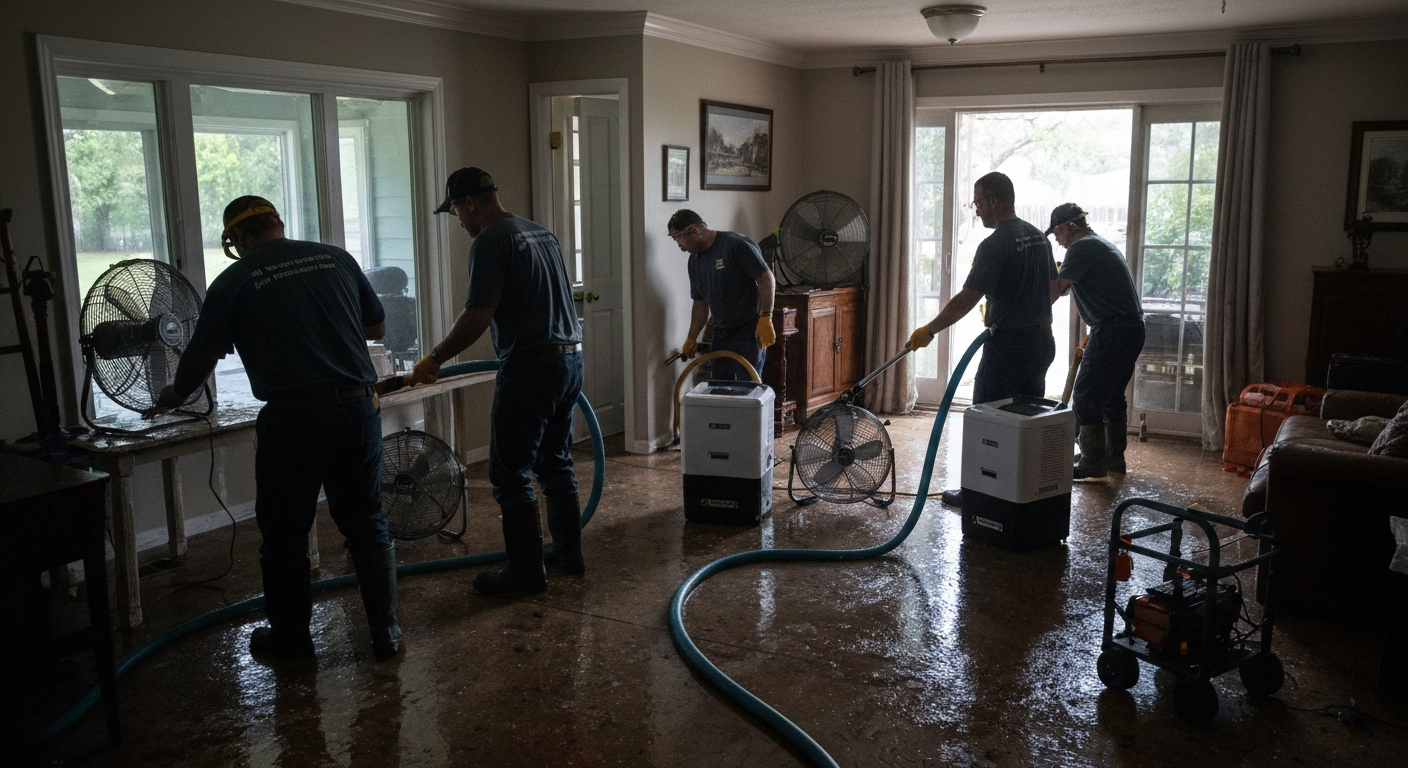
A reputable Bensalem restoration crew will arrive with truck-mounted or portable extraction equipment, commercial-strength air movers, LGR (Low Grain Refrigerant) dehumidifiers, and moisture meters to monitor drying progress. If mold or sewage is present, expect containment barriers, HEPA-filtered air scrubbers, and disinfectant sprayers as well. For structural drying, specialized injectidry or floor-drying mats may be used—vital in homes with hardwood or finished basements. This kind of gear is factored into the typical $1,300–$8,100 (water extraction and drying) or $1,600–$11,500 (mold remediation) price bands. Don’t be shy about asking what equipment they’ll use and how it will address your specific loss.
What should I do in the first hour of a water leak?
First, shut off the main water supply if you can reach it safely—older Bensalem homes often have accessible shutoffs near the foundation or garage. Move small valuables and electronics out of harm’s way, and begin mopping or wet-vacuuming standing water from solid floors if you’re sure the water is clean. Avoid wading into basement floods until you confirm the source isn’t sewage and there’s no electrical hazard. Take photos of everything before moving items or beginning cleanup—these images will be crucial if you file a claim, especially for proving contents loss under your policy. Fast action helps keep restoration costs at the lower end of the $1,300–$8,100 range and can prevent escalation to mold remediation levels. Call a professional for any water you can't fully access or dry within a few hours.
Will my premium go up after a water damage claim?
Most insurance companies in Pennsylvania, including those writing policies in Bensalem, can raise your premium after a water damage claim—especially if the cause is preventable, such as failed maintenance or repeated sump pump loss. A single, sudden event (like a burst pipe) may result in a modest increase, but if you have multiple claims in a few years, your rates may jump or your policy may not be renewed. The actual impact varies by insurer, your policy type, and your claim history, but it’s not unusual for premiums to rise after payouts in the $1,300–$8,100 or higher band. When in doubt, talk candidly with your agent about your options before filing.
What if the insurer's estimate is lower than the contractor's?
It’s not rare in Bensalem for your insurance adjuster’s estimate to come in lower than your contractor’s bid, especially with older homes where hidden damage is common. The typical path: share both the contractor’s detailed scope (outlining work and costs, such as $1,300–$8,100 for extraction and drying) and any extra findings with your adjuster. Most insurers will reconsider if provided with documentation—photos, moisture mapping, and third-party estimates. Don’t authorize work beyond approved scope unless you can afford to pay the difference, but don’t accept an insufficient settlement either. You can request a reinspection or hire a public adjuster if negotiations stall. In Bensalem, with the large number of seasoned restoration firms, adjusters are used to negotiating claims where hidden damage is a proven factor.