Baldwin water damage pricing by scope — 2026
If you’re facing a water loss in Baldwin right now, you’re not alone—and early numbers may matter more than explanations. With 84.2% of Baldwin homes built before 1980 and a 76.0% homeownership rate (U.S. Census Bureau, ACS 2024), it’s not unusual to see pipe bursts or water seeping through basement masonry, especially in older neighborhoods where wet basements and supply failures are routine. Here’s what to expect for repair costs in Baldwin: A full water extraction with drying usually falls in the mid-$3,800 range, but larger or long-standing losses can run to $7,400 or more. Mold complications or sewage backups cost more, especially if the water sits for several days or affects finished lower levels.
| Service |
What it covers |
Typical duration |
Price range |
| Water extraction + emergency drying (Cat 1) |
extraction, air movers, LGR dehumidifiers, daily moisture monitoring |
3–5 days |
$1,200–$7,400 |
| Structural drying only (post-extraction) |
drying to standard after water is already out |
3–5 days |
$1,000–$6,900 |
| Mold remediation with containment |
containment, HEPA filtration, removal, antimicrobial, clearance test |
3–7 days |
$1,450–$10,500 |
| Sewage backup cleanup (Cat 3) |
biohazard protocol, disposal of porous materials, disinfection |
2–5 days |
$2,500–$12,000 |
| Emergency board-up / tarping |
stop further water entry, secure the structure |
same day |
$350–$900 |
Estimates for a typical Baldwin home. Category, affected area and how long the water sat move these figures more than anything else.
Vetting a contractor when you have no time
In Allegheny County’s dense market, quick response is real—restoration crews can reach a Baldwin address within an hour because many are based in or just outside Pittsburgh. This availability is a benefit when water is pouring through the ceiling. But it also means you have your choice, not just the first ad or the one with trucks in your driveway. If you can’t get three bids, your job is to verify three things on the phone: 1) Home Improvement Contractor (HIC) registration—every job over $500 legally requires it; 2) proof of current liability insurance and workers’ compensation; and 3) local experience with homes built pre-1980—older structures require different drying and contain more hidden trouble.
Before a crew sets up fans: 1) demand a contract in writing that describes the scope, 2) check HIC registration at the state website (it’s public) and 3) make sure you see certificates of insurance with your address named as certificate holder. Written paperwork—and only paperwork—protects both sides. Don’t go by a clipboard or a logo van.
- HIC registration number on the agreement
- Current certificate of liability insurance
- Proof of workers’ compensation insurance
- Recent local customer references
- Physical business address, not just a PO box
- Clear written scope of work and estimated charges
- No blank fields or blank-page work authorizations
- Start and completion timelines in contract
- Change-order terms, if extra work is found
- EPA Lead RRP certification (for pre-1978 homes)
The worst pressure tactics: crews trying to start setup (“to limit damage”) before you sign a contract, presenting documents with scope left blank, or pushing for a signature on a single-page work authorization without a full estimate. Don’t let anyone unload until paperwork matches what you agreed.
The mold clock: 24, 48 and 72 hours
In Baldwin’s climate, where winter humidity gets trapped in basements and hilly terrain channels runoff, the timeline from water to mold is short. Generally, the risk starts after 24 hours. If water remains in carpeting, drywall or contents past that, you’ve moved from manageable drying to potential colonization. At 48 hours, you’re facing real risk that spores will begin to root—especially in those pre-1940 basements or on contents pressed against a foundation wall.
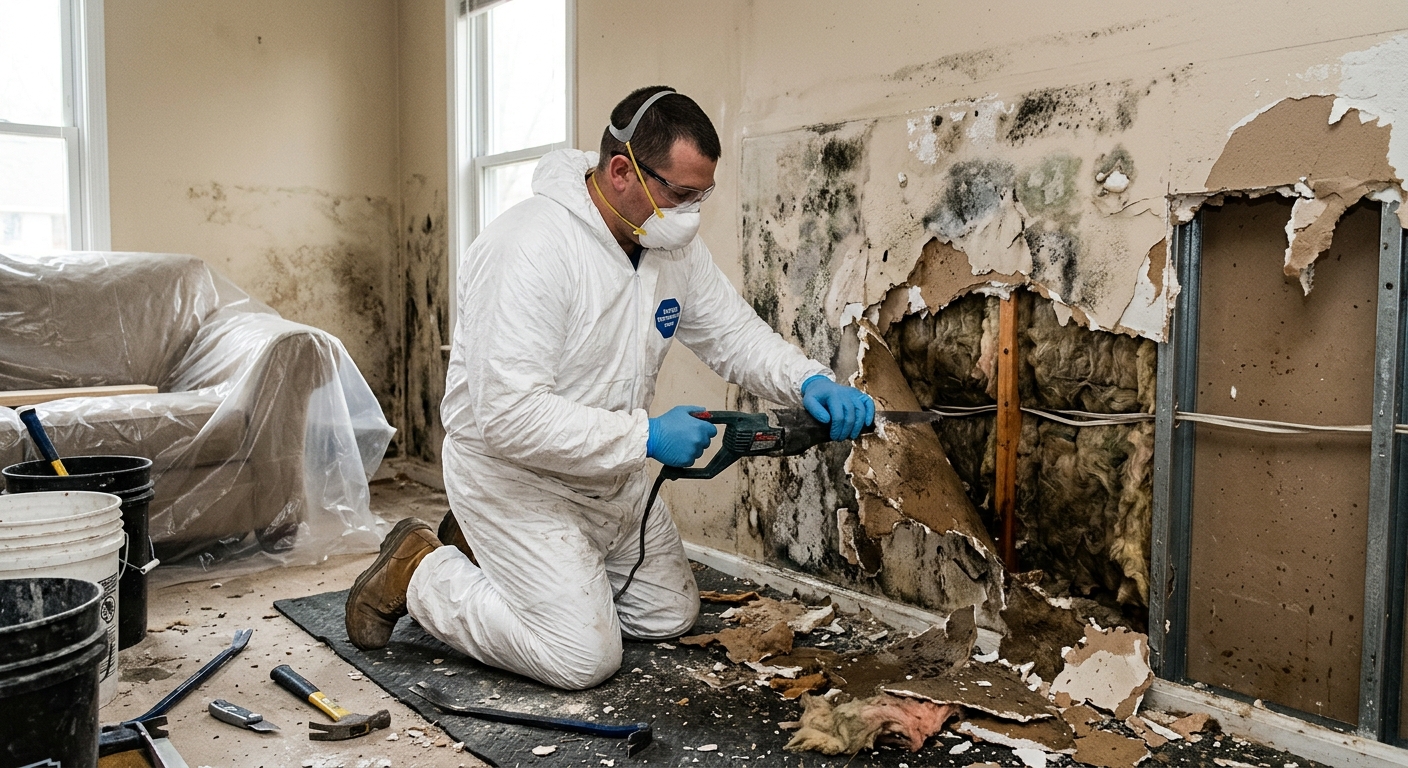
Once you pass 72 hours, your claim cost and scope usually leap. Now, not only will drying and extraction (quoted $1,200–$7,400) be needed, but selective demolition and mold remediation protocols (which can run $1,450–$10,500) are almost certain. At this stage, clean-up means professional containment—plastic barriers built to standard, with every remediator in full PPE, and all air exhausted through HEPA filter units. Anything non-structural that can’t be safely dried is removed.
Clearance testing is a must. This should be performed by a third party—not the same company that did the cleanup—to document that airborne spore counts are back down to normal historical baseline. Always require your clearance results in writing before any repair crew touches new materials or closes up walls. It’s not just about health; without this, your insurer may not release final funds.
Credentials and permits for restoration work in Baldwin
Pennsylvania, including Baldwin, does not require a state-issued trade license for water damage restoration or mold remediation. Restoration is governed by industry standards—primarily, IICRC S500 for water and S520 for mold—not by a state board. This means a business card or company polo shirt tells you little about competence. For a real credential, ask to see your lead technician’s IICRC card on arrival; responsible firms carry them.
Permits in Baldwin are not typically required for water mitigation (drying, extraction, cleaning) unless the job involves structured repairs affecting framing or load-bearing elements—then regulations, especially in Pittsburgh, may kick in for reconstruction. You won’t need a permit for carpet extraction or drying in most boroughs, but you will if repairs involve rebuilding part of a wall or stairs. Always check with your local borough office to confirm whether your particular scope triggers the need.
To verify worker protections, insist on seeing certificates of insurance and workers’ compensation. In Pennsylvania, employers must carry this and you can independently verify coverage via WCAIS (wcais.pa.gov). Before extraction starts, get a signed written contract (not a work authorization form) clearly listing services, payment terms, HIC number, and your right to cancel within 3 business days as required by law.
Contents: pack-out, cleaning and what you can claim
After a water loss, the contents side of a claim is where most homeowners in Baldwin leave money on the table. “Contents” means everything not nailed down: furniture, electronics, clothing, area rugs, and sentimental items. The right move is to photograph every room, from four angles, before anything is moved. Your insurer will want a detailed inventory (model numbers, brand, date, rough value) for every packed-out item going off-site for cleaning.
Restoration pros will pack, barcode, and haul salvageable items to a warehouse for drying and cleaning, using ultrasonic tanks or specialized drying chambers. Upholstered furniture exposed to floodwater or Category 3 raw sewage is almost never salvageable—and neither are most particleboard items or mattresses. Hardwood, leather, metal, and area rugs fare much better and are often worth cleaning, especially if losses are caught within 24–48 hours.
Remember: contents (personal property) is covered under a different line of your policy from structural (walls, cabinets, built-ins). Be scrupulous with your documentation and list every loss before agreeing to any disposal, since most policies only reimburse what’s recorded. Don’t let a crew toss anything until you and your adjuster agree on its final status.
Filing a water damage claim in Pennsylvania
The single costliest insurance trap in Pennsylvania is the difference between a suddenly burst pipe (covered) and groundwater flooding in from the yard (not covered). A standard home policy will pay for Category 1 water from a failed supply line but excludes surface flooding unless you carry a separate flood policy. Many Baldwin residents discover this only after a big rain or a sewer backup forces them to read the fine print.
Gradual leaks—like slow-dripping pipe joints or long-term seepage—are almost always excluded as “maintenance,” and won’t trigger a claim. In areas with combined sewers (as many Pittsburgh Water and Sewer Authority neighborhoods have), a sewer backup rider costs extra; without it, claims for backflow from storm events may be denied.
Actual cash value (ACV) means you get paid what your contents or building materials are worth today, not the cost to buy new (replacement cost, or RC). If you have ACV, expect deductions for age and wear. “Scope of loss” is a detailed, written breakdown prepared by your adjuster, which sets the maximum the insurer will pay per line item—study it before signing any contract.
Direct billing and assignments of benefits mean the contractor may seek payment directly from the insurer, but you’ll still need to authorize all work in writing. The Home Improvement Consumer Protection Act (HICPA) requires a written contract for any job over $500 and gives you a 3 business-day right to cancel. Anyone offering to “waive your deductible” in Baldwin is both violating state law and putting your claim at risk—a legitimate pro never makes that pitch.
What a sewage loss requires
Sewage backup cleanup is a different animal than general water extraction, especially in Baldwin where aging combined sewers make recurrent backups a neighborhood issue. This isn’t just water with an odor—raw sewage is a Category 3 biohazard. Any affected porous material—carpet, pad, upholstered furniture, drywall, insulation—must be removed and disposed of, even if it looks mostly dry. Nothing you can spray or dry will return it to safety standards.
Crews should arrive in full PPE: gloves, Tyvek suits, eye protection, and respirators, using sealed containment barriers and HEPA filtration to stop cross-contamination. Industrial disinfectants and deodorizing agents are mandatory, and no one (family or pets) should enter the affected zone until final clearance is received. Costs for proper cleanup by protocol in this market run $2,500–$12,000 depending on scope.
With a history of basement backups tied to the city’s infrastructure, Baldwin homeowners are wise to ask about municipal programs or cost-sharing for backflow valves—these aren’t universal, but some stormwater divisions do offer rebates for installing them on private lines after multiple reported losses. For prevention, backflow valves are a good investment, and insurance may even discount your premium if one is in place.
Frequently asked questions — water damage restoration in Baldwin
Are Baldwin basements especially prone to flooding?
Yes, Baldwin basements are at higher risk for several reasons you won’t find everywhere else. Many homes here were built before 1940 and sit on full masonry foundations along hilly terrain. That, combined with underlying clay and shale, leads to more groundwater seepage. Heavy freeze-thaw cycles and the proximity to the Allegheny, Monongahela, and Ohio rivers raise local water tables and can overwhelm both modern sump systems and old drains. Because of this, basement water extraction and emergency drying jobs in Baldwin routinely fall in the $1,200–$7,400 band—often triggered by just one night of rain or a failed sump.
Is a shop vacuum enough for standing water?
If you catch a small, fresh spill (especially clean water in a laundry or kitchen) and have the right equipment, a shop vacuum may handle a few gallons on hard floors. But Baldwin homes, with their older basements and frequent carpet or finished area impacts, usually need more. Shop vacuums can’t dry out wall cavities or reach moisture in subfloors, and cannot provide the air movement or dehumidification needed to prevent mold after 24–48 hours. For anything larger than a puddle or in any area that’s been wet for several hours, professional extraction and drying—at a typical cost around $3,800—is the right call.
How much does a flooded basement cost to restore in Baldwin?
Restoring a flooded basement in Baldwin typically falls in the $1,200–$7,400 range for clean water extraction and drying. Costs go up if water sits more than 48 hours, seeps into wall cavities, or if mold removal is needed (which can push totals closer to $10,500). For sewage-contaminated water, expect a higher band of $2,500–$12,000. The exact price depends on square footage affected, materials involved (finished vs. unfinished), and how soon drying starts. The older construction common in Baldwin means more hidden trouble spots—so catching losses early is important.
Do I need a permit for water damage repairs in Baldwin?
Permits are not usually required for most water mitigation tasks in Baldwin—such as extraction, drying, or cleaning—unless you are doing interior structural repairs (like replacing framing or load-bearing elements). In that case, some boroughs and the city of Pittsburgh require permits for the reconstruction phase. For non-structural work, you can usually proceed without a permit. Always verify with your specific municipal office. Regardless, your restoration contractor should provide you with a written contract (not just a work authorization), consistent with Pennsylvania’s Home Improvement Consumer Protection Act for jobs over $500.
Can I wait until morning to call?
Delaying response, even overnight, can move a straightforward drying job into mold remediation. Mold can begin colonizing surfaces in 24–48 hours—the most expensive price jump happens right after. Waiting could increase the scope of demolition and push your bill from the lower end of the $1,200–$7,400 range for extraction into the higher bands for full remediation. With the high humidity and common old basement materials found around Baldwin, after-hours calls aren’t just an upsell—they’re a way to prevent thousands in extra costs. Most local restoration firms are staffed for 24/7 emergencies for exactly this reason.
Does wet insulation have to be replaced?
Yes, in nearly all cases—especially if you have older wall assemblies common in Baldwin’s pre-1980 homes. Once fiberglass or cellulose insulation gets wet (even if the water seems clean), it loses thermal performance and is a perfect medium for mold and musty odors if not dried within 24–48 hours, which is very difficult inside walls. After Category 3 sewage or floodwater, replacement is mandatory by protocol. This removal is included in the drying or demolition scope, generally part of a service priced $1,200–$7,400 for extraction, or higher if full remediation is needed.
What if the insurer's estimate is lower than the contractor's?
This is a common scenario in Baldwin and all across Pennsylvania. Insurers use estimating software, but it sometimes misses older materials or hidden areas in older homes. If your contractor’s quote—say, $3,800 for full extraction and drying—exceeds the insurer’s initial “scope of loss,” don’t panic. Ask both sides to reconcile their line items, and supply documentation (photos, invoices, test results) that justify the higher costs. You may need your contractor to speak directly with the adjuster, and sometimes a second inspection (joint re-inspection) is arranged. Never sign off on a final payment if you think covered items have been missed without a written explanation.
What equipment should a restoration crew bring?
For a job in Baldwin, a professional restoration crew should arrive with commercial truck-mounted or portable extraction units, several high-velocity air movers, and large LGR dehumidifiers. On larger or older houses (very common here), you’ll also see moisture meters, infrared cameras for detecting hidden water, and, for mold-prone jobs, HEPA air scrubbers and containment materials (plastic sheeting, zipper doors). For sewage or mold work, they need PPE (Tyvek suits, gloves, respirators). The scale and quality of this equipment is well beyond what consumer rentals provide and is baked into the $1,200–$7,400 range for water extraction plus drying.
Does insurance cover mold after water damage?
Coverage for mold remediation in Baldwin depends on how the mold developed. If mold arises directly as a result of a “covered peril” such as a sudden burst pipe and you acted rapidly, most Pennsylvania policies will cover necessary mold removal as part of the original claim. However, if you waited several days or the damage is from gradual seepage (a common problem in old Baldwin basements), coverage may be denied or capped at a small limit. Claims for mold often fall in the $1,450–$10,500 range. Always check your policy and act quickly—speed is not just about health, it’s about protecting your reimbursement rights.
How much does water damage restoration cost in Baldwin?
The typical water damage restoration project in Baldwin falls between $1,200–$7,400 for extraction, drying, and basic cleaning. If the loss involves mold or sewage, costs climb—mold remediation with full containment averages $5,900, and sewage cleanup can reach as high as $12,000 for extensive or multi-room jobs. Key factors are the area affected, how long water sat, the building’s age, and whether specialty drying or cleaning is needed. The common presence of older basements and frequent backup events means Baldwin homeowners generally see higher claim amounts than newer communities elsewhere in the state.