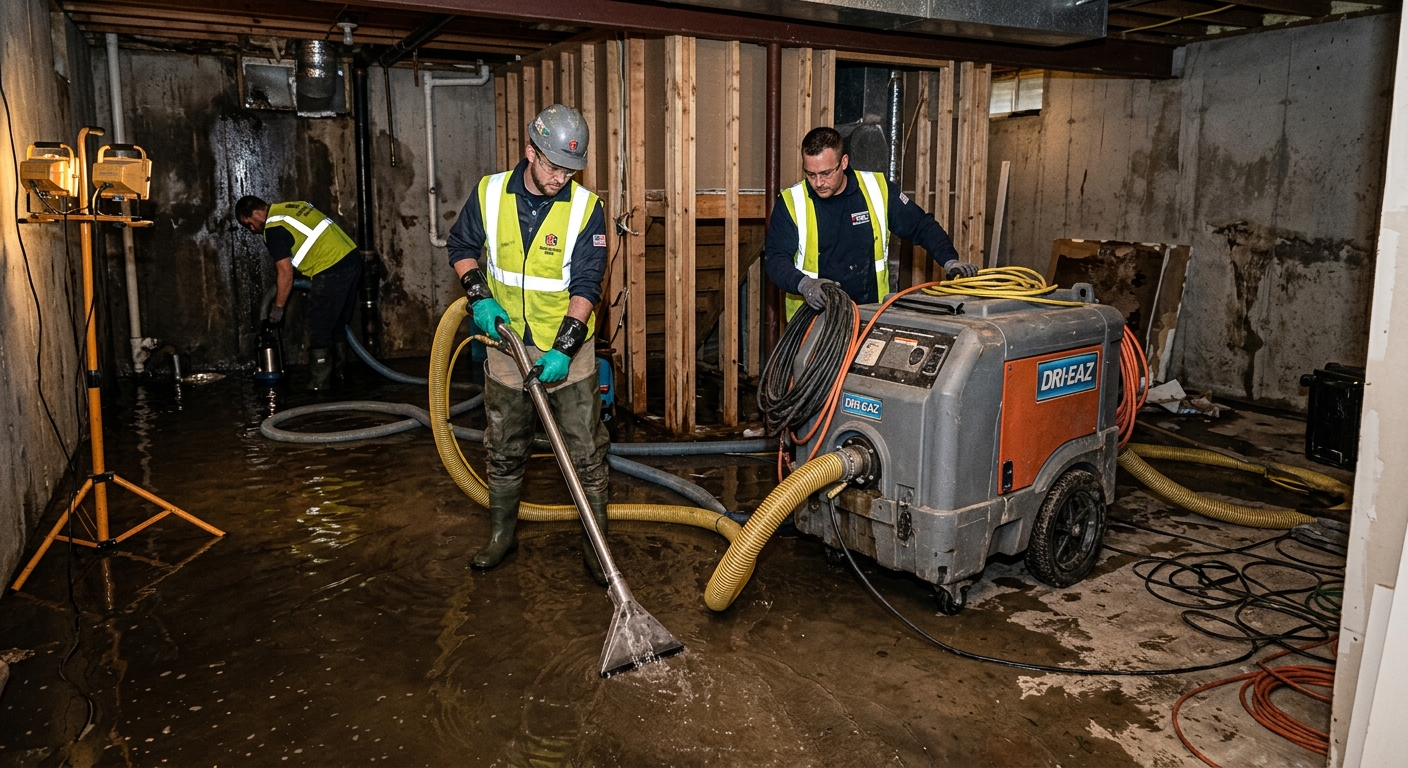
water damage restoration costs in Lower Makefield — 2026
If you live in Lower Makefield and water is pooling on your floor, there’s no time to spare — but knowing the numbers can help you make smart decisions even under pressure. In this part of Bucks County, the combination of 42.0% of homes built before 1980 and 72.4% being single-family properties (U.S. Census Bureau, ACS 2024) means recurring water losses tied to older plumbing and full basements—an issue made worse by the large Levittown-era subdivisions from the 1950s–1960s dominating lower Bucks. Plumbing-related failures, sump issues, and more frequent basement seepage are direct results, putting homeowners at higher risk for both sudden bursts and hidden, slow leaks.
Restoration costs in Lower Makefield are driven by three main factors: (1) what category the water falls into, (2) how saturated the structure is, and (3) how fast you react. Delay lets damage escalate from a lower-dollar dry-out to a much bigger job involving demolition and, in the worst case, mold or sewage protocols. Here’s what typical prices look like for 2026:
| Service |
What it covers |
Typical duration |
Price range |
| Water extraction + emergency drying (Cat 1) |
extraction, air movers, LGR dehumidifiers, daily moisture monitoring |
3–5 days |
$1,500–$9,500 |
| Structural drying only (post-extraction) |
drying to standard after water is already out |
3–5 days |
$1,250–$8,900 |
| Mold remediation with containment |
containment, HEPA filtration, removal, antimicrobial, clearance test |
3–7 days |
$1,900–$13,500 |
| Sewage backup cleanup (Cat 3) |
biohazard protocol, disposal of porous materials, disinfection |
2–5 days |
$3,200–$15,000 |
| Emergency board-up / tarping |
stop further water entry, secure the structure |
same day |
$350–$900 |
Estimates for a typical Lower Makefield home. Category, affected area and how long the water sat move these figures more than anything else.
Regulation, certification and verification in Lower Makefield
Pennsylvania does not license restoration or mold remediation contractors at the state level. This means anyone can print a business card, but the IICRC S500 and S520 are the relevant technical standards in the insurance world—if you want true credentials, ask for your lead technician’s IICRC card. Restoration contractors working in Lower Makefield must carry valid Pennsylvania Home Improvement Contractor (HIC) registration for contracts over $500. You can verify this at hic.attorneygeneral.gov. Insurance—especially workers’ compensation—is mandatory for all employers in this state; any legitimate firm can provide proof, and you can check status through the WCAIS system (wcais.pa.gov).
Permitting works like this: emergency water extraction and drying typically do not require a building permit, but if the work involves removing or replacing structural framing or load-bearing elements, some Bucks County municipalities—including Bensalem Township—do require permits. In Lower Makefield and neighboring towns, you won’t need to pull a permit just to run dryers and remove water, but expect one if the job grows to full reconstruction after mitigation is done.
Before anyone starts extracting, ask for a written contract. State law requires it for jobs over $500, and it should show the HIC registration number, a clear price or price formula, cancellation rights, and a scope of work. Never hand over a deposit or your keys to a crew that can’t give you this paperwork upfront.
How restorers classify water damage
Restoration professionals use two separate axes: category is about the cleanliness (or contamination) of the water, while class is about how much of the building’s structure has absorbed it. Homeowners often confuse the two, but both matter for health, cost, and how the job is done.
Category tells us whether the water came from a supply line (clean), an appliance (grey), or something hazardous like a sewer backup (black). It’s possible for a tiny Category 3 (sewage) loss to cost more than a large clean-water event—just a small 50 square foot sewer backup can push you into the $3,200–$15,000 price range because of the biohazard requirements. Class, on the other hand, has more to do with how much of the building is wet and what it will take to reach dry standard.
One critical piece: even the cleanest water goes bad the longer it sits. In practice, Category 1 water (from a supply line) can become Category 2 after 24–48 hours, and then Category 3 (“black”) in another day or two, especially in older Lower Makefield homes with carpet and drywall. Time is money here: the difference between a $1,500–$9,500 dry-out and tearing out a room due to mold or bacteria growth comes down to how soon you act.
| Classification |
Source or extent |
Health risk |
Cost effect |
| Category 1 — clean |
supply line, appliance line, rainwater |
low |
baseline |
| Category 2 — grey |
washing machine, dishwasher, sump failure |
moderate |
+20–40% |
| Category 3 — black |
sewage, groundwater, water standing 72+ hrs |
biohazard |
$3,200–$15,000 |
| Class 1 |
small area, little absorption into structure |
— |
low end of service1 |
| Class 2 |
whole room, water into walls and subfloor |
— |
$1,500–$9,500 |
| Class 3 |
saturation from above; insulation and walls wet |
— |
$1,250–$8,900 |
| Class 4 |
deep saturation of hardwood, plaster, concrete |
— |
service2 upper range |
Filing a water damage claim in Pennsylvania
The single biggest cost hazard in Lower Makefield is not realizing what your policy covers—until you hear “denied.” Standard homeowners insurance in Pennsylvania usually covers sudden and accidental internal water losses, like a burst pipe. It does not cover outside surface flooding from the Delaware River, Neshaminy Creek, or Pennypack Creek; for that, you need a separate flood policy, and many discover this gap too late.
Gradual leaks and maintenance-related damage are typically excluded—meaning that a slow drip you don’t see isn’t covered. The same applies to sewer backups; unless you bought a specific endorsement, you’re on the hook. Policies may pay either the “actual cash value” (depreciated) or “replacement cost”; read carefully. When a claim is filed, you’re entitled to a detailed “scope of loss,” which breaks down what your adjuster thinks is damaged and what repairs they’ll pay for.
Some restoration firms offer direct billing or request an assignment of benefits—this lets them bill your insurer and deal with paperwork, but you may lose some control over settlement or dispute resolution. Under the Home Improvement Consumer Protection Act (HICPA), you must get a written contract for jobs over $500, and you have a three business-day right to cancel after signing. If anyone offers to waive your deductible, walk away: waiving a homeowner’s insurance deductible is prohibited in Pennsylvania and is a sign a contractor is trying to work the system unethically, which puts your claim at risk.
What proper drying actually looks like
A real drying job in Lower Makefield isn’t just about spreading fans and hauling away water. It starts with mapping every wet area using moisture meters—restorers should produce a log or chart showing meter readings for all affected surfaces. This is what sets science apart from smoke and mirrors. Air movers create evaporation, while LGR dehumidifiers (low grain refrigerant) extract moisture from the air; you need both running 24/7, even when the noise keeps you up. Shutting down overnight just lets water settle back in, making dry-out take longer or fail altogether.
Expect a competent firm to check in daily with updated moisture readings, adjusting or removing equipment as targets are met. The “drying goal” isn’t a guess; it’s a defined moisture content, usually based on unaffected or “control” areas in your home (what’s normal for your subfloor, your walls). Especially in Bucks County, where humid summers and moderate freeze-thaw cycles complicate drying (see climate data above), accurate monitoring is key. Outdoor temperature and humidity management matter: on a sticky July day, venting to the outside will backfire and add water instead of removing it.
At completion, ask to see those daily moisture logs. If a crew can’t supply them, they either weren’t measuring or weren’t doing the job right. Drying results aren’t a matter of opinion—they’re numbers on a meter you can verify.
Outside water, inside water
Here in Lower Makefield, flooding means something different from a broken pipe. Overbank flooding from the Delaware River, Neshaminy Creek, and Pennypack Creek is a real risk for some addresses. The catch: standard homeowners insurance won’t pay a cent if water enters from outside, regardless of how it looks. You need a separate flood insurance policy, often backed by the federal government or a private insurer. These policies are tied to flood zone designations and can take 30 days or more to activate—so you can’t buy one in a panic after watching the forecast.
This matters because a basement full of water is a basement full of water. To you, a flooded rec room after a creek overflow or a burst supply line look the same and require the same type of restoration—often $1,500–$9,500 for dry-out alone. To the adjuster sent by your insurer, one of those is covered and the other is politely rejected. Bucks County’s flood risks aren’t just theoretical; flash-flood and overbank events have repeatedly overrun entire neighborhoods. If you’re in a mapped flood zone or near those watersheds, review your policies before you need them, not after.
Mitigation, then reconstruction: two different timelines
Most homeowners new to water losses in Lower Makefield expect one continuous process, but water restoration really happens in two phases. First is mitigation: extraction, drying, possible demolition, and anything required to stabilize and sanitize the building. This phase moves fast—sometimes everything happens within days and is often direct-billed to insurance. No permit is needed for this emergency work unless structural rebuilding is required.
Once equipment is removed and materials are dry, the job pauses. Reconstruction—putting back drywall, flooring, trim—starts under a separate contract, almost always with a permit in Bucks County if framing or significant repairs are involved. Here’s the pain point: you may wait days or weeks before this phase starts, especially in the saturated contractor market of Greater Philadelphia, where rebuilding crews are often backlogged after regional storms or major losses.
It’s normal to feel abandoned during the gap. The mitigation crew is done, the house is dry, but nothing’s happening while you wait for permits, material delivery, or a reconstruction schedule. Knowing this split exists helps manage expectations—and prevents surprises when the first team leaves, locks the door, and days of silence follow.
Frequently asked questions — water damage restoration in Lower Makefield
Is emergency after-hours service more expensive in Lower Makefield?
Yes, emergency after-hours water extraction jobs in Lower Makefield typically carry a higher price tag, especially in the busy Greater Philadelphia metro market where restoration crews get stretched during storms or widespread events. The market saturation here means firms have to staff for true 24/7 response and pay overtime, and those costs are reflected in your bill. For reference, standard water extraction and drying for a clean water loss runs from $1,500–$9,500 depending on size and urgency. If you call in a crew at midnight for a basement flood, expect to land at the higher end of that range because of dispatch fees and increased labor costs. That said, if water keeps spreading or sits overnight, the bump in price almost always saves money in the long run by avoiding mold or higher-category escalation.
Can I clean up water damage myself in Lower Makefield?
You can tackle small clean water spills yourself if you move fast and the affected area is limited—think an overflowing sink caught immediately. However, Bucks County homes—especially those built before 1980—have construction assemblies (full basements, layered flooring) that can hide moisture. Without professional-grade meters and multiple LGR dehumidifiers, it’s easy to miss saturation in subfloors, walls, or insulation. Missed moisture can turn a $1,500–$9,500 dry-out into a much more expensive mold situation in just days. Also, be aware that sewage or any water that stood over 48 hours should only be handled by a pro using biohazard protocols—it’s a health risk. If in doubt, get a moisture assessment before deciding to DIY.
What is a clearance test and do I need one?
A clearance test is an independent inspection, often including air sampling and moisture verification, performed after mold remediation or a Category 3 cleanup (sewage or grossly contaminated water). In Lower Makefield, a clearance test gives you and your insurer proof the work was actually done to IICRC S520 standards. It’s often required for insurance to release final payment on larger jobs or when selling a home after significant loss. The test typically costs several hundred dollars but is bundled into most mold remediation projects (which run $1,900–$13,500). Not every small dry-out needs a clearance test, but if the loss involved sewage, mold, or compromised immune system occupants, insist on one.
Do older Lower Makefield homes need different treatment?
Absolutely. With 42.0% of Lower Makefield homes built before 1980 (U.S. Census Bureau, ACS 2024), your house may have plaster walls, hardwood subfloors, or hidden voids—a drying challenge compared to modern materials. Older plumbing is also more likely to sprout hidden leaks or burst unexpectedly. Structural drying in these homes can run higher, often toward the upper end of the $1,250–$8,900 range, since drying thick plaster or layered floors takes more time. Special protocols may be needed if your home was built before 1978, since disturbing paint can trigger federal EPA lead-safe requirements. The right contractor will factor these age-related risks into their plan.
What if the insurer's estimate is lower than the contractor's?
This is common in Lower Makefield, where labor costs and material prices run higher than insurer software sometimes reflects. If your contractor’s scope is higher than the insurer’s offer, start by sharing the contractor’s detailed line-item estimate with your adjuster and asking for reconsideration. Most reputable contractors in the region, including regional names mentioned earlier, are used to this negotiation. If there’s still a gap, you may need to supply further documentation or request a re-inspection. Remember, deductibles must be paid by you—waiving them is prohibited in Pennsylvania. Costs for standard water extraction and emergency drying typically fall between $1,500–$9,500, but unusual circumstances or changes in job size can explain differences.
Does wet insulation have to be replaced?
In most cases, yes. Once fiberglass, cellulose, or rock wool insulation gets saturated—especially in Lower Makefield’s common below-grade basements or crawl spaces—drying it in place is usually not practical or sanitary. Wet insulation packs down, loses its R-value, and becomes a mold risk. Restoration protocols based on IICRC S500 call for removal of wet insulation in Category 2 (grey) or 3 (sewage) water. Replacement drives costs into the upper end of drying, frequently adding hundreds or more to your bill—total mold remediation with material replacement can hit $1,900–$13,500. Spot-checking with meters is key; some insulation above a water line may be dry and salvageable, but anything below should come out.
How much does a flooded basement cost to restore in Lower Makefield?
Basement water losses are common in Lower Makefield due to both aging plumbing and the full-basement designs of Levittown-era subdivisions. If the event is clean water and caught early, you’re looking at $1,500–$9,500 to fully extract, dry, and monitor. If the water sits for days, seeps into walls or the loss becomes Category 3 (sewage or severe flooding), costs can climb into the $3,200–$15,000 bracket due to demolition, decontamination and disposal. Factors like finished basements, built-in shelving, or storage areas raise complexity. Quick action and thorough drying are your biggest cost-control tool, as delays drive up both risk and expense.
What should I do in the first hour of a water leak?
If you discover active water loss in Lower Makefield, start by shutting off the main water valve or stopping the water source if possible. Move belongings—especially electronics and documents—out of the affected area, and if safe, unplug electrical appliances. Call a restoration contractor and your insurer; early action can limit category escalation and minimize cost. Never use household fans or a shop vac on sewage or unknown-category water. The first hour is critical: stopping the flow and getting an extraction team on-site can be the dividing line between a straightforward dry-out under $9,500 and a longer, more expensive mold or sewage job. Document everything with photos—you’ll need them for your claim and for contractor scoping.
Is sewer backup covered under a standard policy?
Not by default. Standard Pennsylvania homeowners insurance does not automatically cover sewer backups, which are a known risk in Lower Makefield’s municipalities with documented inflow and infiltration issues. You need to specifically request a sewer or drain backup endorsement—sometimes called a "rider"—to have coverage for these events. Without it, you’re responsible for costs, which for cleanup alone usually falls between $3,200–$15,000. Always check your declarations page or speak with your agent. Sewer backups count as Category 3 water, so DIY is never recommended; these jobs are regulated as biohazards and require professional handling for both health and insurance compliance reasons.
What is IICRC certification and does it matter?
IICRC stands for the Institute of Inspection, Cleaning and Restoration Certification. In Pennsylvania, there’s no state licensing for restoration or mold work, but the IICRC sets the industry standards (S500 for water, S520 for mold) recognized by insurers and the courts. A company that advertises IICRC means they’ve taken formal coursework and passed written exams on drying, remediation, contamination control and documentation. In Lower Makefield, always ask to see your lead technician’s IICRC card—not just a certificate hanging at the office. This extra step helps protect you from undertrained crews, and ensures your claim is documented to a recognized standard. On any job from $1,500 emergency drying to $13,500 complex remediation, training matters and your insurer will expect these protocols followed.