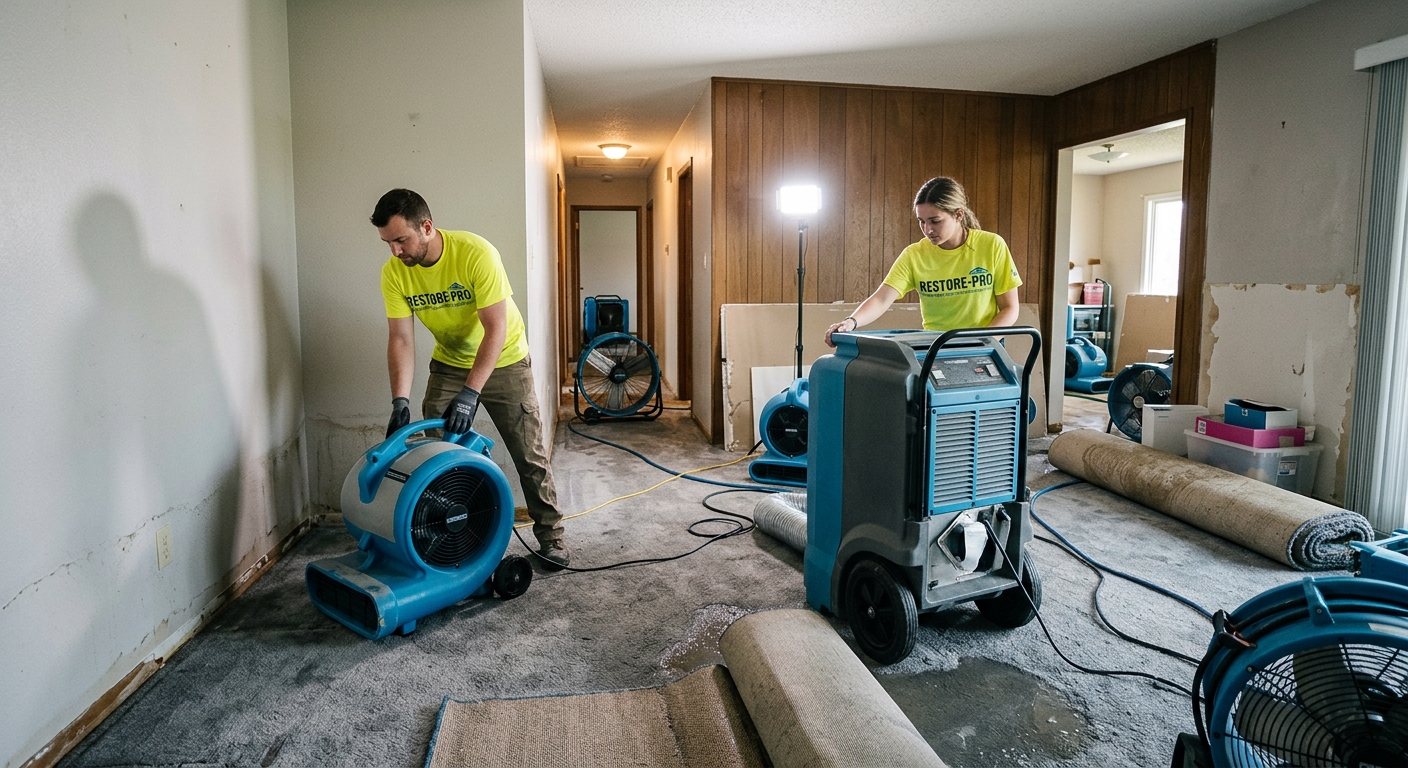
What water damage restoration costs in Adams
Adams Township residents facing active water damage are dealing with something that's harder to price than it seems. In Adams and across Cambria County, restoration costs can swing widely depending on where, how, and why the damage occurred. Local homeowners are mostly in single-family houses (73.6%) with basements, and most homes were built before 1980—many before 1940, especially in Johnstown and Westmont. That means more old plumbing failures and a higher risk of repeated leaks. Extracting water from a finished basement with wood trim and drywall can cost double what it would in an unfinished block basement. Don't look at national averages; local realities—like longer drying times in unheated or stone-walled basements—matter more.
Here's what you can expect to pay in Adams, whether the cause was a burst pipe or sewer backup:
| Service |
What it covers |
Typical duration |
Price range |
| Water extraction + emergency drying (Cat 1) |
extraction, air movers, LGR dehumidifiers, daily moisture monitoring |
3–5 days |
$1,150–$7,300 |
| Structural drying only (post-extraction) |
drying to standard after water is already out |
3–5 days |
$950–$6,800 |
| Mold remediation with containment |
containment, HEPA filtration, removal, antimicrobial, clearance test |
3–7 days |
$1,450–$10,000 |
| Sewage backup cleanup (Cat 3) |
biohazard protocol, disposal of porous materials, disinfection |
2–5 days |
$2,400–$11,500 |
| Emergency board-up / tarping |
stop further water entry, secure the structure |
same day |
$350–$900 |
Estimates for a typical Adams home. Category, affected area and how long the water sat move these figures more than anything else.
Adams's flood exposure and what it means for coverage
Living in Adams Township means taking the area's water risks seriously—especially with Johnstown’s history. The city sits where the Stonycreek River and Little Conemaugh River join, which has led to devastating floods and ongoing flood exposure for many properties. If your home is in or near these flood-prone zones, your risk is higher than many Pennsylvania homeowners realize.
Here’s the catch: standard homeowners insurance in Adams does not cover flood damage from overland water. Whether you’re in Johnstown or a neighboring township, if water seeps or flows in from outside—because a river overflows or heavy rain pushes water through your foundation—you need a separate flood policy. These FEMA-backed or private flood policies are entirely distinct and must be bought before an event. Most come with a 30-day waiting period, so once local rivers are rising or a major storm is forecasted, it’s usually too late to get coverage for that event.
If both a neighbor with burst pipes and a neighbor with river flooding have similar damage, their claims go very differently. Burst pipe water—a “sudden and accidental” event—goes through standard insurance. Floodwater from the Stonycreek or Little Conemaugh Rivers? That’s a denial unless you have flood insurance in force. It pays to know your address’s flood zone so your coverage is ready before the next wet season.
What a sewage loss requires
Sewage backups in Adams are not just another wet mess—they’re a genuine biohazard, especially in Johnstown with the city’s documented combined sewer overflow problems. When sewers back up, water isn’t just dirty; it’s Category 3 “black water,” full of bacteria, viruses, and often chemical contaminants. That means every crew member needs full PPE: fitted respirators, Tyvek suits, gloves, and boots, along with zipwall containment to prevent cross-contamination into clean areas of the home.
Law or not, best practice here means every porous material in the affected area—drywall, insulation, carpet, and especially furniture—must go, whether it “looks” salvageable or not. You can disinfect hard floors and some structural elements, but there is no safe way to clean and keep that carpet or padding. After removal, crews apply hospital-grade disinfectants and run air scrubbers for odor control and microbial safety. Occupants should stay out until the air clears and the area passes a final cleaning check.
Combined sewers make this a recurring risk in Johnstown, and it happens during big rain events—they’re not isolated accidents. Some townships offer backflow prevention cost-share, but in Johnstown you’re likely on your own; installation is still your best prevention. Expect backup cleanup to run $2,400–$11,500, depending on square footage and affected finishes.
Documenting and recovering contents in Adams
After water or sewage damage, most Adams homeowners focus on the walls and flooring, but contents—furniture, electronics, clothing, valuables—are where many lose out on coverage simply due to poor documentation. Insurers want a full inventory of every claimable item, and the best time to take photos is before anything moves. Pack-out involves carefully removing salvageable items to an off-site cleaning facility, where each piece is cleaned, deodorized, and stored until your home is ready.
Before contractors touch your belongings, walk through and photograph each room, open drawers and closets, and keep lists as items are removed. The insurance policy covers contents separately from the structure, with specific dollar limits and “actual cash value” adjustments for depreciation. Upholstered furniture in a sewage loss (Category 3), particleboard furniture, unsealed books, and mattresses rarely justify cleaning due to health risks and cost. Solid wood, leather, ceramics, and some electronics are often restorable, assuming damage is from clean or slightly contaminated water and not long-term sitting. The more you document, the more you recover—and restoration contractors in Adams will expect you to provide proof.
Salvage decisions after a water loss
No two Adams homes are identical—especially with so much pre-1940 construction, where unique materials and layouts affect what can and should be saved. Here’s a local take on materials:
- Fiberglass insulation—Once wet, it loses its R-value and can harbor mold. Replace it.
- Carpet pad—Usually gets pulled; it traps moisture and stays damp.
- Drywall below the waterline—Almost always needs to be cut and replaced, especially with old lath-and-plaster hiding inside walls in Johnstown and Westmont houses.
- Solid hardwood floors—Can often be saved if dried fast with floor mat systems. Engineered flooring almost never makes it; delamination and swelling set in fast.
- Plaster walls—Typical in older Johnstown homes; these stay damp for weeks and often need extended drying before repairs, but can sometimes be preserved.
- Cabinets—Solid wood frames fare better, but most modern particleboard units and toe-kicks fall apart.
Full basements are standard here, and that means hidden moisture behind old paneling, in rim joists, and under stairs. A contractor pushing full demolition of undamaged walls likely isn’t being honest. Conversely, anyone promising to save everything—especially in a pre-war house soaked for more than 24 hours—is likely leaving future mold for someone else. Honest guidance in Adams is material-based: cut what’s unsalvageable, use meter readings for the rest, and don’t pay for unnecessary gutting or impossible saves.
Why below-grade water is its own problem
Full basements are standard in Adams Township and around Johnstown, owing to the hilly terrain and traditional masonry construction. Below-grade water damage isn’t just like a wet floor upstairs—it’s far more complicated. Hydrostatic pressure pushes water through even the tightest block or stone wall; there’s no gravity drainage, so standing water lingers unless you extract aggressively. Basements also hold moisture longer, especially if outside temperatures drop below frost depth (which is a full 36 inches here), slowing down drying even more.
Finished basements—very common in Cambria County—double or triple the scope versus unfinished space. Every foot of wet drywall, carpet, and baseboard adds time and cost to extraction and drying. Water often travels behind walls and under floors, hidden from sight. Sump pump failure is the most common cause for sudden basement floods here, and a backup battery system is worth more than its price in avoided headaches every time the power blinks during a thunderstorm. Remember: if your basement has a water episode, the job isn’t just drying what you see—honest contractors in Adams will check every nook, chase, and rim-toe for trapped moisture.
Credentials and permits for restoration work in Adams
Pennsylvania does not license restoration or mold remediation contractors statewide—there’s no trade license or state board overseeing the work. In Cambria County, the gold standards are IICRC S500 (for water damage) and S520 (for mold cleanup); insurers expect them, so ask to see your contractor’s IICRC certification card for the lead tech. It’s your best assurance of training in structural drying and mold safety.
Permits are not triggered for in-place drying or extraction in Johnstown and Adams Township—those services happen fast, without a code inspection. If framing or subfloor replacement is needed as part of restoration, then a permit is usually required in Johnstown (and most neighboring boroughs), but not just for drying. For contracts over $500, the contractor must provide a written contract under the Home Improvement Consumer Protection Act. Nobody can legally offer to “waive your insurance deductible.”
Before the crew starts, ask for proof of current general liability insurance and workers' compensation, and verify each using the state WCAIS system. Get all estimates and protocol details in writing—a reputable Adams contractor will include equipment lists, documentation procedures, and scope before a blower even runs.
Frequently asked questions — water damage restoration in Adams
What does structural drying cost if I extracted the water myself?
Structural drying in Adams—after you’ve already removed the standing water—runs less than a full extraction job, but still involves professional dehumidifiers, air movers, moisture readings, and monitoring. For most single-family homes here, expect a range of $950–$6,800. The lower end covers a single affected room in an unfinished basement, while the upper end applies if your finished lower level was saturated across multiple rooms or if dense construction (plaster over lath) means a longer drying schedule. Doing extraction yourself will save the cost of pump and vacuum labor, but drying equipment rental and professional monitoring are worth it to avoid hidden moisture that turns into mold. Always ask whether the price you’re quoted in Adams includes daily moisture checks and drying logs for your insurer.
What is a clearance test and do I need one?
A clearance test, conducted after mold remediation in Adams, means running air or surface samples by an independent party to prove the cleanup meets industry standards. This is especially important in older Johnstown-area housing, where hidden cavities and multiple wall layers make it difficult to ensure all mold is gone. The test generates a lab report verifying that mold spores have returned to background levels. While clearance testing isn’t always legally required, most insurers want documentation—especially for claims involving finished basements or visible growth across framing and drywall. The cost is typically bundled into full mold remediation jobs, which in this market run $1,450–$10,000. If your adjuster or the repair scope wants it “by the book,” it pays to make sure this test is in the contract.
Is bleach effective against mold?
In Adams, using bleach on mold in houses—especially in old basements or on porous materials—rarely achieves what you want. Bleach might make dark patches fade, but it doesn’t kill roots in drywall, wood, or framing: it just treats the surface. Most restoration contractors here (and the IICRC S520 standard) recommend against bleach, preferring EPA-registered fungicides that penetrate deeper. On concrete or tile, bleach might temporarily clean, but it won’t prevent regrowth if moisture isn’t addressed and will not pass a clearance test if you need one after remediation. For anything beyond minor surface mold, especially after a sewage backup or a major leak in a pre-1980 Adams home, the best tact is professional remediation, which costs between $1,450–$10,000 locally.
What is Category 3 black water?
Category 3 “black water” means the water in your Adams home is grossly contaminated—with sewage, bacteria, chemicals, and other hazards. This is what you get after a clogged or overloaded combined sewer backs up during a storm in Johnstown, not just dirty rainwater. Cleanup isn’t just about drying: all porous building materials must be removed, and strict disinfection protocols followed. The process needs professional PPE, containment to keep air safe in the rest of the house, and hospital-grade sanitizers. Don’t let anyone talk you into “saving” carpet or drywall after a Category 3 event. Cost for proper cleanup—removal, disposal, disinfection, and documentation—typically ranges from $2,400–$11,500 in Adams. Always err on the side of safety.
What is an assignment of benefits and should I sign one?
An assignment of benefits (AOB) lets a restoration contractor bill your insurance company directly for water damage work in Adams. While it can speed up processing, signing over your rights means you lose some direct control over claim scope and negotiation—it’s now the contractor dealing with the insurer, not you. In Pennsylvania, reputable firms operating in Cambria County rarely require this except for emergency mitigations where speed is crucial. Never sign an AOB before reading the full contract and understanding if you’re still liable for costs that exceed what your insurer allows. If a contractor offers to “waive your deductible,” that’s illegal here. Know that emergency drying jobs locally can run $1,150–$7,300, so clarity before you sign is vital.
Is it safe to stay in the house during drying?
It depends on the scope and category of the loss. For clean-water (Category 1) events in Adams, it can be safe to remain in your home during drying, provided the affected area is isolated with equipment running and the rest of the house isn’t affected by elevated humidity or airflow. For sewage backups or mold remediation, most professionals in Adams will recommend you vacate until air scrubbers, containment, and a clearance test confirm safety. Equipment noise, cord hazards, and heat can make living conditions during drying uncomfortable, especially in homes with older layouts and little separation between basement and living areas. Remember that professional drying for a moderate loss typically costs $1,150–$7,300, and your insurance may cover additional living expenses if your home is uninhabitable.
Are Adams basements especially prone to flooding?
Yes, Adams Township homes—much like others in the Johnstown metro—are particularly prone to basement floods. Almost all houses are built with full basements, often below the water table and serviced by sump pumps to manage groundwater. Heavy rains and hilly terrain mean water can enter through unsealed walls or floors, and old construction commonly lacks modern drainage systems or waterproofing. Sump pump failure in a finished basement is a leading cause of extensive water losses here. Local restoration firms regularly see costs from $1,150–$7,300 just for extraction and drying after a single rainstorm or plumbing mishap. Upgrading pumps and adding battery backups can make a substantial difference.
How do I verify a restoration contractor's insurance?
In Pennsylvania, legitimate restoration contractors carry both general liability and workers’ compensation insurance. Ask for a copy of each, but don’t just take a certificate at face value—use the state WCAIS system to confirm coverage is active and actually lists the business you’re hiring. In Adams, this is critical because there’s no state trade license guaranteeing a firm is qualified: anyone can advertise restoration services. Contractors must also provide a contract for jobs over $500, and you should not hand over any deposit until you see written proof of insurance. Structural drying and mold remediation jobs here average $950–$6,800; don’t risk those costs (and safety) on uninsured crews.
Is emergency after-hours service more expensive in Adams?
Yes—many restoration firms serving Adams (including those headquartered in Ebensburg and the Altoona area) charge higher rates for late-night or weekend callouts. Outlying boroughs in Cambria County can attract travel surcharges or emergency response fees, especially for immediate extraction or board-up. While a typical business-hours water removal might run $1,150–$7,300, expect the high end of that band (or slightly above) if you need same-day response in the middle of the night, especially for widespread events where multiple homes are hit. If the water is contained and you can wait until morning, you may save a substantial amount. Always ask for a written estimate before approving out-of-hours work.
What if the insurer's estimate is lower than the contractor's?
This is common in Adams, where insurers often use software that defaults to national material costs and may underestimate actual labor rates or local travel surcharges. If a contractor’s bid for drying, demolition, or mold remediation comes in above your adjuster’s estimate, ask both parties for a line-by-line explanation. Insist your contractor documents material types (e.g., original plaster, antique trim, finished versus unfinished basement) because older Cambria County homes do not align with standard rebuilding costs. Emergency drying in Adams usually falls between $1,150–$7,300, but older homes with custom details can edge higher. You can negotiate or submit supplemental documentation—most claims are settled with some back-and-forth if you can prove the costs are needed for a proper, code-compliant restoration.