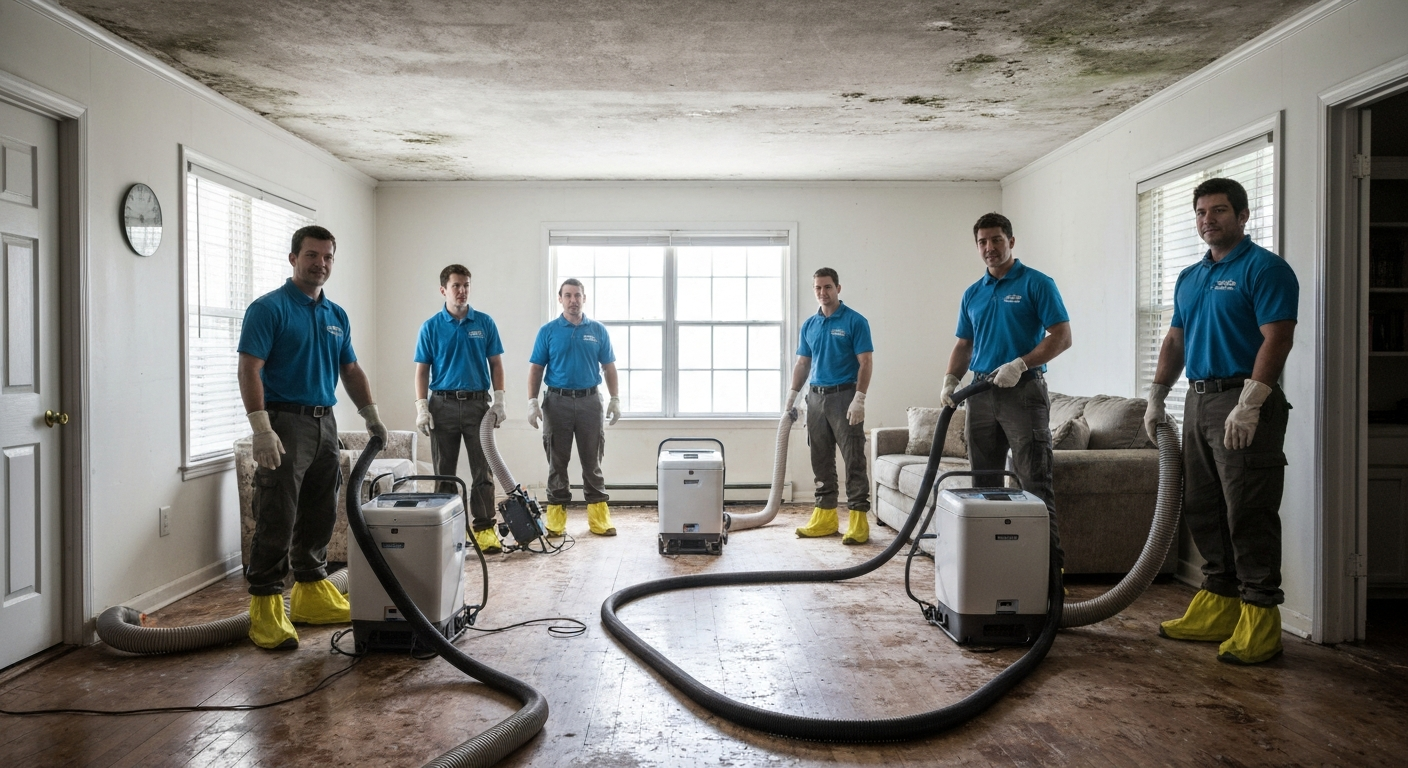
Ridley Park water damage pricing by scope — 2026
If you’re looking up Ridley Park water damage costs right now, you’re probably dealing with an active leak or flood. Disaster pricing can feel like a black box, but in Ridley Park, there are clear ranges for each service. Two things push costs most here: the age of your house (over 93% pre-1980) and the fact that nearly half of the homes are single-family (U.S. Census Bureau, ACS 2024), often with full basements. Older plumbing—especially cast iron and galvanized supply lines from the 1920s–1950s era seen in nearby Upper Darby neighborhoods—means more sudden failures, and older basement construction means bigger, harder-to-dry spaces when things go wrong.
You’ll see pricing depend on the category of the loss (clean, grey or black water), how long water sat, and how much area was hit. The ranges below are what you should expect for proper work; outliers exist but are rare unless you have a large or neglected loss. Mitigation costs can end up lower if the crew can contain the damage quickly; mold or sewage bumps things into much higher bands.
| Service |
What it covers |
Typical duration |
Price range |
| Water extraction + emergency drying (Cat 1) |
extraction, air movers, LGR dehumidifiers, daily moisture monitoring |
3–5 days |
$1,250–$7,800 |
| Structural drying only (post-extraction) |
drying to standard after water is already out |
3–5 days |
$1,050–$7,300 |
| Mold remediation with containment |
containment, HEPA filtration, removal, antimicrobial, clearance test |
3–7 days |
$1,550–$11,000 |
| Sewage backup cleanup (Cat 3) |
biohazard protocol, disposal of porous materials, disinfection |
2–5 days |
$2,600–$12,500 |
| Emergency board-up / tarping |
stop further water entry, secure the structure |
same day |
$350–$900 |
Estimates for a typical Ridley Park home. Category, affected area and how long the water sat move these figures more than anything else.
Ridley Park's housing and its water damage profile
Ridley Park’s homes reflect Delaware County’s broader trends—over 93% built before 1980 (U.S. Census Bureau, ACS 2024). The bulk of stock dates to the building wave from the 1920s to 1950s, which has big consequences during a water loss. First, drain and water supply lines are often cast iron, galvanized steel, or early copper, and after 70–100 years, these pipes are vulnerable to corrosion and sudden breaks. Supply leaks from old plumbing are common, especially where pipe insulation is missing or in partially finished basements.
Wall construction here skews towards plaster over wood lath, not drywall. Plaster walls can trap moisture much longer and require more monitoring, which can add days to the drying process. Drywall, where present in basement renovations from the 1970s and 80s, soaks up water faster and shows damage earlier, but is easier to cut and replace.
Basements are the rule in Ridley Park and nearby inner-ring suburbs—full, below-grade spaces increase risk during heavy rains and multiply drying challenges after a leak or flood. When these basements flood, water wicks into the slab, old foundation walls, and even up into first-floor joists, requiring both aggressive extraction and prolonged drying with commercial dehumidifiers. In short: older homes here don’t just spring leaks—they need longer, more tailored interventions to truly dry out and prevent lasting structural or mold issues.
Your belongings after a water loss
Most Ridley Park homeowners focus on drying walls and floors, but contents—what you own—drive much of the claim and the emotional weight after a water loss. Rather than drying things in place, reputable crews often “pack out” affected items for off-site cleaning and storage. This involves inventorying, photographing, and carefully labeling every piece before it leaves the property. Accurate records are crucial: your insurance policy treats “contents” (furniture, clothing, electronics, rugs) and “structure” (walls, cabinets, built-ins) as separate buckets with their own reporting and claim process.
Some items are unfortunately unsalvageable after certain kinds of water: upholstered furniture, rugs, mattresses, and anything with particleboard tend to be total losses after Category 3 (sewage) events, since they trap bacteria and are impossible to fully disinfect. Solid wood and metal furniture can often be saved with professional drying and cleaning, especially after a clean-water leak. Electronics require swift removal and desiccant drying, but results vary. The crucial step: take photos before anything moves and demand a full written inventory. Overlooked items or unrecorded damage can make for tense insurer conversations. A methodical pack-out protects your checkbook and your peace of mind.
How a Ridley Park crew dries a house
Water extraction is just step one—what really prevents mold and structural issues in Ridley Park is how the crew approaches drying. First, they’ll map wet areas using penetrating and non-penetrating moisture meters, logging readings at set points on floors, walls, and ceilings. This log (ask to see it!) keeps everyone honest—making sure equipment is targeting truly wet materials and tracking drying progress day by day.
Crews deploy commercial air movers to speed evaporation; the real workhorses are the LGR (low grain refrigerant) dehumidifiers, which pull gallons of moisture from the air even in our humid summers. In southeastern Pennsylvania, summer conditions can see outsized moisture loads—skimping on dehumidification means the job drags on or mold sets in. Equipment must stay running 24/7; shutting it off overnight resets the clock and moves you backward.
Daily monitoring visits matter. Each day, the lead tech should record readings, adjust the setup, and report the “drying goal”—the target moisture content for your materials, usually set a bit below the baseline for indoor air and building materials in this region (tied to our typical 4,800 annual heating degree days). A true pro finishes when readings hit the goal—not just when things “feel dry.” If your contractor can’t show you three days’ worth of meter logs, they weren’t tracking—and drying may be incomplete.
How restorers classify water damage
When you hear “category” and “class” tossed around after a water loss, know that these mean two separate things. CATEGORY describes how contaminated the water is—Category 1 is clean (supply line, rain), Category 2 is slightly dirty (laundry overflow, sump backup), and Category 3 is a true hazard (sewage, groundwater, or anything that’s sat for days). CLASS is about how much material was affected—Class 1 is a corner of a room, Classes 2–4 mean bigger saturation, from floors up into walls, insulation, or even concrete slabs.
It’s common for a small Class 3 loss (say, a toilet backup affecting just a bathroom) to cost more than a whole-room clean water event—hazard protocols, protective equipment, and disposal rules drive up response and labor costs. For example, a Category 1 room may dry out for $1,250–$7,800, but even a small Category 3 backup jumps immediately to $2,600–$12,500. Time is a factor: clean water left standing degrades—after 24–72 hours, even a supply leak can become a biohazard, bumping the entire job into a higher price band. Fast response equals cleaner water and a cheaper claim.
| Classification |
Source or extent |
Health risk |
Cost effect |
| Category 1 — clean |
supply line, appliance line, rainwater |
low |
baseline |
| Category 2 — grey |
washing machine, dishwasher, sump failure |
moderate |
+20–40% |
| Category 3 — black |
sewage, groundwater, water standing 72+ hrs |
biohazard |
$2,600–$12,500 |
| Class 1 |
small area, little absorption into structure |
— |
low end of service1 |
| Class 2 |
whole room, water into walls and subfloor |
— |
$1,250–$7,800 |
| Class 3 |
saturation from above; insulation and walls wet |
— |
$1,050–$7,300 |
| Class 4 |
deep saturation of hardwood, plaster, concrete |
— |
service2 upper range |
What a Pennsylvania restoration contractor must actually hold
Delaware County—and Pennsylvania as a whole—does not require a specific state license for restoration, mold, water mitigation, or demolition contractors. Anyone can print a business card, so credentials matter. The industry standard is IICRC certification (S500 for water, S520 for mold), which is recognized by insurers and credible contractors alike. Ask to see the lead technician’s IICRC card at the door. For projects over $500, the law requires a Home Improvement Contractor (HIC) registration issued by the Pennsylvania Office of Attorney General; you can check a contractor’s status online before signing.
No permit is normally needed for emergency drying in most Delaware County boroughs, but if walls or ceilings must come out—especially in Upper Darby—demolition often triggers a building permit. Always confirm with your local office before any demolition. Every crew must carry active liability insurance and workers’ compensation (even for “helpers”); you have the right to request insurance certificates, and to verify workers’ comp on the official site for Pennsylvania.
Before extraction or demolition, insist on a written contract detailing scope, price band, and your right to cancel within three business days. Pennsylvania law forbids any contractor from waiving your insurance deductible. If you run into a vendor offering “zero deductible,” look elsewhere.
Salvage decisions after a water loss
Delaware County’s older housing stock shapes what can be saved after a water loss—and what’s simply not worth the gamble. Plaster walls, common in Ridley Park’s 1920–1950 homes, stay wet for days longer than drywall. Sometimes the surface looks dry while the lath behind is still damp; careful crews will meter multiple layers before calling a wall safe. That means more demolition, but stopping at “looks dry” can allow hidden mold. On the other hand, drywall below the waterline—if water sat more than a few hours—usually calls for a “flood cut,” removing 12–24 inches up to prevent trapped moisture and microbial growth.
Solid hardwood is sometimes restorable with specialty drying mats—especially if extraction is fast—but engineered and laminate floors almost always swell or delaminate, making removal smarter than expensive restoration. Carpeting can sometimes be cleaned if the water was Category 1, but pad and all soft goods go if it was Category 2 or 3. Fiberglass insulation behind finished basement walls usually gets removed; it holds moisture and lets mold colonize fast.
Old cast-iron drain failures—a Delaware County hallmark—frequently show up in finished basements with soaked paneling and carpet. Push back if a contractor insists every wall or ceiling must come out for a minor supply leak, but be equally wary of promises to “save everything” when you’re dealing with sewage, flooded basements, or water that sat for more than 24 hours. Sometimes a limited, careful demolition is the only way to avoid a mold claim six months from now.
Frequently asked questions — water damage restoration in Ridley Park
Can I clean up water damage myself in Ridley Park?
If you catch a small, clean-water spill right away, you might succeed with towels and a wet vac—especially if it’s on tile or above-grade floors. But most Ridley Park homes have full basements, old subfloors, and a lot of plaster or layered wall finishes. These hold moisture deep beneath the surface, making it hard to spot what’s still wet. If you miss the hidden damp, you could face mold or rot down the road, costing well above $1,550–$11,000 for remediation. For more than a few square feet, or if the leak sat overnight, skipping professional drying usually backfires in this older housing stock.
Does homeowner's insurance cover water damage in Ridley Park?
Most standard homeowner’s policies in Ridley Park do cover sudden and accidental water leaks—from burst pipes or appliance failures. What they don’t usually cover is gradual seepage, long-term leaks, or anything resulting from outside flooding (like from the Delaware River or Chester Creek). If you’re dealing with a drain backup or overland flood, check for specific “backup” or flood endorsements. Quick professional intervention can help keep your claim category lower and costs down—mold remediation can range from $1,550–$11,000 if things are delayed. Always notify your insurer and document the damage promptly.
Can hardwood floors be saved after flooding?
In many Ridley Park houses with old-growth hardwood, fast action makes a difference. If the water was clean and mats are set up quickly, it’s possible to rescue the boards with specialty drying (in the $1,050–$7,300 range for structural drying). Once boards start to cup or buckle, or if the water sat for over a day, chances drop. Engineered wood and laminate are another story—almost always unsalvageable after more than a surface spill. The older the floor, the better shot you have, but it often comes down to how quickly extraction happens and the type of wood installed.
What does structural drying cost if I extracted the water myself?
If you’ve already removed standing water with a shop vac or pump, you still need thorough drying of the walls, subfloors, and air pockets—especially in full basements common in Ridley Park. Crews will deploy commercial fans and dehumidifiers and monitor daily until moisture hits target—usually taking 2–5 days. For this kind of structural drying only, expect $1,050–$7,300 as a realistic range, depending on affected area and how much water penetrated. Skipping this step is false economy; hidden moisture is where mold and future repairs multiply costs.
Why is water damage priced per square foot?
Crews typically scope water losses by affected square footage because drying needs, demolition, and monitoring all scale with area. In Ridley Park, basements and first floors tend to be larger open spaces, and that means more materials to dry and more equipment time. That’s why a big basement incident carries higher price tags—expect water extraction and drying to run $1,250–$7,800 depending on scope, not just on the description of the leak alone. The square footage approach keeps billing proportional and transparent for both sides.
Is sewer backup covered under a standard policy?
Most standard homeowner’s policies in Ridley Park specifically exclude sewer and drain backups unless you added a backup endorsement. Given that parts of Delaware County—including some Ridley Park blocks—can be affected by combined sewer overflow, this is worth checking before an emergency happens. Professional sewage cleanup jobs start at $2,600–$12,500 because of biohazard precautions and disposal. If you’re browsing coverage now, ask for drain backup riders; many insurers offer them for a modest annual premium compared to the out-of-pocket cost during a real event.
Can a contractor waive my deductible in Pennsylvania?
No, it is strictly prohibited under Pennsylvania’s Home Improvement Consumer Protection Act (HICPA) for any contractor to waive, rebate, or absorb your insurance deductible. In Ridley Park or anywhere else in the county, a contractor offering “zero deductible” bids is breaking state law and putting your claim and policy at risk. Legitimate water or mold work—whether for $1,250–$7,800 or more—means you pay your share as agreed. If you’re asked to sign anything with a waived deductible, walk away.
What causes most water damage in Ridley Park homes?
The biggest culprits in Ridley Park are old cast-iron and galvanized drain lines finally failing after decades, plus appliance leaks and heavy rain events causing basement seepage. The area’s pre-1980 housing means pipes, water heaters, and even foundation walls are well past their first life cycle, making sudden breaks or seepage common. It’s not uncommon for a minor plumbing leak to require $1,250–$7,800 in professional extraction and drying simply because hidden moisture travels through plaster, joists, and old subflooring fast.
What equipment should a restoration crew bring?
In Ridley Park, you should expect a real crew to show up with heavy-duty portable extractors, multiple commercial air movers (fans), and at least one low grain refrigerant (LGR) dehumidifier for every affected room or two. Moisture meters and infrared cameras are standard for tracking wet spots—ask to see daily logs. For sewage or mold jobs, HEPA air scrubbers and full personal protective equipment are needed. Proper setup—costing in the $1,250–$12,500 range for typical jobs—makes the difference between a real dry-out and a cosmetic pass.
How long before mold starts growing?
Under summer conditions in Ridley Park, mold can start in as little as 24 to 48 hours on wet drywall or framing, especially in our humid climate. That’s why speed matters, and why experienced techs begin documenting and drying immediately. If the water sat for even a day or two, your risk of a Category 2 or 3 job—which costs $1,550–$11,000 for proper mold remediation—jumps dramatically. Fast, thorough drying isn’t just about structure; it’s your best shot at avoiding a second costly claim.