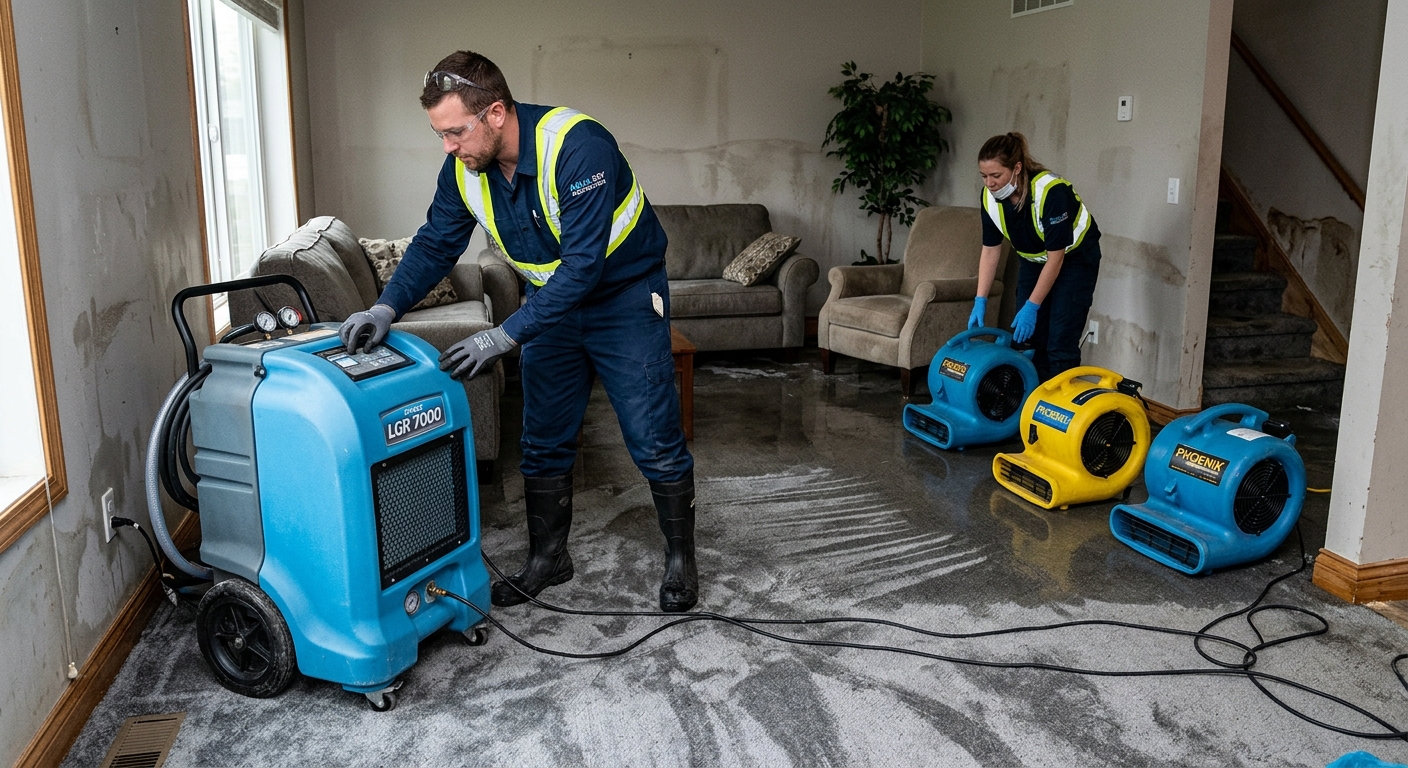
What water damage restoration costs in West Brandywine
If you’re in West Brandywine dealing with water damage at this moment, cost is likely one of your first questions. The typical home here — where 76.0% are single-family and nearly a third were built before 1980 (U.S. Census Bureau, ACS 2024) — is likely to have a finished basement and glued-down flooring. Both features mean water finds its way under surfaces and into materials, which pushes up restoration time and cost compared to areas with older, unfinished basements or slab-on-grade foundations.
Because Chester County homes are mostly post-1950 suburban construction, restoration often means removing baseboards and possibly replacing sections of drywall, especially if water reached behind finished walls. Glued-down flooring, common in these homes, is typically not salvageable after sitting wet, and its removal adds to the work needed. Delaying response will push the project from simple drying to demolition and even mold remediation, which drives your price up as seen below:
| Service |
What it covers |
Typical duration |
Price range |
| Water extraction + emergency drying (Cat 1) |
extraction, air movers, LGR dehumidifiers, daily moisture monitoring |
3–5 days |
$1,350–$8,300 |
| Structural drying only (post-extraction) |
drying to standard after water is already out |
3–5 days |
$1,100–$7,800 |
| Mold remediation with containment |
containment, HEPA filtration, removal, antimicrobial, clearance test |
3–7 days |
$1,650–$11,500 |
| Sewage backup cleanup (Cat 3) |
biohazard protocol, disposal of porous materials, disinfection |
2–5 days |
$2,800–$13,500 |
| Emergency board-up / tarping |
stop further water entry, secure the structure |
same day |
$350–$900 |
Estimates for a typical West Brandywine home. Category, affected area and how long the water sat move these figures more than anything else.
When water damage becomes a mold problem
The clock matters as soon as water hits drywall or flooring. In southeastern Pennsylvania’s humid summers, mold colonization begins within 24–48 hours if building materials remain wet. This is not just a concern for allergy sufferers — it’s a reason costs escalate so sharply with delays.
In the first 24 hours, most West Brandywine homes can be dried in-place. Crews extract water and set equipment, aiming to save drywall, glued flooring, and trim. This stage falls in the $1,350–$8,300 range. If water sits longer — common with basement floods or undetected plumbing leaks — the work shifts. Selective demolition becomes necessary: cutting drywall (often two feet up), pulling flooring, and checking for trapped moisture in finished basements drives the scope upward and may push you into mold remediation pricing: $1,650–$11,500.
Should mold growth take off, proper containment is now required to protect the rest of your home. HEPA air filtration and demolition happens under plastic, with technicians in protective gear. The last step is clearance testing: an independent measure showing spore levels have returned to a baseline. Always get this in writing — it confirms your home isn’t left with hidden contamination after the crew packs up.
The bottom line: West Brandywine’s basement-heavy housing stock, with humidity-prone lower levels, means fast action keeps you out of the mold remediation bracket, but delays become costly almost overnight.
Credentials and permits for restoration work in West Brandywine
Pennsylvania does not issue state licenses for water damage restoration or mold remediation. That means a business card, uniform, or truck wrap does not guarantee any particular training. The recognized industry standard in Chester County is IICRC certification (S500 for water, S520 for mold). Do not be shy — ask the lead technician to show their IICRC card and check that it covers the type of work needed.
No permit is required in West Chester Borough for like-for-like drywall replacement or emergency drying, but the picture changes if repairs get into plumbing, electrical, or structural reconstruction. Then, a local permit is triggered — your restoration company should know when to pull one and how to coordinate with the West Chester Borough Department of Code Enforcement.
Contractor registration is required for any agreement over $500, and you can verify their Home Improvement Contractor number at hic.attorneygeneral.gov. Workers’ compensation coverage is also mandatory for all employers — you can check via the state WCAIS portal before a crew sets foot in your home.
Do not pay a deposit or sign a contract until you have, in writing, the company's HIC registration, proof of insurance, and a contract documenting your right to cancel within three business days. In pre-1978 homes, ask if any disturbance will trigger the EPA Lead RRP Rule and request their lead renovator certification.
Why below-grade water is its own problem
Most West Brandywine homes have full basements — a feature that doubles your risk profile versus an unfinished crawl or slab. Hydrostatic pressure during storms, or rising groundwater from Brandywine Creek or the Schuylkill River watershed, means water doesn’t just flow in: it is often forced up through cracks or around the foundation, defeating gravity drainage.
Because finished basements are so common in Chester County’s post-1950 housing, the real work is often hidden. Water may wick up the backside of drywall, under baseplate lumber, or beneath glued-down flooring where it stays moist and invisible — especially during a humid southeastern Pennsylvania summer. This creates a pocket that resists drying, raises the risk of mold, and often requires removing more material than a surface inspection suggests.
Sump pump failure is the number-one cause of basement water losses here. If your sump went quiet during a storm and you lack a battery backup, water can fill a basement in less than an hour. Compared to unfinished basements, restoring a finished space can nearly double the bill — every extra inch of drywall, flooring, and furniture adds hours of labor and disposal cost.
The 30-inch frost depth in southeastern PA means foundations are dug deep enough to stay safe from freeze, but this also puts your living space well below the exterior grade. Having a professional assess hidden moisture is not optional in this setup; a DIY “looks dry” check risks leaving a long-term mold problem sealed behind brand new walls.
What to expect week by week in West Brandywine
In West Brandywine, restoration divides into two phases — mitigation and reconstruction — but most don’t realize how different they are until they’re living it. Mitigation is urgent: water extraction, structure drying, and (if needed) mold remediation, all typically wrapped within three to seven days. This work is often direct-billed to insurance, and crews show up fast: there are at least eight capable firms serving Chester County, with trucks rolling from Exton and Malvern.
Once the dryers and dehumidifiers are gone, many homeowners feel confused — why is nobody here, and why can’t repairs begin? This is the gap. Reconstruction (restoring drywall, flooring, paint) is a separate contract, often done by a different crew. Because Chester County’s restoration firms juggle a steady stream of claims in this moderate suburban-Philadelphia market, you might wait one to three weeks before repairs start. Permits, insurance checks, or materials can widen that gap.
The best way to stay sane is to get clear communication: ask your mitigation contractor for a written summary of what’s left to restore, and whether their company handles reconstruction or refers out. Knowing this handoff is normal helps you plan those transition weeks — and reduces frustration about an “abandoned” project when, in reality, mitigation did exactly what you needed.
Contents: pack-out, cleaning and what you can claim
When water hits a finished basement or spreads beyond flooring, your personal property — the “contents” of your West Brandywine home — often needs just as much attention as your drywall. The insurance claim splits into two buckets: structure (walls, flooring, cabinetry) and contents (furniture, clothing, electronics, memorabilia). Many homeowners under-claim here because they lack documentation.
Pack-out means trained techs inventory, photograph, and carefully remove salvageable contents for transport to an off-site cleaning facility. Every item is cataloged, usually by barcode or digital photo — this is crucial, because adjusters require proof for both cleaning and replacement. Before anything moves, snap your own photos or phone video, room by room. This avoids headaches later if there are disputes about what was lost or damaged in the process.
Some things are rarely worth saving: upholstered furniture in sewage (Category 3) losses, particleboard bookcases, mattresses, and low-cost area rugs are typically marked “non-salvageable” and totaled. Solid wood furniture, electronics, and valuables are usually cleaned and returned. Keeping a paper trail protects you when it comes time to settle your claim — and justifies the cost, which can easily add $1,650–$11,500 to a complex Category 3 job.
Flooding vs plumbing failure in West Brandywine
In West Brandywine, it makes a huge difference whether your water loss came from inside — a burst pipe or a failed water heater — or outside, like the Brandywine Creek or Schuylkill River watershed overflowing after a storm. Insurance treats these as two totally separate categories. Standard homeowner’s policies almost always exclude “flood” — defined as water entering from the ground up, which usually means river or surface water, not a plumbing leak.
If your address falls in a FEMA-designated flood zone (determined by proximity to those named water bodies), a separate flood insurance policy is needed, usually backed by the National Flood Insurance Program or a private carrier. Critically, flood coverage cannot be purchased at the last minute; it carries a waiting period, often 30 days, so you have to buy it before the forecast turns ugly.
Both a flooded basement and a burst pipe might leave similar water marks and damaged floors — but to the insurance adjuster, they are night and day. The right coverage could mean the difference between a $4,300 water extraction bill being covered or left 100% on the homeowner. A quick call to your agent is worth it, especially with the Brandywine and Schuylkill nearby putting more homes at risk on a regional basis.
Frequently asked questions — water damage restoration in West Brandywine
Will my premium go up after a water damage claim?
Insurance companies in Pennsylvania, including in West Brandywine, can raise your premium after any paid claim, including water damage. How much the increase is depends on your carrier and claims history. One-time events, like a burst pipe, may result in smaller hikes than repeated losses or a mold claim. While a typical water extraction and emergency drying job here runs $1,350–$8,300, the insurer's exposure guides their decision. Always check your deductible: sometimes it’s less expensive to self-pay minor incidents to keep your record clean. If the water source was preventable (old sump pump, neglected maintenance), expect higher scrutiny and possibly a surcharge. Discuss renewal and non-renewal with your agent before you file.
Can hardwood floors be saved after flooding?
In West Brandywine’s climate, hardwood floors sometimes survive if the water is quickly extracted and drying starts within hours. The more common glued-down type in post-1950 homes fares worse than true nail-down planks. Even with aggressive drying methods costing $1,100–$7,800, cupping or warping is likely if water sits over 24 hours. The source matters too — clean water gives you a shot; sewage or groundwater almost never justifies the effort and expense. Your contractor should check subfloor moisture with meters and advise if selective plank replacement makes economic sense. If insurers will not pay for refinishing or patching, sometimes the results are not worth chasing.
Does homeowner's insurance cover water damage in West Brandywine?
Generally yes, but not always. In West Brandywine, standard homeowner’s insurance covers sudden, accidental water damage caused by things like burst pipes or a malfunctioning supply line. However, it will not cover water entering from the ground, like overflow from Brandywine Creek or the Schuylkill River watershed — that’s considered flood and needs a separate policy. If covered, you can expect payment for emergency work such as water extraction and drying (usually $1,350–$8,300). Check your declarations page to confirm excluded scenarios, and remember: damage from ongoing leaks or poor maintenance may be denied.
How long before mold starts growing?
Here in West Brandywine, with our humid southeast Pennsylvania summers and common finished basements, mold can begin colonizing wet materials in as little as 24 to 48 hours after a water event. That’s why most water restoration crews move fast to dry out surfaces within the first day. If drying is delayed past the 48-hour mark, your job can easily move from emergency drying ($1,350–$8,300) to full mold remediation, which may cost as much as $11,500 if the problem spreads. Containing the damage quickly is both a health and cost issue here.
What causes most water damage in West Brandywine homes?
Most water damage calls in West Brandywine come from sump pump failures and plumbing mishaps in basements, which are almost universal given Chester County’s suburban, below-grade construction. Heavy rain overflows from the Brandywine Creek and pumped-out basements are familiar scenes, but an old water heater or burst washing machine hose is statistically more likely. A typical mitigation bill for these incidents — including equipment and labor — is $1,350–$8,300. Preventative maintenance of sump pumps and good plumbing checks help lower your risk.
Why did the crew cut my drywall two feet up?
When a water extraction crew works in West Brandywine, you’ll often see a horizontal cut about two feet up from the floor. This is called a “flood cut.” It’s the fastest way to remove wet insulation and prevent hidden moisture from promoting mold growth — especially in finished basements, which are the norm in Chester County. The lower two feet are most likely to be soaked and slow to dry. This process falls under normal structural drying or mold remediation services (often in the $1,100–$11,500 range depending on complexity). The material is replaced after drying and clearance.
How much does a flooded basement cost to restore in West Brandywine?
Restoring a finished basement after water damage in West Brandywine usually falls in the higher end of the water extraction price range — often $4,300–$8,300 for extraction and drying alone. If water was present for more than 48 hours or if it was not a clean source, you may need mold remediation or sewage cleanup, which can raise the bill to as much as $13,500. The finished nature of basements here doubles the scope because drywall, insulation, carpet or glued flooring, and furniture are all affected. Unfinished spaces are less expensive to restore.
How much does sewage backup cleanup cost in West Brandywine?
Sewage backup is a Category 3 job — the highest hazard class — and it commands a higher price because of the mandatory safety steps and disposal rules. For a typical West Brandywine home, expect a price range of $2,800–$13,500, with an average project running around $7,200. The bill covers removal of porous materials, thorough disinfection, HEPA filtration, and special personal protective equipment for the crew. Sewage-contaminated items are often unsalvageable, which adds to the cost. Insurance may cover this, but a claim is always required for reimbursement.
Is a shop vacuum enough for standing water?
For small puddles or very shallow leaks from clean sources, a shop vacuum may help remove surface water if you catch it early. But in West Brandywine’s typical finished basements, water quickly seeps under floors and behind walls where household vacuums can’t reach. Professional water extraction and emergency drying, while an investment ($1,350–$8,300), ensures hidden moisture is tracked and eliminated. Improper DIY often results in hidden mold, which can escalate your costs later. For Category 2 or 3 water (grey or sewage), never use a shop vac, as you risk cross-contamination and serious illness.
How do I verify a restoration contractor's insurance?
In Pennsylvania, including West Brandywine, you have the right to verify your contractor’s insurance before any work begins. Ask for a Certificate of Insurance that lists both liability and workers’ compensation. For workers’ compensation, use the state’s WCAIS site to check active coverage. For home improvement and restoration, proper registration (HIC) is also mandatory on contracts over $500 and can be verified through hic.attorneygeneral.gov. Reputable firms here provide these documents up front. Don’t hesitate to walk away if a crew cannot, even if their quoted price is in the lower range ($1,100–$3,300) — the risk is not worth a savings.