Warrington water damage pricing by scope — 2026
If you’re dealing with water damage in Warrington, you need straightforward answers on cost—especially if water is still spreading. With a high homeownership rate and over a third of homes built before 1980 (U.S. Census Bureau, ACS 2024), Warrington sees a steady stream of interior losses. Much of lower Bucks—including Warrington—is shaped by large Levittown-era subdivisions built in the 1950s–1960s. This era’s aging plumbing triggers recurring pipe bursts, failed valves, and slow leaks, sometimes unnoticed in finished basements until it’s a true emergency.
Whether the disaster came from a sump pump failure, a leaking appliance, or an overbank event, expect the actual price to track with the size of the affected area and the timing. Sitting water is more expensive than a fast response. Most bills in Warrington fall between $1,400–$8,600 for clean water extraction and drying, but some jobs—especially involving mold remediation or sewage—reach several times that. Here’s what typical projects cost in 2026:
| Service |
What it covers |
Typical duration |
Price range |
| Water extraction + emergency drying (Cat 1) |
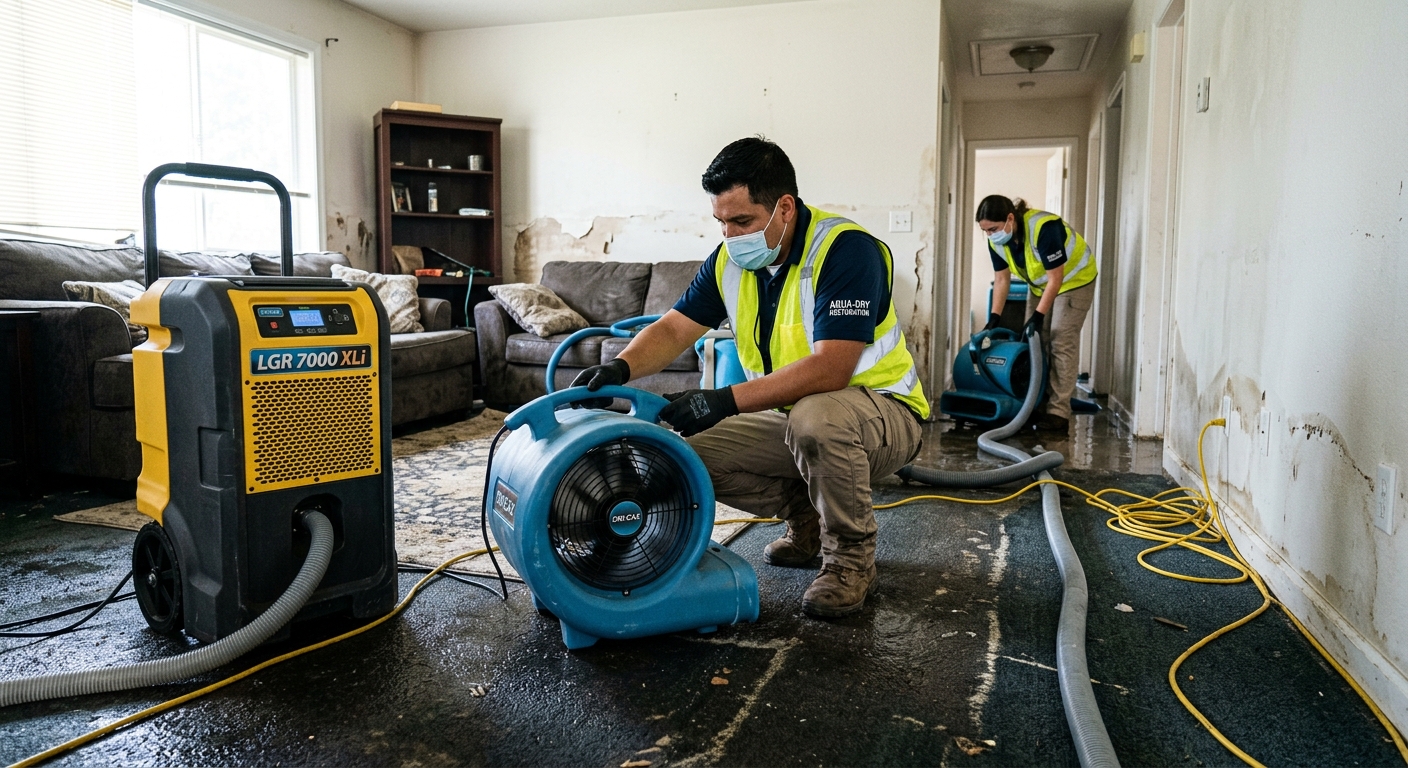
extraction, air movers, LGR dehumidifiers, daily moisture monitoring |
3–5 days |
$1,400–$8,600 |
| Structural drying only (post-extraction) |
drying to standard after water is already out |
3–5 days |
$1,150–$8,000 |
| Mold remediation with containment |
containment, HEPA filtration, removal, antimicrobial, clearance test |
3–7 days |
$1,700–$12,000 |
| Sewage backup cleanup (Cat 3) |
biohazard protocol, disposal of porous materials, disinfection |
2–5 days |
$2,900–$14,000 |
| Emergency board-up / tarping |
stop further water entry, secure the structure |
same day |
$350–$900 |
Estimates for a typical Warrington home. Category, affected area and how long the water sat move these figures more than anything else.
Vetting a contractor when you have no time
Warrington sits inside a saturated restoration market, with local crews and regional firms servicing Bucks County—so help is close. But competition means nothing if you’re caught in the rush to stop ongoing damage and have to decide without three quotes. The honest truth: you can vet a company in minutes by focusing on the essentials, without sacrificing your legal and financial protection. Before anyone arrives, confirm three things on the phone:
- The company holds active Home Improvement Contractor (HIC) registration for Pennsylvania—have them read it to you over the phone, then check at hic.attorneygeneral.gov.
- They carry current liability insurance and workers’ comp for all on-site workers—ask for policy numbers to check.
- They have IICRC-certified technicians, and the lead will be on site. Ask for the lead tech’s IICRC card upon arrival.
Before a piece of equipment is unloaded, you should have:
- Written scope of work on company letterhead.
- Line-item contract, not just a work order—required by Pennsylvania law if over $500.
- Copy of HIC registration and proof of insurance (certificate of insurance should name you and your address).
- No blank-scope contracts or “just sign so we can start” papers.
- No crews unloading until you’ve seen documentation and signed an agreed scope and price—not a blank total.
- No assignments of insurance benefits (AOB) without time to review. These can complicate your claim process.
- Clarify who is responsible for permitting if reconstruction is required—don’t assume mitigation contractors will file.
- Ask about daily updates and how moisture readings will be documented for your insurer.
Beware pressure tactics: it’s common for some crews to roll out equipment and push for quick signatures before terms are set. Never feel obligated to sign a broad “authorization” before you see—and understand—the written scope. Pennsylvania law backs you up: get everything in writing, including that 3 business-day cancellation period for contracts over $500.
Warrington's flood exposure and what it means for coverage
Flooding in Warrington isn’t an abstract risk, given the proximity to the Delaware River, Neshaminy Creek, and Pennypack Creek—all named flood sources that drive both overbank and flash-flood events. If your home is in a mapped flood zone along these waterways, your risk is as much about insurance fine print as anything. Standard Pennsylvania homeowners policies do not cover flood water entering from rising creeks or river overflows. Flood coverage must be purchased as a separate policy, usually with a 30-day waiting period. You can’t buy it last minute when a storm is forecast.
This is why coverage denial surprises so many: to an adjuster, a family room six inches deep in water looks the same whether it’s a failed washing machine hose or a swollen creek, but the origin changes everything. If floodwater enters your basement—even by an inch—standard homeowner’s won’t respond unless you hold a qualifying flood policy. On the other hand, sudden pipe bursts, water heater ruptures, or sewer backups are typically covered (subject to policy limits and exclusions). If you’re in a zone affected by the Delaware or Neshaminy, talk to your insurance agent about where your address sits. Act before water is at your door; coverage can’t be retroactive or added in the midst of an event. This distinction is the single most expensive knowledge gap for Bucks County homeowners after a storm.
What a sewage loss requires
Sewage backup is not just water damage with a foul odor—it’s a Category 3 biohazard that demands strict protocols. In Warrington and much of lower Bucks, backups often stem from issues with municipal sanitary sewers, where inflow and infiltration make repeat events possible. This isn’t an unlucky accident; it’s a system-level risk managed by the Bucks County Water & Sewer Authority, which means prevention strategies like backflow valves matter—but municipal cost-sharing for these upgrades is rare, and most residents fund them themselves.
Proper cleanup requires more than extraction. Restoration crews enter in full PPE—respirators, gloves, splash suits—and set up containment to avoid cross-contamination. Every porous item touched by Category 3 water (drywall, carpet, baseboard, many subfloors) must go, regardless of surface cleaning. Salvage is mostly limited to hard items after thorough disinfection and deodorization. Occupants and pets should be out until clearance is achieved.
Cleanup costs in Warrington fall between $2,900–$14,000 depending on area and contents, reflecting the labor, disposal, and decontamination needed versus clean water jobs. If your home faces recurring sewer exposure, ask about installing a plumber-rated backflow device; though not cheap, it’s cheaper than repeat remediation, and often under $1,700–$3,500 installed.
Preventing the next one
In our climate, you’re more likely to prevent the next water loss in Warrington with a few well-chosen upgrades, not a “total prevention” package. The most cost-effective move is upgrading washer hoses and water heater supply lines ($60–$200 for quality braided replacements), as these are failure points in Levittown-era homes. Adding a smart automatic shutoff valve ($450–$1,100 plus install) catches burst pipes even when you’re not home. Sump pumps with battery backup ($200–$590 for just the unit) are essential in full-basement homes, especially with Warrington’s 30" frost depth driving freeze-thaw infiltration and power outages.
Leak sensors ($25–$70 per unit) placed under washing machines, water heaters, and behind toilets give early warning, but aren’t a fix by themselves. A simple drain pan under the water heater ($65–$120 with proper drain connection) buys you time in a finished basement. Backflow valves are a must in homes with a history of sewer backups, but not justified for everyone; unless you’re in a known risk zone, save your money. Whole-home water detection systems and full perimeter drain overhauls are expensive and generally not necessary for most Warrington homes unless you’ve had recurring foundation leakage after coastal storm remnants.
Regulation, certification and verification in Warrington
Pennsylvania does not license restoration or mold contractors; there is no state-issued restoration or mold remediation license, so a business card means nothing here. What your insurer and most reputable firms will expect is IICRC certification, especially S500 for water damage and S520 for mold. Don’t be shy—ask to see the lead technician’s actual IICRC card when they arrive.
If your project involves only mitigation (drying, extraction, or mold removal), no building permit is needed unless you move to structural repairs. In Warrington, permits are typically only triggered if you’re replacing load-bearing elements or doing reconstruction after mitigation. Always have your contractor clarify if and when a permit will be filed—this is your assurance the job will pass a final inspection.
Before you start, verify HIC registration (required for jobs over $500, checkable at hic.attorneygeneral.gov) and insist on written proof of liability insurance and workers’ compensation, which you can verify via Pennsylvania’s WCAIS. Never agree to start work until you hold a detailed contract outlining scope and costs. This is your protection: no handshake deals, no ambiguous work authorizations—get it in writing.
What to expect week by week in Warrington
Restoration in Warrington follows a two-phase rhythm that surprises many homeowners. The first phase—mitigation—is fast and urgent: crews arrive to extract, set up drying, or remove contaminated materials, sometimes within hours. This phase rarely takes more than a week, and is usually direct-billed to your insurance. The house gets loud, hot, and full of equipment; every visit is documented for your adjuster.
Once drying logs show the site is safe, the crew packs up and leaves—often before you have a reconstruction plan in place. Here’s where many in Warrington feel abandoned: nothing seems to be happening, but this gap is normal. Permitted reconstruction (replacing drywall, baseboard, flooring) may wait several weeks, as law requires a written scope, contract, and often a new firm. In Bucks County’s saturated contractor market, wait times for scheduling are usually shorter than rural regions, but you may still see a gap of 1–4 weeks between mitigation and the start of rebuild. Different work, different contract, sometimes different people entirely.
If you know to expect this hand-off—and demand daily updates through the process—you’ll avoid a lot of stress. Your insurer will also need new documentation for the reconstruction phase, so keep every receipt and update in one place.
Frequently asked questions — water damage restoration in Warrington
What does structural drying cost if I extracted the water myself?
If you’ve already handled water extraction in your Warrington home, hiring a professional structural drying crew is significantly less expensive than a full-service extraction and drying job. For most homes in the area, the cost for structural drying only—meaning the crew monitors affected materials, sets up dehumidifiers and air movers, and documents moisture readings—typically runs between $1,150–$8,000. The final price depends on how many rooms are affected, the makeup of your basement or living spaces, and how thoroughly the water was removed before drying started. In Warrington, finished basements in Levittown-era homes are prone to hidden moisture in walls and subfloors, so professional equipment is still crucial even if you started the job yourself. Make sure the contractor provides daily moisture logs for your insurance claim—documentation matters just as much as the work itself.
Does Pennsylvania license mold remediation contractors?
No, Pennsylvania does not have a state license specific to mold remediation contractors. In Warrington—like the rest of the state—there’s no government registry or licence for mold remediation. Instead, the industry standard is IICRC S520 certification. Reputable firms will have technicians trained to this national guideline, and you can (and should) ask to see proof of this with the lead technician’s card when they arrive. Keep in mind that the lack of a state license means unscrupulous companies can still operate here—always verify Home Improvement Contractor (HIC) registration (required for any job over $500) using the Attorney General’s site, and require a written contract clearly stating the scope and price before work begins.
How much does sewage backup cleanup cost in Warrington?
Sewage backup cleanup in Warrington is a specialized biohazard service with stringent protocols. For a typical residential loss, expect costs between $2,900–$14,000, with most projects falling in the midrange. This range covers protective equipment for crews, containment setup, mandatory removal and disposal of affected porous items, industrial-level disinfection, and full deodorization to eliminate odors and pathogens. The cost depends on both the size of the affected area and how long sewage was present. With documented municipal sewer inflow and infiltration issues in lower Bucks, homeowners should invest in backflow prevention if they’ve had repeat backups. Note: this service requires occupants—including pets—out until work is cleared by a technician. Insist on detailed documentation for your insurance claim.
How long does water damage drying take in Warrington?
For a typical Warrington home, drying after water damage usually takes three to five days—sometimes a bit longer if wall cavities or subfloors are affected, or if high humidity lingers. This timing assumes professional extraction and thorough installation of air movers and LGR dehumidifiers. Homes with basements, especially from the 1950s–1960s era common to lower Bucks, can hold hidden moisture, so daily monitoring is critical. If you catch the water loss quickly, the lower end of the range ($1,400–$8,600 for extraction plus drying) is realistic. High humidity or a slow leak discovered late can push the timeline and the bill upward. Always ask your restoration contractor for daily moisture readings—they’ll need this for your insurance, and it’s the surest way to confirm drying is actually finished.
What if the insurer's estimate is lower than the contractor's?
It’s not unusual in Warrington for your insurance adjuster’s estimate to come in lower than the actual bill from a restoration contractor. Insurers base payments on standardized pricing for your zip code, while real-world conditions—like full basements, layered finished flooring, or extensive contents in mid-century homes—can create extra cost. Pennsylvania law gives you the right to dispute or supplement your claim. Start by requesting a detailed bill, with clear line items, from your contractor. Compare this to the adjuster’s scope. Sometimes, the difference is documentation—missing rooms, or a misunderstanding of affected materials. If you can’t reconcile amounts, contractors can provide a “supplement” for review. Ultimately, you’re responsible for any gap unless your claim is adjusted. For reference, most full drying jobs land in the $1,400–$8,600 range, but specific scenarios could still cost more.
What is an assignment of benefits and should I sign one?
An assignment of benefits (AOB) is a contract that allows your Warrington restoration company to work directly with your insurer and collect payment on your behalf. While it sounds convenient, it shifts control of the claim—meaning you may have less say over billing disputes, supplemental work, or even the choice of contractor if the claim expands. In Pennsylvania, you’re not required to sign an AOB, and most homeowners prefer to retain claim management themselves. Protect yourself by declining any AOBs presented as a formality or rushed before you review the contract. Never sign an AOB if the scope and line-item cost are unclear. Legitimate restoration firms in Bucks County will let you pay them directly and handle communication with your insurer, just requiring your written signature for work over $500 as required by law.
What is Category 3 black water?
Category 3, or “black water,” is industry language for the most hazardous type of water damage—water that contains significant biological or chemical contaminants. In Warrington, this usually means water from a toilet overflow, sewer backup, or flooding from the outside after a storm carries in soil and debris. This category requires extra precautions: workers in full protective suits and respirators, removal and safe disposal of any porous material touched, aggressive cleaning and disinfection, and thorough deodorization. Costs run higher than regular clean water jobs, typically landing in the $2,900–$14,000 band for residential sewage cleanup. Occupant and pet safety is the top concern; no one should return until the site tests clean. Choose only an IICRC-standard contractor to handle Category 3 work.
How long before mold starts growing?
In Warrington’s humid summers, mold growth can start within 24–48 hours after a water loss if moisture isn’t fully removed. Older homes—many built before 1980—are especially prone due to hidden wall cavities and finished basements that don’t dry as easily. Fast extraction and active dehumidification are your best defense. Once mold is present, professional remediation with containment and clearance testing is required, and jobs typically cost from $1,700–$12,000 depending on scope. If you spot visible growth or persistent musty odor, do not attempt extensive clean-up yourself—disturbing mold can spread spores and worsen contamination. Prompt response is your best long-term savings.
Are Warrington basements especially prone to flooding?
Most homes in Warrington and lower Bucks feature full basements—a legacy of 1950s–1960s suburban construction. These basements, while providing great space, also mean more risk of water intrusion from sump failure, seepage, or local flash floods driven by the Delaware River and Neshaminy Creek. With aging infrastructure and high groundwater after storms, even newer homes can experience unexpected basement water. The high homeownership rate in Warrington means local contractors see these losses regularly, and pricing for water extraction in basements starts around $1,400 and rises by area affected. Prevention is mostly about sump pump maintenance and sealed perimeter drains—watch for signs of backup after heavy rain or sudden thaw.
Can I clean up water damage myself in Warrington?
You absolutely can tackle small-scale water damage yourself in Warrington—think spills, appliance leaks, or quick clean-water events covering a few square feet on tile or concrete. For any loss that saturates carpet, subfloor, drywall, or gets into a finished basement, professional equipment is much more effective at drying out hidden areas and preventing mold. DIY failure often comes from stopping when the surface "feels dry," ignoring how porous materials hold moisture. If you still want to try, rent commercial fans and dehumidifiers and purchase a moisture meter. Remember: any sewage loss, or job covering more than a room or two, should be handled by an IICRC-certified crew. Most homeowners end up calling in a pro after realizing the limits of household fans—by then the tab is still within the $1,400–$8,600 band if caught quickly.