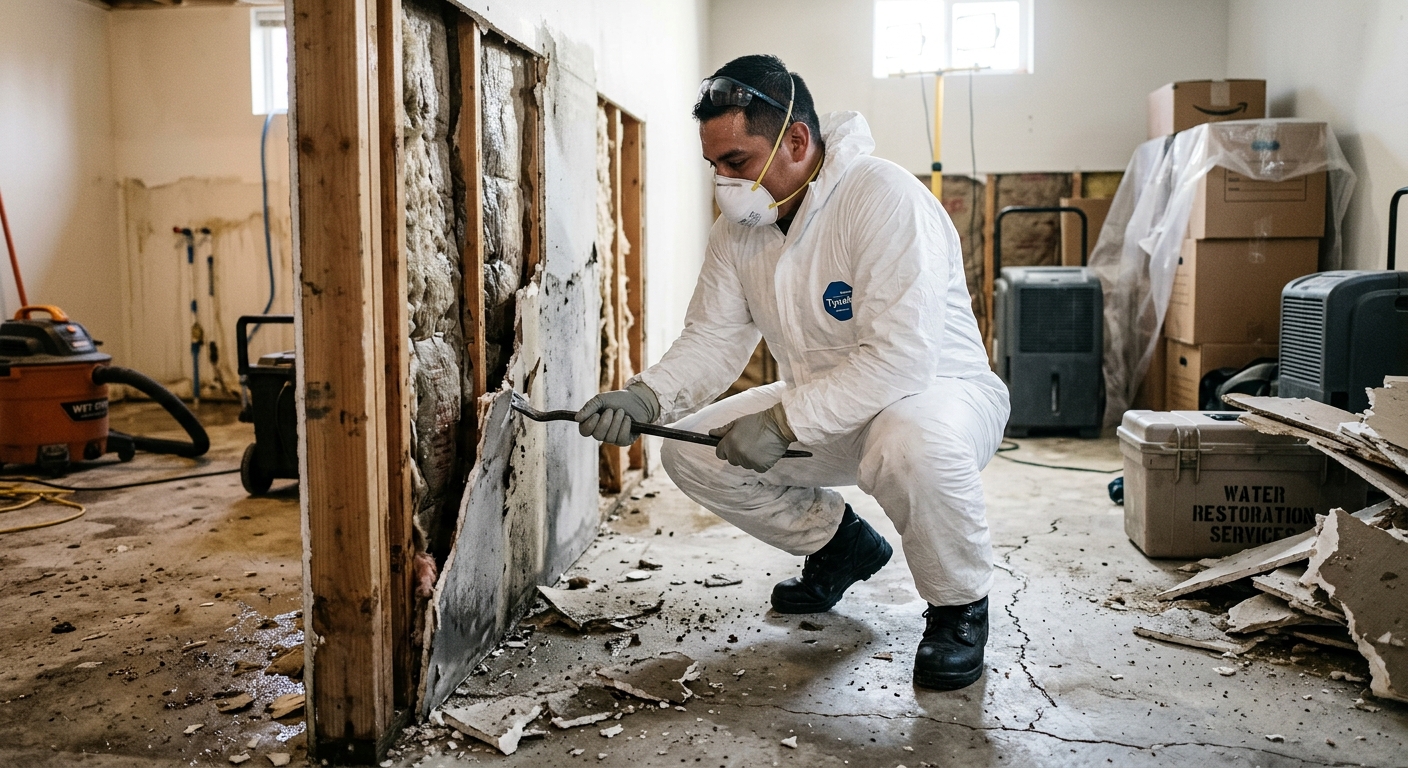
What water damage restoration costs in St. Marys
St. Marys homeowners facing water damage are often looking for quick, clear numbers—especially with an active leak or flooded basement. Costs here run a little higher than many expect, given the age and type of local houses. With about 73% of Elk County’s homes built before 1980 and most being early 20th-century wood-frame construction (U.S. Census Bureau, ACS 2024), water has a habit of getting deep into plaster, behind walls, and down into basements. Hidden moisture in thick plaster and lath, plus the prevalence of full basements, often means more drying equipment, demolition, and time than in areas with newer ranch or slab-on-grade structures.
If you’re cleaning up after a burst pipe that’s just demolished your lounge ceiling, or a sump failure has soaked your finished basement, expect the following service bands for Elk County:
| Service |
What it covers |
Typical duration |
Price range |
| Water extraction + emergency drying (Cat 1) |
extraction, air movers, LGR dehumidifiers, daily moisture monitoring |
3–5 days |
$1,100–$7,000 |
| Structural drying only (post-extraction) |
drying to standard after water is already out |
3–5 days |
$950–$6,500 |
| Mold remediation with containment |
containment, HEPA filtration, removal, antimicrobial, clearance test |
3–7 days |
$1,400–$9,800 |
| Sewage backup cleanup (Cat 3) |
biohazard protocol, disposal of porous materials, disinfection |
2–5 days |
$2,300–$11,000 |
| Emergency board-up / tarping |
stop further water entry, secure the structure |
same day |
$350–$900 |
Estimates for a typical St. Marys home. Category, affected area and how long the water sat move these figures more than anything else.
Regulation, certification and verification in St. Marys
Pennsylvania does not issue a state license for water damage or mold restoration. In St. Marys and throughout Elk County, any restoration company can legally advertise and work—there’s no government exam or state-issued qualification required. The standard most insurers and professionals recognize is IICRC (Institute of Inspection, Cleaning and Restoration Certification). Always ask if the lead technician on site carries an IICRC card; any trained water damage or mold lead should be able to show this on request.
Permits in St. Marys are not required for minor non-structural interior drying and cleanup after leaks, but any structural repairs after significant water damage—like removing and rebuilding walls, flooring, or ceiling work—generally require a building permit from the City of St. Marys Code Enforcement Office. If there’s any question of reconstruction, your contractor should confirm permit status up front.
Pennsylvania law requires restoration contractors to hold a Home Improvement Contractor (HIC) registration for jobs over $500. You can check a contractor’s registration at hic.attorneygeneral.gov. Workers’ compensation is mandatory for all employers: ask for a certificate of insurance, and verify coverage through the state’s WCAIS system at wcais.pa.gov. Before any crew brings equipment inside, make sure you have a written contract (required by state law for jobs over $500) that spells out the work, price, and your right to cancel within three business days.
What construction era means for a water loss here
Elk County’s housing—especially in St. Marys—is dominated by homes built before 1980 (U.S. Census Bureau, ACS 2024), most of them framed in wood, with plaster walls and full basements. For most insurance jobs, that means leaks aren’t limited to single rooms. Water will find its way deep into wall cavities lined with lath and plaster, or seep through old subflooring into basements, making full structural drying—and sometimes significant demolition—unavoidable.
Older homes here often use galvanized steel or copper supply lines, both decades past their prime and prone to hidden pinhole leaks. Drains might be cast iron, which corrodes inside and complicates any cleanup involving gray or black water. When water intrusion occurs—like a failed washer or a sump pump malfunction—drying subfloors, joists, and interior plaster takes longer than drying modern drywall and engineered wood. Extensive plasterwork, as opposed to drywall, drives up both drying time and repair costs. Finished basements (almost always with wood framing and sometimes actual plaster walls for dividing rooms) multiply the volume of wet material.
Newer construction in Elk County is comparatively rare. But even 1970s–1980s homes may have their original supply lines, water heaters, or mid-century electrical, all of which are weak points for water damage claims as they reach the end of their safe lifespan. No matter the era, the construction details here set the stage for prolonged mitigation and deeper rebuilds compared to places with younger, slab-based homes.
Category 3 cleanup in St. Marys
Sewage backup (Category 3) cleanup isn’t just water extraction with a worse odor. This is true biohazard work that requires full personal protective equipment, containment barrier setup, and disposal of anything porous—carpeting, pads, insulation, drywall—even if the material looks clean after extraction. Hard surfaces must be thoroughly disinfected and deodorised, not just wiped down. Residents and pets absolutely need to stay out of affected zones until air clearance tests and final disinfection are complete.
St. Marys has documented localized sewer backup complaints during heavy rain, so this isn’t a rare one-off. Neighborhoods here tie into the municipal wastewater system, making you dependent on the city’s storm handling capacity. In practice, if you don’t have a backflow prevention valve, you’re exposed to sewer water rising from city lines during flood events. These devices must be installed by a plumber and, as of now, St. Marys doesn’t cost-share installation—so it’s entirely homeowner expense.
Category 3 cleanup starts at $2,300–$11,000 for Elk County-area homes, easily doubling the price of lesser water events because of the required demolition, hazardous disposal, and specialist labor. If your home has experienced a backup, don’t cut corners here: your insurance adjuster will expect certification and full documentation for any reimbursement.
Vetting a contractor when you have no time
If your basement’s flooding and gear is on the driveway, normal vetting goes out the window. In rural counties like Elk—where only a handful of restoration firms serve St. Marys and most travel from outside—having “someone available” is rare enough that you may feel compelled to go with whoever picks up. But taking just 10 minutes to confirm the basics can save you thousands.
First on the phone: (1) Are they HIC registered in Pennsylvania? (2) Can they provide proof of workers’ comp and general liability insurance? (3) Is an IICRC-certified technician leading the crew?
Once they arrive, don’t let any equipment inside until you have in hand:
- HIC registration number you’ve cross-checked online
- Certificate of insurance with your address named
- Copy of the lead tech’s IICRC certification card
- A written, detailed contract identifying work and price
- Your 3-day right to cancel clearly stated (required by law for contracts over $500)
- Estimate for each service, not just a total or “time and materials”
- Timeline for service—in writing
- What demolition or “invasive” work is planned and who authorizes it
- Plan for debris removal and proper disposal
- Who will handle permit applications if reconstruction is required
Avoid any provider who asks you to sign a generic or blank work authorization, skips giving a full contract, or starts unloading fans and dehumidifiers without agreement. Pressure tactics—like “we have to start now or your claim won’t be covered”—are a red flag. Elk County’s thin contractor market does not justify skipping steps meant to protect you.
How restorers classify water damage
Restoration jobs are classified on two independent scales homeowners often blur. Water CATEGORY describes how contaminated the water is—clean, gray, or black—while CLASS describes how deeply water has soaked into the structure. Both directly affect price.
A sewage backup (Category 3) in a small utility room can cost more than a clean water (Category 1) pipe break saturating an entire floor. For example, even a small Category 3 job runs $2,300–$11,000, often higher than a big Cat 1 job. Jobs are classified not just by origin: if clean water sits for more than 2–3 days, it degrades to Category 3, triggering biohazard pricing and demolition, regardless of original source.
Here’s how it breaks down for Elk County homes:
| Classification |
Source or extent |
Health risk |
Cost effect |
| Category 1 — clean |
supply line, appliance line, rainwater |
low |
baseline |
| Category 2 — grey |
washing machine, dishwasher, sump failure |
moderate |
+20–40% |
| Category 3 — black |
sewage, groundwater, water standing 72+ hrs |
biohazard |
$2,300–$11,000 |
| Class 1 |
small area, little absorption into structure |
— |
low end of $1,100–$7,000 |
| Class 2 |
whole room, water into walls and subfloor |
— |
$1,100–$7,000 |
| Class 3 |
saturation from above; insulation and walls wet |
— |
$950–$6,500 |
| Class 4 |
deep saturation of hardwood, plaster, concrete |
— |
$6,500 (upper end structural drying) |
The biggest lesson: the longer water sits, the worse both health risk and costs get—sometimes doubling or tripling your bill by the third day.
How long the whole thing takes
Most St. Marys homeowners aren’t prepared for how two separate phases shape water restoration: mitigation (urgent, 2–5 days) and reconstruction (often weeks). The first is fast—extracting standing water, setting up drying equipment, and demolishing unsalvageable materials. This part is handled by specialized crews, and can often be direct-billed to your insurance. The structure is then left clean, safe, but unfinished: bare studs, missing flooring, and gaps where drywall used to be.
The second phase—reconstruction—requires a permit in St. Marys if you’re rebuilding rooms or making structural changes. This work is often done not by the mitigation team, but by local contractors or remodelers. With Elk County’s thin market and most outfits traveling from State College or Erie, scheduling can introduce a gap of days or weeks before repair starts. During this “dead time,” the job can feel abandoned when the real situation is just supply and demand.
From water loss to a fully put-back home, expect mitigation to take 3–7 days (including mold drying/clearance if needed); reconstruction, if involved, can take several weeks depending on material availability and how soon a local crew is free to pick up the permit and finish-out work.
Frequently asked questions — water damage restoration in St. Marys
What is IICRC certification and does it matter?
IICRC stands for the Institute of Inspection, Cleaning, and Restoration Certification. In Pennsylvania, there’s no state licensing for water damage or mold work, so IICRC certification is the main signal that your St. Marys contractor follows recognized industry standards like S500 for water restoration. Ask to see proof—the lead technician should be able to show an IICRC card for water damage or mold remediation. Certification isn’t just a piece of paper; it means training on proper drying, contamination control, and documentation. Given Elk County’s older homes and the higher risk of hidden damage, you want a company that knows both the science and the paperwork your insurer will require. Non-certified outfits might offer a lower initial bid but can end up leaving you exposed if the job isn’t up to par. Typical mitigation here runs $1,100–$7,000, so it’s worth choosing a certified pro.
Do I need mold testing or just remediation?
In most St. Marys homes, testing for mold is only needed if you require written clearance—typically when buying, selling, or if your insurance asks for it. If you can see visible growth or smell musty odors after water damage, you usually need remediation, not expensive testing. Remediation with proper containment prevents further spread and includes clearance testing as the final step for documentation. The standard for professional containment and remediation here is $1,400–$9,800, including HEPA filtration and an optional post-remediation clearance test. For routine jobs, reliable contractors will walk you through visible issues, identify hidden risks in old plaster and framing, and target remediation to what’s actually present. Don’t let anyone upsell you on lab tests if mold is visually obvious and you’re not in a regulatory conflict.
Why did the crew cut my drywall two feet up?
In St. Marys’ typical early-century homes, crews often perform what's called a "flood cut"—removing drywall and sometimes plaster two feet above the visible water line. This is done because water wicks upward inside wall cavities, especially in plaster-on-lath or old wood-frame homes so common here. Cutting at two feet ensures all the wet insulation, wiring, and framing can dry properly and mold doesn’t start in hidden spaces. While it may seem excessive, it’s actually the standard of care, especially since insurance will expect visible removal of all potentially affected material. The cost for this type of demolition and drying is included in typical restoration bands—expect $950–$6,500 for structural drying alone, depending on the extent. Trust that a reputable restorer is preventing bigger issues later on.
Will my premium go up after a water damage claim?
In Pennsylvania—including St. Marys—insurance carriers handle water damage claims based on the cause and your past claim history. If you make a claim for a small incident in an older home, your premium might increase at renewal, especially if you’ve had other property claims recently. Sewer backup and repeated sump failures can particularly affect insurability in Elk County, where full basements and aging infrastructure play against homeowners. Some minor events may not be worth claiming; consider out-of-pocket repairs for jobs under $1,100–$7,000 if your deductible is already a significant percentage of the total. Always consult your agent before submitting any non-emergency claim, and carefully weigh the math—some repairs may be more cost-effective handled without insurer involvement.
Can I rent dehumidifiers instead of hiring a company?
You can absolutely rent dehumidifiers and fans at a local hardware store in St. Marys, but keep in mind those units are not as powerful as what professional contractors use. For small, surface-level leaks confined to tile or vinyl areas, DIY might be sufficient. But for wall or basement flooding—especially in older Elk County homes with thick plaster, full basements, and wood framing—consumer units rarely achieve a full dry-out, risking future mold or hidden rot. DIY might save you money on straightforward jobs (under $1,100 in materials), but you won’t get documentation, clearance, or insurance support. If more than a couple square feet are involved, it’s safest to at least have a pro do an initial inspection.
How much does water damage restoration cost in St. Marys?
Costs in the St. Marys area depend on the category and extent of damage. Typical water extraction plus drying after a clean-water event runs $1,100–$7,000, while mold remediation is $1,400–$9,800. Sewage cleanup, which is more involved, lands between $2,300–$11,000. Older homes with plaster, basements, and concealed cavity moisture (common here) are on the higher end because of necessary demolition, drying, and repair. How long the water sat is often just as important as how much spilled, because clean water quickly degrades—pushing jobs into costly “biohazard” territory.
Is basement flooding covered by insurance in Pennsylvania?
In St. Marys and statewide, basement flooding coverage depends on your individual policy. Most standard homeowners’ policies exclude groundwater seepage and overland flood unless you have specific endorsements or a FEMA flood policy (which is a separate purchase). Sudden losses—like burst pipes or water heater discharges—are usually covered, provided maintenance was up to date. Flooding from the Clarion River or sewer backups often require riders or optional coverage, so check closely. Cleanout and structural drying, which in this market ranges $950–$6,500, might be reimbursed only in covered scenarios. Always talk to your agent as soon as a loss happens, and don’t assume everything wet is eligible for a claim.
What causes most water damage in St. Marys homes?
The main culprits in St. Marys are aging supply lines, sump and foundation leaks, and sewer backups after heavy rains. With so many homes built before 1980 (U.S. Census Bureau, ACS 2024), hidden pipe failures and seepage through stone foundations are especially common. The presence of full basements throughout Elk County increases incidents because water has somewhere to pool unseen. City sewer backups are a known risk during big storms, adding to above-ground sources. Mold and structural drying services frequently hit $1,400–$9,800 in these settings because moisture hides inside walls and subfloors much more easily than in newer construction.
Can I wait until morning to call?
For slow leaks or isolated puddles that you can clean up, waiting until business hours in St. Marys is reasonable—especially if you’re confident there’s no ongoing intrusion. But if you’re seeing standing water, water dripping through ceilings, or any sign of a sewer backup, calling immediately can prevent damage from worsening. With most restoration firms serving Elk County coming from other counties, there could be a delay even for “emergency” service. The added damage—and increased risk that clean water turns into a much pricier Category 3 scenario (up to $11,000)—is usually not worth a wait if drying can safely start now. If in doubt, call and describe your loss; a pro can tell you if it’s safe to pause or if immediate action is urgent.
Why is water damage priced per square foot?
Restoration in St. Marys is priced per square foot because drying needs, demolition, and rebuild scale with the actual volume of wet material—wall, flooring, or ceiling—affected after a leak. Especially in Elk County’s older, larger homes with wide rooms or full basements, the number of wet square feet quickly determines the number of fans, dehumidifiers, and labor hours required. Price bands, like $950–$6,500 for structural drying, are built on a per-foot basis but depend on material (plaster takes longer than drywall), accessibility, and how long the water sat. Insurance companies expect this detail on every estimate for accurate reimbursement, so an itemized scope is always provided.