What water damage restoration costs in Plum
In Plum, where 62.9% of homes were built before 1980 and nearly four out of five are single-family houses (U.S. Census Bureau, ACS 2024), water losses often escalate fast—especially with the region’s many pre-1940 homes notorious for basement seepage and old pipes. If you’re reading this with water still standing, you’re not alone; plumbing failures and soaking basements are regular calls here, not rare events. The most important variable is how long water sits, since delays drive up both cost and scope—waiting even a day or two often means shifting from simple drying to a major demolition and mold concern.
Expect cleanup and restoration costs in Plum to fall in these ranges:
| Service |
What it covers |
Typical duration |
Price range |
| Water extraction + emergency drying (Cat 1) |
extraction, air movers, LGR dehumidifiers, daily moisture monitoring |
3–5 days |
$1,250–$7,800 |
| Structural drying only (post-extraction) |
drying to standard after water is already out |
3–5 days |
$1,050–$7,300 |
| Mold remediation with containment |
containment, HEPA filtration, removal, antimicrobial, clearance test |
3–7 days |
$1,550–$11,000 |
| Sewage backup cleanup (Cat 3) |
biohazard protocol, disposal of porous materials, disinfection |
2–5 days |
$2,600–$12,500 |
| Emergency board-up / tarping |
stop further water entry, secure the structure |
same day |
$350–$900 |
Estimates for a typical Plum home. Category, affected area and how long the water sat move these figures more than anything else.
Salvage decisions after a water loss
Deciding what can and should be saved in a Plum water loss is often shaped by this area's aged housing and basement types. With many homes in Pittsburgh and its older suburbs predating 1940, full masonry basements and outdated piping mean water commonly soaks insulation, wall finishes, and flooring. Here’s what typically survives and what rarely does on these jobs.
- Fibreglass insulation and carpet pad: Once wet, especially below grade, these materials almost never dry to a safe standard and usually go straight to disposal—even with aggressive drying.
- Drywall: Anything saturated below the waterline is typically cut out. Attempting to save it often just sets up a mold claim and more costs later on.
- Solid hardwood flooring: Sometimes salvageable using floor-drying mats and aggressive dehumidification, but success rates drop fast with prolonged saturation. Engineered flooring, which is common in local mid-century homes, rarely survives more than a minor event.
- Plaster: Common in pre-1940s houses in this region, plaster is more robust than drywall but holds moisture much longer. This can delay demolition but also prolong the risk of mold if not closely monitored.
- Cabinets: Plywood-box cabinets sometimes survive minor leaks, but anything made with particleboard generally swells and fails, especially after being soaked overnight.
If your contractor insists on immediate, full-scale demolition before a thorough evaluation, you may be overpaying. On the other hand, any company promising to salvage every finish is setting up risks that can come back as a much bigger mold problem—especially in old basements where moisture lingers. Honest restoration balances urgency with keeping only what can be safely dried and cleared.
Regulation, certification and verification in Plum
Pennsylvania does not license water or mold restoration contractors—if someone flashes a business card, it does not guarantee skill. The recognized industry standard here is IICRC S500 for water jobs and S520 for mold. Ask to see the IICRC card for the actual crew leader, not just the sales rep, before a job starts. Mold specialists are not licensed by the state, but most insurers in this county expect work to follow the IICRC S520 protocol.
No permit is needed in most of Plum for cleanup or drying out after water damage, as long as there’s no interior structural alteration. In Pittsburgh, a permit is required only if the job touches framing or other load-bearing elements during reconstruction. For peace of mind, ask your restorer to confirm permit requirements with your municipal code office.
Every business with employees in Pennsylvania must carry workers' compensation insurance. You can verify this through the WCAIS system (wcais.pa.gov) before anyone sets foot in your house. For any contract over $500, contractors must have a current Pennsylvania Home Improvement Contractor registration—check status at hic.attorneygeneral.gov and get a copy with your contract. Before agreeing to anything, insist on a written contract itemizing scope and price—this is not just protection, but state law under the Home Improvement Consumer Protection Act.
How restorers classify water damage
Restoration projects always hinge on two separate axes that homeowners often confuse: category and class. The category rates how contaminated the water is, from clean (Category 1) to outright hazardous (Category 3, typically sewage or river water). The class describes how deeply the water has soaked into materials, not just area covered but what’s wet—just the surface, or deep into walls and floors?
Here’s the catch: a small Category 3 incident (say, a sewer backup affecting just one room) can out-cost a whole-house Category 1 event. For instance, a modest partial cleanup with Category 3 water can easily run $2,600–$12,500, while a larger but cleaner Category 1 job averages much less.
Most important in Plum is this: water left sitting almost always “upgrades” from Category 1 to 2, and then 3, as it picks up contaminants from surfaces and prolonged time. A rainwater leak into a finished basement is a Category 1 job if started the same day, but becomes Category 2 (or even 3) if left until mold blooms or sewage mixes in. Prompt action is not about fear—it’s about preventing safe jobs from turning into biohazard cleanups.
| Classification |
Source or extent |
Health risk |
Cost effect |
| Category 1 — clean |
supply line, appliance line, rainwater |
low |
baseline |
| Category 2 — grey |
washing machine, dishwasher, sump failure |
moderate |
+20–40% |
| Category 3 — black |
sewage, groundwater, water standing 72+ hrs |
biohazard |
$2,600–$12,500 |
| Class 1 |
small area, little absorption into structure |
— |
low end of $1,250–$7,800 |
| Class 2 |
whole room, water into walls and subfloor |
— |
$1,250–$7,800 |
| Class 3 |
saturation from above; insulation and walls wet |
— |
$1,050–$7,300 |
| Class 4 |
deep saturation of hardwood, plaster, concrete |
— |
upper range of $1,050–$7,300 |
Equipment, monitoring and drying standards
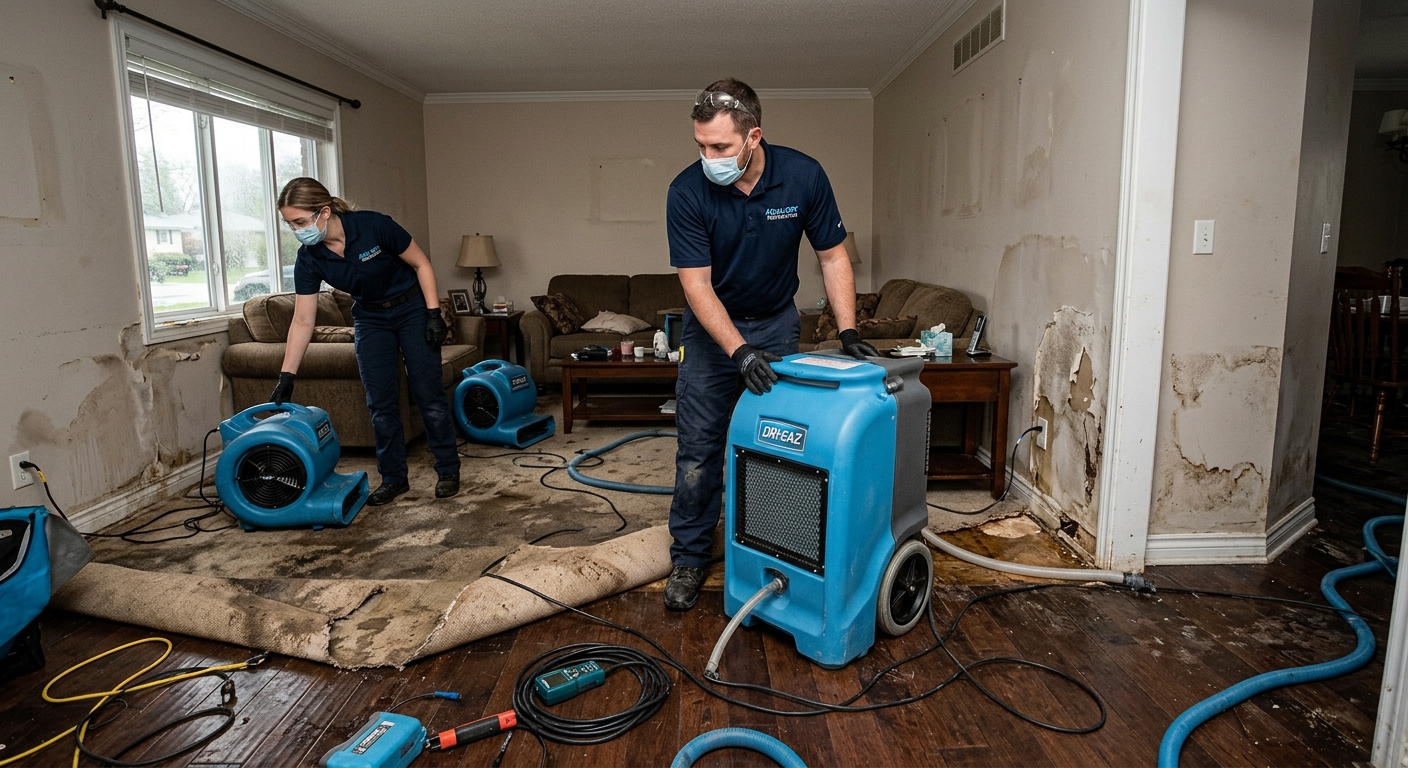
The nuts and bolts of drying out a flooded Plum home comes down to careful measurement and matching the right gear to the job, not just setting fans and hoping for the best. Reputable crews start with moisture meters—reading not just surfaces, but hidden layers in walls and flooring—and keep daily logs. This written moisture record is the difference between documentation and guesswork, both for insurance and for your own peace of mind.
For actual drying, a mix of air movers (to push moisture off surfaces) and LGR dehumidifiers (to pull vapor out of the air) run nonstop for several days. It might seem noisy and overkill, but the humid Pennsylvania climate—think 5,600 heating degree days, regular freeze-thaw, and clay-heavy soils—makes short cuts risky. Turning the machines off at night, or pulling them too soon, means slow spots go undetected and mold can creep in beneath new finishes.
A trusted contractor visits daily, logs every zone’s readings, and chases “dry standard”—not a guess, but a target moisture content matched to unaffected building material in your own house. You should always ask to see daily logs. If a restorer can’t produce them, they weren’t measuring—and that’s a red flag worth pausing the job over.
Documenting and recovering contents in Plum
On most insurance claims, homeowners in Plum lose money by under-documenting and under-claiming personal contents—especially during the panic of a loss. A thorough contractor will perform a contents “pack-out,” moving items out to an off-site cleaning facility and creating a photo inventory as they go. Before crews move anything, photograph every room and every item in place. This is your proof for insurance, and crucial if valuations are disputed later.
Insurers treat your contents (furniture, clothing, electronics, books) separately from the house’s structure. Off-site cleaning can often salvage area rugs, heirlooms, and finished-wood furniture, but some items are rarely worth restoring: upholstered pieces contaminated in a Category 3 water loss (sewage), particleboard furniture exposed to any standing water, and mattresses almost always head to disposal. However, many solid-wood or metal items—once stripped, cleaned, and dried—are worth the pack-out process, especially if they’re higher value or irreplaceable.
The key: if you want it covered, photograph it before it leaves your house. And if in doubt, keep a written inventory as soon as possible—even a handwritten list is better than nothing if time is short and water is spreading.
Sewage backup: a different job entirely
Sewage cleanup is simply not in the same category as ordinary water damage. When raw sewage, river water, or stormbacked flows enter your home, every affected porous item—from carpet and drywall to bedding and any soft furniture—must be removed. This isn’t over-caution: Plum and much of Pittsburgh are served by aging combined sewers, which means basement backups recur across multiple neighborhoods, not just isolated households—a known risk in our region.
Proper protocol means sealed containment of the area, workers in full PPE, regulated biohazard disposal, and thorough disinfection and deodorisation. Even items that look fine may hold dangerous pathogens. Occupants, especially kids and those with health conditions, should be out until cleaning and clear air tests are complete.
To guard against repeats, homeowners sometimes install sewer backflow valves. Check with your local municipality—most in Allegheny County do not cost-share these improvements, but some boroughs periodically offer rebate programs after regional flood events. Full sewage backup cleanup in Plum typically runs $2,600–$12,500—more if contents cleaning, finishing or structure rebuilding is needed after removal.
Frequently asked questions — water damage restoration in Plum
How do I know the house is actually dry?
Restoration in Plum is done to industry-accepted moisture standards set by the IICRC, but you don't need to take any contractor's word for it. The crew should produce a detailed moisture log, showing daily readings from meters in every affected area—walls, floors, even inside cavities. Your "dry standard" is based on values taken from unaffected materials in your own home. If they can't show you this documentation, I'd question their process. A missed damp spot in a basements or wall cavity can mean mold problems that would later cost $1,550–$11,000 for remediation alone. Always ask to see, not just hear, these daily records before paying the final invoice.
Does homeowner's insurance cover water damage in Plum?
In Plum, most standard homeowner's policies do cover sudden water losses—like a burst pipe or failed washer supply—unless specifically excluded. That said, floodwater from rivers like the Allegheny or groundwater intrusion isn't covered under a regular policy; it requires separate flood insurance. Coverage for sewer backups (quite common given the county’s aging combined sewers) is add-on only, so check your policy. Even with coverage, you’ll likely pay your deductible out-of-pocket, and waiving it is illegal in Pennsylvania. Typical insurance claims for water extraction and emergency drying here fall in the $1,250–$7,800 range.
Does insurance cover mold after water damage?
Most standard homeowner’s policies in Pennsylvania—including Plum—exclude mold as a covered peril unless the mold results directly from a "covered" water loss and you take reasonable steps to mitigate. That means the moment you spot water, call a restoration pro and document your actions. If you delay, the insurer may argue that later mold is due to neglect, and you’d be stuck with an uncovered bill. Mold remediation in this market typically falls between $1,550–$11,000. Read your policy or ask your insurer to spell out mold limitations in writing.
How much does water damage restoration cost in Plum?
Restoration in Plum usually lands between $1,250–$7,800 for a Category 1 water cleanup with basic drying. But the numbers can spike: structural drying or reconstruction pushes it up, while a Category 3 sewer event—more common than most people realize in older Plum basements—can run anywhere from $2,600–$12,500. Area affected, source, and how long water sits are the biggest drivers. Get multiple written estimates and do not trust a one-size-fits-all price over the phone.
Why is water damage priced per square foot?
Square footage is only a starting point for calculating water loss estimates in Plum. Most companies use specialized software that accounts for affected area, water category, class, and what was damaged (walls, flooring, contents). While you may hear a "per square foot" cost—often $3–$8 for straightforward drying—jobs in older, layered constructions (as common in Plum's pre-1980 homes) add up quickly when hidden cavities, insulation, or historic finishes are affected. For example, a 500 sq. ft. minor leak may run $1,250–$7,800, but just a small sewage-affected area costs much more per square foot.
Can a contractor waive my deductible in Pennsylvania?
No. In Pennsylvania, waiving a homeowner’s deductible is prohibited under the Home Improvement Consumer Protection Act (HICPA). Any restorer offering to "eat" your deductible is breaking the law, and you as the homeowner could lose coverage or face claim troubles later. Written contracts are required for all jobs over $500, and all pricing must be above-board. For perspective, the typical insured water loss in Plum runs $1,250–$7,800, so you should always see your deductible plainly shown, not secretly absorbed.
Can hardwood floors be saved after flooding?
In many Plum homes, especially with solid hardwood common in older construction, floors occasionally can be restored if the water is clean and not left standing more than a day or two. Specialized floor drying equipment can sometimes return wood boards to their pre-loss state, saving you thousands. However, engineered wood and plywood layers rarely survive any extended soaking. Salvage attempts must be honest; if a company claims it can always restore flooded floors, be skeptical. If unsalvageable, replacing hardwood floors after a water loss can drive your project total into the upper tier of $7,800—factor that into your claim decisions.
How fast do restoration companies respond in Plum?
With Plum situated inside the dense Allegheny County market, homeowners are rarely left waiting. Local companies like ServiceMaster, Un-Flood-It, and Bactronix maintain 24/7 dispatch and usually arrive within hours, not days, including on nights and weekends. Fast response is especially crucial for smaller Category 1 and 2 jobs; the sooner you extract water, the less risk of escalating to a Category 3 cleanup (which runs $2,600–$12,500). Don't wait—prompt calls almost always save you money here.
Are Plum basements especially prone to flooding?
Yes, especially in older parts of Plum where full masonry basements are built into hillside grades and local soils are dense clay or shale. This combination, along with frequent freeze-thaw cycles, drives water into foundation cracks during wet seasons. Insurance data and local claims reflect that basement seepage and groundwater intrusion is one of the most common calls in this region. Downstream consequences like mold are frequent, with remediation averaging $1,550–$11,000 in persistent damp areas.
Can I rent dehumidifiers instead of hiring a company?
You can absolutely rent basic dehumidifiers and fans from Plum-area hardware stores for light, surface-level jobs—especially if you catch a spill quickly and structural materials are barely wet. Budget under $100 per day for a consumer-grade setup. But household units won't match the drying power of professional LGR dehumidifiers, which are essential for deep saturation in wall cavities, insulation, or basements. Missed moisture can lead to much bigger expenses, like $1,550–$11,000 for mold removal. If you’re dealing with more than a few square feet, or can't reach hidden spots with your own meters, professional evaluation is the safe move.