O'Hara water damage pricing by scope — 2026
If you’re in O’Hara Township and facing water damage right now, you’re not alone—this area’s mix of aging homes (with 70.3% built before 1980) and high homeownership means pipe failures and basement water problems are common. Many Pittsburgh and inner-ring suburbs, including O’Hara, are loaded with pre-1940 housing stock. When a supply line ruptures or a river creeps in, restoration costs swing widely based on speed of response, house age, and how long the water sits.
The most typical water extraction and emergency drying job here usually falls between $1,300–$8,300, depending on how much water gets loose and how quick you catch it. Sewage backup cleanup and thorough mold remediation both climb higher, especially if a basement is involved or the water sat more than a couple days. Insurance usually covers the initial dry-out if it’s a sudden pipe break, but not always if outside water is involved (see below on floods).
| Service |
What it covers |
Typical duration |
Price range |
| Water extraction + emergency drying (Cat 1) |
extraction, air movers, LGR dehumidifiers, daily moisture monitoring |
3–5 days |
$1,300–$8,300 |
| Structural drying only (post-extraction) |
drying to standard after water is already out |
3–5 days |
$1,100–$7,700 |
| Mold remediation with containment |
containment, HEPA filtration, removal, antimicrobial, clearance test |
3–7 days |
$1,650–$11,500 |
| Sewage backup cleanup (Cat 3) |
biohazard protocol, disposal of porous materials, disinfection |
2–5 days |
$2,800–$13,000 |
| Emergency board-up / tarping |
stop further water entry, secure the structure |
same day |
$350–$900 |
Estimates for a typical O'Hara home. Category, affected area and how long the water sat move these figures more than anything else.
The first hour: what to do before anyone arrives
In O’Hara, your first actions after discovering water are worth thousands of dollars in damage prevented. Here’s what to do, in this order: First, if water is actively flowing, shut it off at the main (usually near the water meter or where the pipe enters your basement). If the electric panel is dry and easily accessible, switch off power to affected outlets and circuits before entering a wet area. Never step in standing water to reach a panel.
Photograph every affected room and item before moving or adjusting anything—insurance will ask. Move belongings and furniture up off the floor to limit absorption; use foil or plastic under furniture legs. Do not run a household vacuum or shop-vac on standing water—these can short out or create a shock hazard, especially on a masonry basement floor. Waterproof gear is needed for this job.
Call your insurance company as soon as you’ve taken these safety steps, or call a restoration firm with 24/7 service. The order doesn’t matter as much as having photos and documentation to back your claim. Do not wait until morning. In O’Hara’s old basements, mold can start taking hold in as little as 48 hours after water exposure, sending your bill from $4,300 for a quick dry-out to $6,600 or more for full mold remediation. Fast action limits both the damage—and your out-of-pocket costs.
What proper drying actually looks like
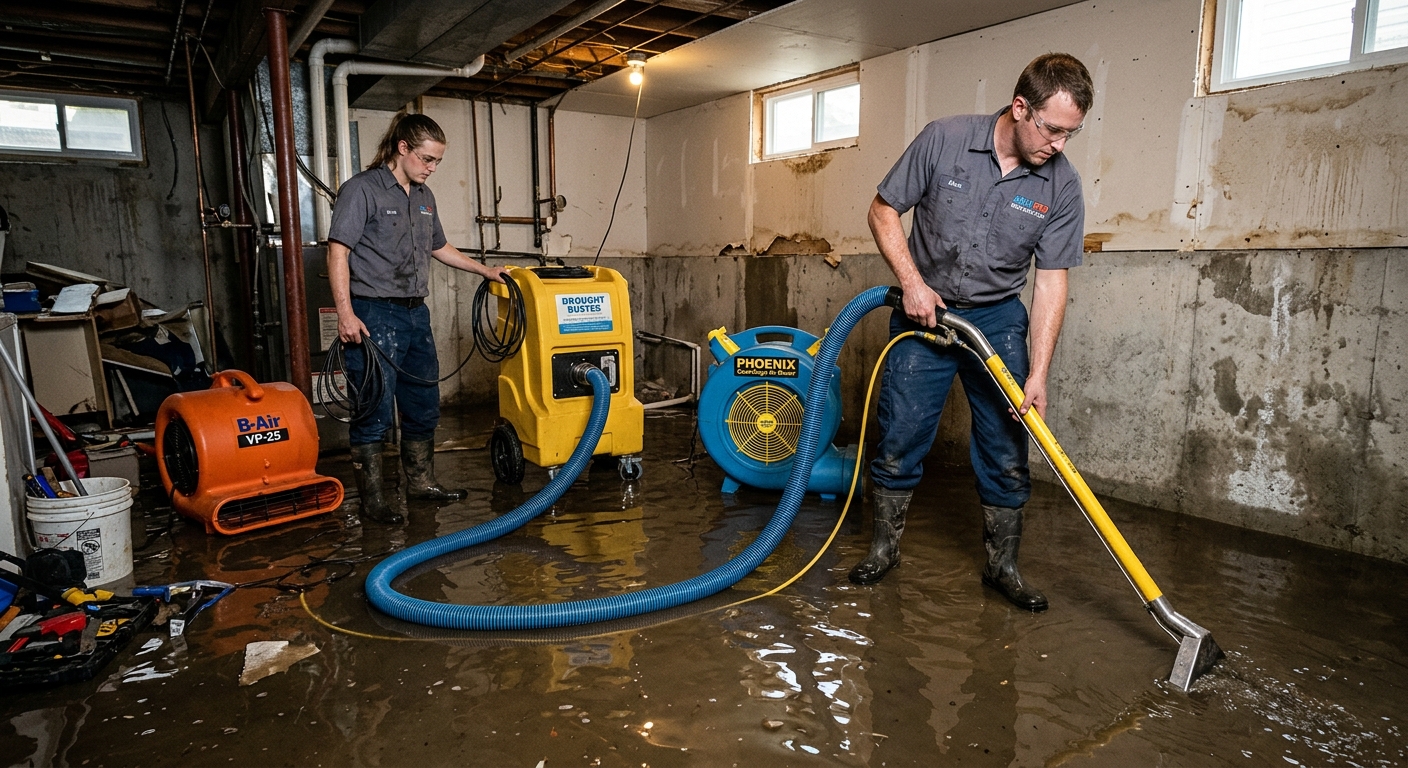
Restoration crews in O’Hara need to do much more than set out fans. Every legitimate job starts with moisture mapping: using a meter to check walls, floors, and sometimes ceilings, logging readings daily. This isn’t just paperwork—it documents drying progress and proves to insurers and you that hidden framing isn’t still soaking. Air movers (high-velocity fans) move water out of surfaces, while LGR dehumidifiers pull that moisture from the air. The two work together to dry both structure and air, running 24/7 for several days until targets are met.
Equipment should never be turned off at night—it slows the process and risks unseen mold growth. Crew members should make daily visits, logging real numbers from their meters. Drying is complete when those logs show everything at or below the “dry standard” for that material, not a guess or how something feels to the touch. In this part of southwestern Pennsylvania, with an average winter design temperature of 8 °F and constant freeze-thaw cycles, outside air isn't used for drying; it’s too damp or too cold.
The test for a competent crew is simple: ask for their daily moisture logs. If they can’t provide them, they weren’t measuring and you should question the whole job.
After the repair: hardening the house
Prevention costs much less than a repeat call to restoration. Here’s what delivers real results for O'Hara homes, in order of impact per dollar:
- Automatic water shutoff valves: These detect out-of-control leaks and cut water fast. Install professionally for $500–$1,200.
- Replacing old washer and water heater supply lines: Aging lines are the top cause of burst-pipe claims in older O’Hara homes. Stainless braided hoses cost $30–$120 per fixture—a plumber can do them both in an hour. Worth every cent.
- Sump pump with battery backup: For hillside basements and clay-rich subgrade, flooding happens when the power goes out. Expect $900–$2,200 for the right setup. Cheap pumps aren't worth the risk.
- Backflow valve: Where the sewer is combined, this stops backups. The right valve runs $700–$2,500 installed; high-value in backup-prone areas.
- Water heater pans and drains: Low-cost peace of mind at $150–$350 for most setups. Only works if a floor drain is present.
- Leak sensors: Place under washers, water heaters, and sinks—avoid fancy Wi-Fi ones unless you travel frequently. A basic set runs $50–$150.
Don’t spend on expensive “whole-house” water monitors unless you have a very large home, frequent travel, or expensive finishes. If your basement pipes freeze: extra insulation and heat tape matter more than gadgets—frost depth in O’Hara is 36 inches for a reason.
Credentials and permits for restoration work in O'Hara
There is no statewide license in Pennsylvania for water, mold, or general restoration work. A business card or logo alone means nothing in Allegheny County—state law does not require specific trade licensing for this work. Industry standards come from the IICRC (Institute of Inspection, Cleaning and Restoration Certification) — ask for the lead technician’s IICRC card, and look for S500 (water loss) or S520 (mold) on their credentials.
Permits: In Pittsburgh, a permit is required if interior structural repairs (framing, load-bearing) are needed after water damage. In O’Hara and similar suburbs, basic cleanup, extraction, and non-structural drying are not trigger points for permits—only once you rebuild do permit requirements kick in, handled by your local municipal office.
Contractors must have a Home Improvement Contractor (HIC) registration from the Pennsylvania Office of Attorney General for jobs over $500—check it at hic.attorneygeneral.gov, and request proof of workers’ compensation coverage, which you can verify online via the WCAIS system. Before work starts, get a clear written contract (required over $500) describing the work, cost, payment schedule, cancellation rights, and confirm it prohibits insurance deductible waivers—those are illegal here.
What to expect week by week in O'Hara
Water restoration in O’Hara runs in two distinct phases that are easy to confuse. First is mitigation: the urgent part—extraction, drying, mold protocol, usually wrapped in 3–7 days, with crews onsite daily. This is the step that keeps a $4,300 claim from ballooning into a much costlier loss, and it's commonly billed directly to insurance.
Once mitigation wraps up, the second phase begins: reconstruction. This covers drywall, plaster, floor replacement, painting, and any structural repair triggered by the initial damage. Reconstruction is not instant—lead times can be anywhere from a couple of weeks to two months in Allegheny County. Here, with a dense field of restoration firms, the good news is you’re unlikely to be left waiting for crews to drive in from another city, but top-quality trades are still in demand.
Expect a gap after the fans and equipment leave; this “silent” period is where many homeowners feel left in limbo. Permitting and scheduling reconstruction contractors can feel slower than the rapid pace of mitigation. Naming the gap in advance lets you ask the coordinator (restoration or adjuster) for real timelines—so you know when work is actually scheduled, not just “pending.”
Outside water, inside water
In O’Hara, the flood risk is real and comes with local quirks. The Allegheny, Monongahela, and Ohio Rivers, plus neighborhoods along Chartiers Creek, drive most flood risk in Allegheny County. If your water damage is from one of these sources—storm-driven river flooding, creek overruns, or groundwater surging up through a basement slab—your standard homeowner’s policy will not cover the loss. Flood insurance is always a separate purchase, federally backed, and it nearly always carries a 30-day waiting period. No buying it when the creeks start to rise.
This is crucial because a flooded home and a burst pipe can look identical once the basement is underwater—but your claim is treated entirely differently. A pipe break or washing machine overflow inside the walls? Covered, if sudden and accidental. Overland flooding from a creek? Not covered, unless you bought a flood policy in advance.
Every property’s flood risk is mapped by FEMA; your mortgage may require flood insurance if your home is in or near the official zone, but it’s worth checking even if your bank doesn’t ask. If you’re in a questionable spot, get a clarity from your insurer before water finds its way in. Flood events do not play by the same rules as plumbing leaks or appliance failures, and the fine print matters in O'Hara.
Frequently asked questions — water damage restoration in O'Hara
How do I know the house is actually dry?
To confirm your O’Hara home is truly dry after water damage, insist on more than a visual check or a “feels dry” test. Professional crews track drying with digital moisture meters and log readings for each room and building material, day by day. Always ask to see those daily moisture logs before signing off. If you’re not handed them, or the numbers don’t reach your home’s dry standard, push for additional drying. Failing to hit the mark leads to hidden mold, sagging drywall, or warped floors—problems that could drive up your $4,300 extraction bill to well into mold remediation territory (think $1,650–$11,500 for typical cleanup). Don’t let a team skip this crucial step—demand documentation you can keep.
How long before mold starts growing?
Mold can start forming in as little as 48 hours in the humid basements common throughout O’Hara and other parts of Allegheny County. With older homes and frequent basement water, this window comes up quick. Even in winter, once water gets into drywall or wood framing, the clock is ticking for surface and hidden mold to take root. That’s why immediate extraction and drying are crucial—delays push a simple dry-out at $1,300–$8,300 toward extensive remediation. If you see visible mold or musty odors, don’t ignore them; request an inspection and, when in doubt, ask for the crew’s IICRC credentials as proof they follow industry standards.
Do I need separate flood insurance in O'Hara?
Yes, in O’Hara, standard homeowners’ insurance does not cover water that enters from outside sources—like the Allegheny or Monongahela Rivers, or from creek and hillside flooding. Flood insurance is a separate policy, often required by lenders only in mapped flood zones, but local risks exist even outside those areas. Don’t wait until a weather event is forecast—flood insurance requires a 30-day wait before it covers anything. The cost for flood damage cleanup can easily hit $2,800–$13,000, but without a flood policy, you’ll pay out of pocket. If your basement sits near Chartiers Creek or a hillside runoff area, check your address’s risk and act before the water comes.
Is emergency after-hours service more expensive in O'Hara?
In Allegheny County’s dense restoration market, with firms stationed locally and not coming in from another metro, after-hours rates stay relatively stable. You’ll pay within the same price band—such as $1,300–$8,300 for water extraction—even if you call at 2 a.m. However, faster response always saves on hidden costs: letting wet materials sit overnight increases the odds you’ll need full-scale mold remediation, which can be far pricier. The main reason to call overnight isn’t a lower rate—it’s to start the clock before the damage (and costs) grow.
How do I verify a restoration contractor's insurance?
In Pennsylvania, it’s your right to request (and receive) proof of a contractor’s liability insurance and workers’ compensation coverage before any restoration starts on your O’Hara home. All legitimate contractors must carry these—especially anyone handling jobs above $500. You can double-check workers’ comp status using the public WCAIS database. For insurance itself, ask to be named as a certificate holder on their policy for your address and project. Make sure the business name on their insurance matches their contract and HIC registration. In this market, plenty of firms operate correctly—don’t settle for someone who won’t provide written proof up front.
What if the insurer's estimate is lower than the contractor's?
It’s not unusual for an insurance adjuster’s initial estimate to fall short of a local contractor’s real-world bid, especially around Allegheny County where older homes can conceal hidden damage. Ask for the insurer’s full scope in writing, line by line, and compare it to the contractor's breakdown. If the adjuster’s estimate won’t cover proper drying (typically $1,100–$7,700 for structural drying only), push back with the contractor’s daily logs and any extra documentation. You’re entitled to fair repair based on real costs—sometimes it takes another inspection, or involving your contractor to clarify site conditions, for the insurer to adjust their loss payout.
Does wet insulation have to be replaced?
Nearly always, yes. In O’Hara’s older houses, wet insulation—especially fiberglass batts—doesn’t dry out completely once soaked. Left behind, it compresses, loses R-value, and can become a hidden breeding ground for mold and musty odors. If your water loss soaked wall cavities, expect crews to remove and replace the affected insulation as part of proper mitigation. This usually falls under your dry-out scope, with cost reflected in water extraction and drying bands ($1,300–$8,300). Don’t let a crew skip removal to save time; it will cost more to fix mold behind finished walls down the road.
How does southwestern Pennsylvania's climate affect drying times?
O’Hara and Allegheny County have a climate with cold winters (winter design temp 8 °F), high humidity, heavy freeze/thaw cycles, and up to 5,600 heating degree days annually. Outdoor air is too damp to help much—even in summer rains, condensation forms fast in a cool basement. That means drying here must rely on dehumidification and air movers, not just open windows or heat. Expect proper dryouts to require 3–7 days of constant equipment, with daily meter readings logging progress. Trying to cut that time short is false economy: mold grows fast, turning a <$4,300 drying job into much more costly remediation. Always push for daily logs from your crew as proof.
How much does water damage restoration cost in O'Hara?
For a typical job—such as water extraction and emergency drying after a burst pipe or appliance failure—costs in O’Hara range from $1,300–$8,300, with the average dry-out sitting around $4,300. Sewage backup or mold remediation can run higher, reaching up to $13,000 for large, complicated losses or homes where water sat for days. Factors that swing the cost most are how long the water was present, the area affected, and if there’s secondary damage like mold. Homeowner’s insurance usually covers sudden and accidental events, while flood events require separate policies—and can run out-of-pocket if not covered.
Can I clean up water damage myself in O'Hara?
For very minor spills on tile or concrete, a careful O’Hara homeowner might manage with fans and dehumidifiers—if all water is removed within a couple hours and nothing seeped into walls or floors. But in most local basements, especially with old finishes or carpet, water moves fast into cracks, subfloor, and insulation. Without commercial-grade extraction and continuous drying (which you’d pay $1,100–$7,700 for), DIY efforts almost always leave moisture behind, leading to hidden mold and bigger bills later. If you’re unsure, have a restoration pro use a moisture meter to spot hidden water before assuming all is safe. Sometimes, spending a little now prevents a lot more damage down the line.