What water damage restoration costs in New Sewickley
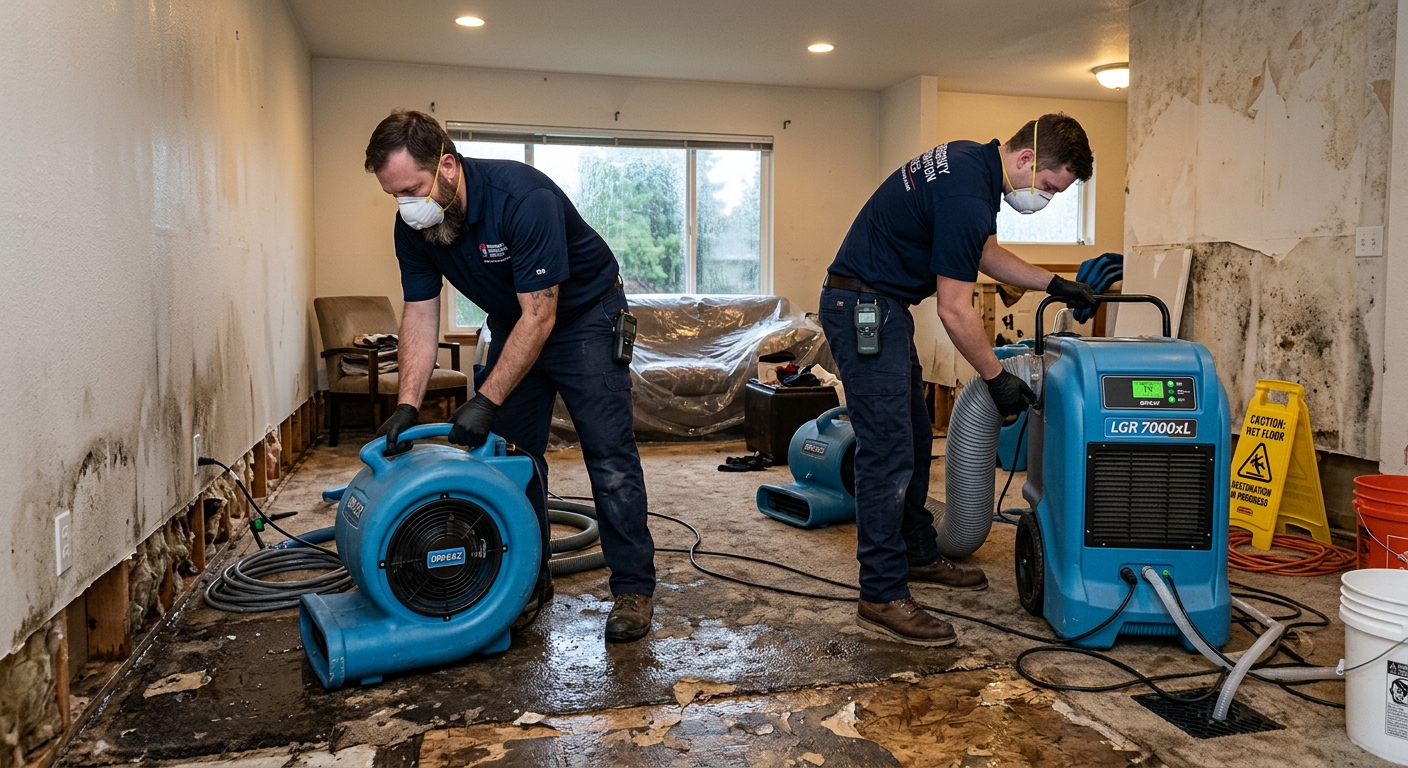
If you’re looking up water damage restoration costs in New Sewickley, chances are you have water in your basement or living area right now. Here's what you should know about costs here, fast: Older homes dominate this area—over half are built before 1980 and most are single-families (U.S. Census Bureau, ACS 2024). That means aging pipes and full basements, both of which spell a higher chance for water claims and, often, more extensive repairs. Interior leaks from old plumbing in places like Beaver Falls and Aliquippa drive more cleanwater (and not-so-clean) losses than you'd see in newer suburbs. The presence of full basements—common across Beaver County—means more areas for water to find, but also more chance for things to go unnoticed until extraction, drying, and sometimes mold work are all needed.
| Service |
What it covers |
Typical duration |
Price range |
| Water extraction + emergency drying (Cat 1) |
extraction, air movers, LGR dehumidifiers, daily moisture monitoring |
3–5 days |
$1,150–$7,100 |
| Structural drying only (post-extraction) |
drying to standard after water is already out |
3–5 days |
$950–$6,600 |
| Mold remediation with containment |
containment, HEPA filtration, removal, antimicrobial, clearance test |
3–7 days |
$1,400–$9,900 |
| Sewage backup cleanup (Cat 3) |
biohazard protocol, disposal of porous materials, disinfection |
2–5 days |
$2,400–$11,500 |
| Emergency board-up / tarping |
stop further water entry, secure the structure |
same day |
$350–$900 |
Estimates for a typical New Sewickley home. Category, affected area and how long the water sat move these figures more than anything else.
Mitigation, then reconstruction: two different timelines
The most common surprise for New Sewickley homeowners is that water restoration happens in two main phases with a dead spot in between—and nobody tells you this up front. When a pipe bursts or sewer backs up, mitigation starts immediately: extraction, drying, and containment (if there’s mold or biohazard). That’s urgent work, typically completed in 3–7 days and sometimes billed directly to your insurer. But once the equipment comes out and your structure is dry, everything stops—because now you’re waiting on reconstruction. That means drywall, trim, paint, flooring, sometimes subfloor and baseboard replacement. It’s a separate crew (often a different company), requires a new contract, and generally isn’t scheduled until mitigation passes a dry-out verification and you have an insurance adjuster-approved scope.
Reconstruction takes weeks or even months, especially in Beaver County where several restoration firms dispatch crews from metro Pittsburgh. Even with moderate suburban contractor density, your project gets in line—and bigger disasters (like severe storm surges along the Ohio or Beaver rivers) bump up all lead times. That quiet gap—between “all equipment gone” and “carpenters arrive for repairs”—leaves many homeowners concerned something is wrong. It isn’t. Ask for written clearance and adjuster approval so you know exactly where you stand. Good communication sets expectations and relieves most worry during that gap period.
Your belongings after a water loss
In the rush to dry out the house, many New Sewickley homeowners miss documenting possessions—often because they don’t realize “contents” and “structure” are two separate claims. If water, especially from a backed-up sewer or long-sitting flood, has affected your home, reputable restoration crews will offer pack-out: carefully inventorying, photographing, boxing and transporting your salvageable items off-site for cleaning and drying while your house is repaired. Before anything moves, take photos yourself. Insurers expect a written inventory with supporting pictures for any contents reimbursement, and you’ll want personal proof of what was lost or damaged.
Some items rarely survive: upholstered furniture exposed to Category 3 (sewage/groundwater) goes straight to disposal for health reasons, as do mattresses and most particleboard furnishings that soak up contamination. Hardwoods, solid tables, and many electronics (if not fully submerged) may be worth restoring—especially if you have replacement cost coverage. Appliances, clothing, and sentimental items get case-by-case consideration. Don’t let anyone toss anything until you’ve had a chance to photograph, list, and talk to your adjuster. Document everything—underdocumentation is the most common, and most expensive, homeowner mistake here.
Choosing a restoration company in twenty minutes
No one in New Sewickley plans for an urgent water loss, and the usual slow-burn advice—three written quotes, interviews, checking references—just doesn’t work when water is on the floor and crews are stacking up jobs. With multiple major firms and independents serving Beaver County from Pittsburgh, someone can usually be there fast, but your first call should still cover the basics: (1) ask if they’re properly registered as a Home Improvement Contractor with the Pennsylvania Office of Attorney General (every contract over $500 requires this); (2) verify that they carry current workers’ compensation insurance (get the certificate, not just a verbal “yes”); (3) request confirmation that they'll provide a written scope and contract before any work begins. Before equipment is unloaded or demolition starts, you should have:
- PA HIC registration and number (verify at hic.attorneygeneral.gov)
- Certificate of insurance showing workers’ compensation (checkable at wcais.pa.gov)
- Lead technician’s IICRC card—this is your best assurance of S500 adherence
- Detailed, written contract with price or price method stated
- Scope of work you can compare to your adjuster’s estimate
- Clear explanation of who is present, their employer, and their role
- Timeline—expected start and finish for mitigation
- Cancellation rights in writing (HICPA gives you three business days on jobs over $500)
- Written acknowledgment that waiving your insurance deductible is prohibited
- Name and number for a manager or owner, not just a supervisor on site
Beware of crews unloading equipment before you’ve seen any paperwork, any blank or unsigned “work authorizations,” and any pressure to sign before you’ve spoken to your insurer. Honest companies slow down when you ask questions—they don't rush the contract step.
Why your neighbour's bill was half of yours
Two things drive water restoration bills in New Sewickley—but they’re easy to confuse. First is CATEGORY: how contaminated the water is. Second is CLASS: how much of the structure (like drywall, subfloor, or insulation) absorbed it. Homeowners often compare only area and timing, but a small Category 3 (sewage) loss can be twice the cost of a much larger cleanwater (Category 1) job. For example, even a contained basement sewage backup will usually cost somewhere between $2,400–$11,500 because of the biohazard protocol, no matter the square footage, while a full-room cleanwater drying might be as little as $1,150–$7,100.
The critical point is time: cleanwater (Category 1) degrades to Category 2, and then to Category 3 (biohazard) if left more than 72 hours. This is why delays spike bills—every day can push an easily dried supply break into full gut-out, antimicrobial, and clearance testing territory. Your neighbor’s leak, discovered and remediated day one, was cheaper than your three-day-old backup. Mold and class—whether water got into brick, hardwood, or plaster—add another layer. Deep, old Beaver County basements with wet subfloor (Class 4) are simply more labor-intensive than small, surface-only (Class 1) events.
| Classification |
Source or extent |
Health risk |
Cost effect |
| Category 1 — clean |
supply line, appliance line, rainwater |
low |
baseline |
| Category 2 — grey |
washing machine, dishwasher, sump failure |
moderate |
+20–40% |
| Category 3 — black |
sewage, groundwater, water standing 72+ hrs |
biohazard |
$2,400–$11,500 |
| Class 1 |
small area, little absorption into structure |
— |
low end of service1 |
| Class 2 |
whole room, water into walls and subfloor |
— |
$1,150–$7,100 |
| Class 3 |
saturation from above; insulation and walls wet |
— |
$950–$6,600 |
| Class 4 |
deep saturation of hardwood, plaster, concrete |
— |
service2 upper range |
Regulation, certification and verification in New Sewickley
If you’re comparing companies for water damage or mold work in New Sewickley, know there is no Pennsylvania state license for restoration or mold remediation. Anyone can offer the service—so a business card proves nothing by itself. The industry standards insurers and adjusters expect are IICRC S500 (for water) and S520 (for mold). Always ask for the lead technician’s IICRC card, not just a company plaque. For proper contracts (over $500), the firm must have a valid Pennsylvania Home Improvement Contractor (HIC) registration—verify this at hic.attorneygeneral.gov before you sign anything.
Permits from your local code office are usually not required for emergency mitigation—just for reconstruction. That includes wall or floor replacement, structural carpentry, or any electrical rewiring (which is municipally licensed). Always request a current certificate of workers’ compensation insurance and check it via the state WCAIS system (wcais.pa.gov), since every employer is required to carry coverage. Never let anyone start extracting, demoing, or hauling before you have a contract, full scope of work, and evidence of both HIC registration and insurance in hand.
Filing a water damage claim in Pennsylvania
For New Sewickley homeowners, the costliest misunderstanding comes down to what your insurance covers: sudden internal water (a burst pipe, broken supply line) is typically covered under standard homeowner policies—but any surface floodwater entering from outside the home is generally excluded unless you bought separate flood coverage. Many discover this only when the Ohio or Beaver River rises, and it’s too late to adjust.
Gradual leaks and maintenance issues—like an old pipe that’s been seeping for weeks, or water staining left unaddressed—are usually excluded as well. If your backup is from the sanitary sewer (common in Beaver Falls mill-era homes), you often need a special sewer backup rider: this isn’t usually part of base coverage. Policy type matters, too: “Actual cash value” means depreciation gets deducted from your claim, while “replacement cost” pays what it takes to actually buy new materials.
Your adjuster will create a scope of loss document that both sides reference, but it’s rarely the final word—contractor estimates frequently come in higher. Direct billing to the insurer or an “assignment of benefits” simplifies cashflow but gives the contractor the right to deal directly with your insurer—and often means you have less control if there’s a dispute. Pennsylvania’s Home Improvement Consumer Protection Act (HICPA) requires a written contract over $500, with a three-business-day right of cancellation. If anyone offers to waive your deductible, that’s both illegal here and a red flag for shady practice—insurers and the state view this as insurance fraud. Never sign a blank or incomplete contract under pressure.
Frequently asked questions — water damage restoration in New Sewickley
Is emergency after-hours service more expensive in New Sewickley?
Emergency water damage service is almost always more expensive after-hours, and this holds true in New Sewickley. If you call at 2 AM during a rainstorm or sewer backup, expect charges toward the upper end of the local range—often $3,700–$7,100 for full extraction and drying, especially if crews are already booked in Beaver Falls or along the river valleys. However, immediate response can save hundreds or even thousands later, since every hour that water sits ups the chance it degrades into a higher (and more expensive) category of loss. Always get a price or minimum response fee in writing when calling after-hours, and know that most insurers cover these costs if you can document that waiting until morning would make the damage worse.
What is the difference between water damage class and category?
In New Sewickley, understanding the difference can save you confusion and money. Category refers to the contamination level of the water—like Category 1 (clean from a supply line) versus Category 3 (sewage or long-standing water). Class, on the other hand, is about how much of the house materials have gotten wet—Class 1 is just a small area and Class 4 means water’s soaked into concrete, plaster, or hardwood. For example, a basement sewage backup (Category 3) covering 100 square feet may cost more—between $2,400–$11,500—than a cleanwater pipe burst (Category 1) that soaks two rooms. The highest costs often happen when high category meets deep class. Always ask your restorer which you’re dealing with so you’re not surprised by the bill.
What if the insurer's estimate is lower than the contractor's?
This happens all the time in Beaver County and New Sewickley—especially when adjusters use generic software pricing and local contractors account for our specific construction or materials. If your contractor’s estimate for water extraction and drying is $3,700 and your insurer’s scope only allows half that, compare the actual scopes of work line by line. Sometimes the insurer missed upgrades (like plaster repair common in older Beaver Falls homes) or omitted pack-out services. Frequently, the adjuster has authority to negotiate up with more detail or justification—having photos, itemized inventories, and moisture readings strengthens your case. Most reputable restorers will talk directly with your adjuster, but don’t accept being shortchanged without a conversation. If there’s still a gap, Pennsylvania law gives you the right to a fair, written dispute process.
Are New Sewickley basements especially prone to flooding?
Yes, and the reason ties directly to the area’s landscape and construction. Most New Sewickley homes have full basements, and hillside lots above the Ohio and Beaver rivers force groundwater toward foundation walls. Combine that with clay and shale-rich soils and historic sanitary sewer systems in nearby towns like Beaver Falls, and backups or seepage are common. Many water claims here involve basement flooding, sometimes requiring both extraction and full drying at a cost ranging from $1,150–$7,100. Groundwater intrusion is rarely covered by standard homeowners’ policies, so knowing your risk and coverage up front is key.
Is bleach effective against mold?
Bleach is not considered effective against mold in New Sewickley homes—especially with older plaster, drywall, or basement walls, where roots and hyphae extend below the surface. While bleach can kill surface spores, it doesn’t penetrate porous materials like those found in the area’s 1900–1950 mill-era homes. Professional mold remediation, with full containment and HEPA filtration, generally costs $1,400–$9,900 but includes removal down to clean substrates and clearance testing to verify results. Don’t waste effort (or money) on DIY bleach “removal”—it’s only masking the problem.
Does insurance cover mold after water damage?
In New Sewickley, typical homeowners’ policies don’t cover mold that results from neglected or long-standing water problems. If the mold results directly from a covered sudden water loss—such as a pipe burst—it may be partially covered, but with strict limits (often well below the actual remediation cost of $1,400–$9,900). However, mold from ongoing leaks, high humidity, or surface flooding (Ohio or Beaver River overflows) is nearly always excluded. Review your policy for mold endorsements and notify your insurer as soon as you see possible mold growth after water damage to avoid claim complications.
Why is water damage priced per square foot?
The per-square-foot pricing you hear about in New Sewickley is a baseline—labor and equipment are both deployed by area. But square footage is just the start; the total is always bumped up or down by the category (contamination) and class (depth of saturation). Removing water and drying a basement here might run $1,150–$7,100 for a full space, or much less for a smaller area. But deep saturation in older construction, with multiple layers or built-in cabinets, can make a small job cost more per foot than a larger, surface-only job. The total bill always reflects the full scope, not just raw area.
What is a clearance test and do I need one?
A clearance test is a third-party verification (sometimes by air or surface sampling) that an area affected by water or mold loss is safe and meets recognized cleanup standards. In New Sewickley, it’s most often required after Category 3 sewage cleanup or antimicrobial mold remediation—jobs that fall at the upper end of the cost range, such as $1,400–$9,900. Some insurers mandate clearance before approving reconstruction, especially in older homes where health risks are higher. For small, cleanwater-only jobs it’s rarely needed, but for anything with potential for hidden contamination, a clearance test provides both peace of mind and crucial paperwork for resale or tenant safety.
Can I wait until morning to call?
Sometimes you can, sometimes you shouldn’t. In New Sewickley, if a basement is merely damp from seepage and no more water is entering, it’s safe to document thoroughly, take preventive steps, and call first thing during regular hours—saving you from after-hours rates (which can reach $3,700–$7,100). But if water’s still pouring in, sewage is present, or you see arcing outlets, waiting risks turning a manageable event into a major, more expensive (and more hazardous) loss. Always stop the source if you can, move valuables to safety, and when in doubt, call a pro for free advice—any reputable company in Beaver County will talk you through the specifics before sending a truck.
Do I need a permit for water damage repairs in New Sewickley?
You do not need a permit for extraction, drying, or containment—the immediate restoration work in New Sewickley. Local code enforcement only gets involved when reconstruction happens: drywall, flooring, carpentry, or any structural or electrical trade beyond basic tear-out and cleaning. Those steps, especially after a major sewer backup or structural damage, may require a permit through your town or city code office. For the initial mitigation, just make sure your contractor follows all required Pennsylvania registration and insurance rules. If you roll right into repairs, ask your contractor to handle the permitting and verify it’s included in your written scope of work.