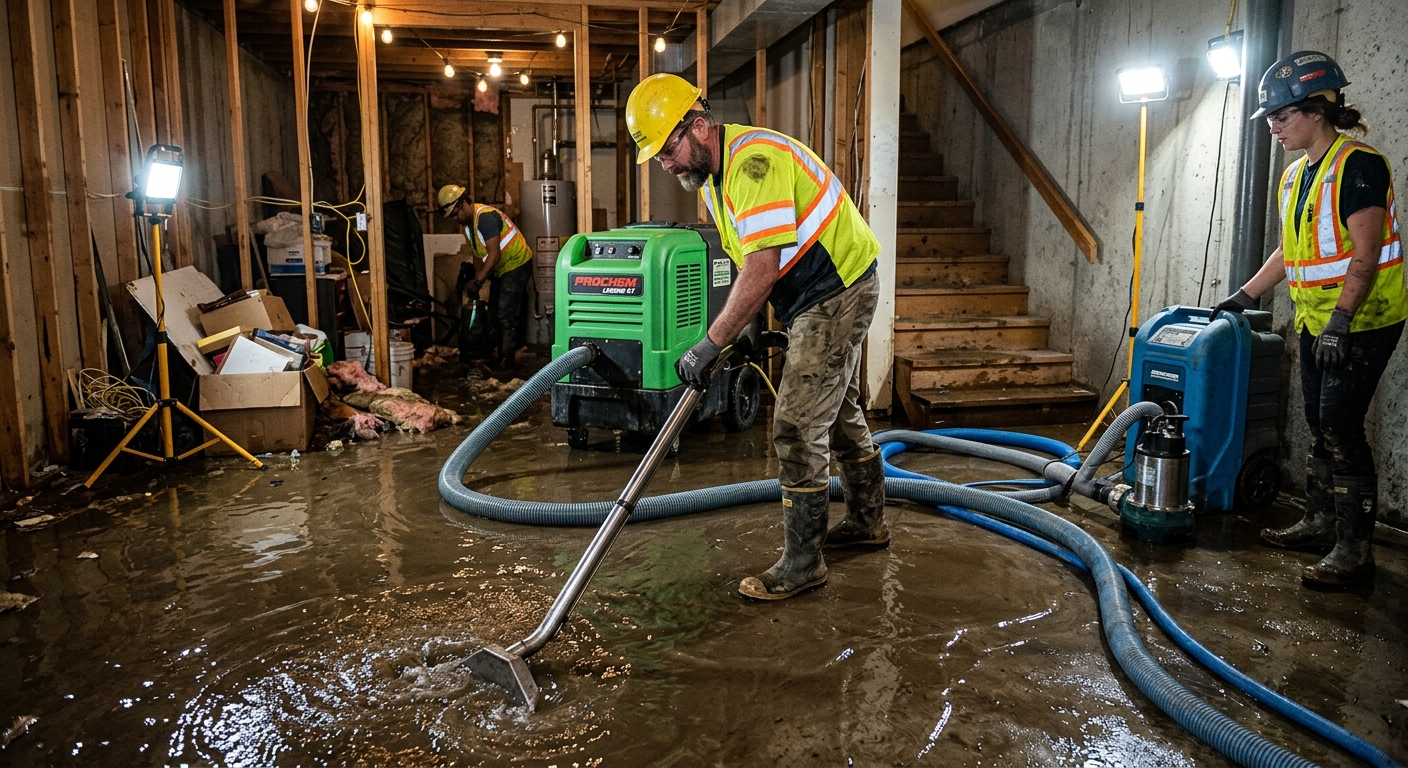
New Cumberland water damage pricing by scope — 2026
If you’re reading this in New Cumberland, you may already be dealing with wet floors and the clock ticking on a water loss. Numbers matter now, so here’s what real jobs cost in Cumberland County—and why. Most houses here were built before 1980, and single-family homes account for more than 65% of properties (U.S. Census Bureau, ACS 2024), many with full basements that invite trouble when supply lines or old cast-iron drains go. Recurring claims in the post-1960 tracts of Hampden and Lower Allen Townships are fueled by aging plumbing. That history means the costs and scope below reflect what insurance and restoration contractors see day to day in this area: not catastrophic flood, but burst pipes and basement intrusions in traditional construction.
| Service |
What it covers |
Typical duration |
Price range |
| Water extraction + emergency drying (Cat 1) |
extraction, air movers, LGR dehumidifiers, daily moisture monitoring |
3–5 days |
$1,200–$7,400 |
| Structural drying only (post-extraction) |
drying to standard after water is already out |
3–5 days |
$1,000–$6,900 |
| Mold remediation with containment |
containment, HEPA filtration, removal, antimicrobial, clearance test |
3–7 days |
$1,500–$10,500 |
| Sewage backup cleanup (Cat 3) |
biohazard protocol, disposal of porous materials, disinfection |
2–5 days |
$2,500–$12,000 |
| Emergency board-up / tarping |
stop further water entry, secure the structure |
same day |
$350–$900 |
Estimates for a typical New Cumberland home. Category, affected area and how long the water sat move these figures more than anything else.
Salvage decisions after a water loss
In New Cumberland homes—especially in the post‑1960 subdivisions of Hampden and Lower Allen Townships—water losses usually start in finished basements or main-level bathrooms with aging copper pipes or cast-iron drains. That means you’re dealing with common materials: drywall, fiberglass insulation, solid and engineered wood flooring, particleboard cabinetry, and the occasional old-school plaster wall. Here’s what you can truly expect to save:
- Fiberglass insulation and carpet pad: Almost always removed. They hold water and dry poorly, creating high mold risk. Save the hassle; these aren’t worth fighting for.
- Drywall below the waterline: Typically cut out, even after prompt drying. If the area is small and you catch it same-day, some pros may try drying in place, but persistent moisture invites hidden mold.
- Solid hardwood: Can sometimes be rescued using floor mats and specialty drying equipment, but only if extraction and drying start fast. Engineered flooring almost always delaminates or warps—rarely worth saving.
- Plaster walls: Older homes with plaster (especially in full basements) dry much slower than drywall and can retain moisture unseen for weeks. Expect more cautious demolition or extended monitoring here.
- Cabinets: If made of plywood or hardwood, rapid drying may salvage them. Particleboard cabinets—common in tract homes—tend to swell and crumble, usually meaning replacement.
If a restoration firm in Cumberland County pushes for full-gut removal on every job, be wary—they might be padding the demo (and your bill). But a company that promises to “save everything” after standing water, especially on drywall and fiber-filled areas, may be setting you up for a mold claim down the road. Honest mitigation means acting fast, cutting where needed, and documenting every decision. If in doubt, ask for daily moisture readings and keep your own notes.
Choosing a restoration company in twenty minutes
In the Harrisburg–Carlisle metro area, New Cumberland homeowners have more options than most: the market is saturated with regional restoration firms, so expect actual competition and fast response—sometimes within the hour. With so many crews based in and around Mechanicsburg and nearby townships, you don’t need to settle for the first truck that answers. But when water is still on the floor, you will need to choose quickly. Here’s how to make a fast, sound decision:
On the initial call, confirm three things:
- They have an active Home Improvement Contractor registration (check at hic.attorneygeneral.gov).
- They carry Pennsylvania-mandated workers' compensation (verify via WCAIS if needed).
- They have the right gear and crew for your loss type (not just a sales rep).
Before letting equipment off the truck, have these in hand:
- Written, signed contract (for work over $500 per HICPA).
- Proof of insurance (declaration page naming their company, not just a “policy available on request”).
- Scope of work—detailed, not “to be determined.”
- Local address or proof they routinely serve this area.
- Lead technician’s IICRC credentials, if offered.
- Estimate of start-to-completion time based on your loss category.
- No pressure to sign before you read the contract—walk away otherwise.
- No blank signature pages or ambiguous authorizations.
- No emergency crew unloading until you have agreed to terms.
- Names and numbers for references—not just a website testimonial.
Pushy tactics show up often: blank work authorization forms, “this is standard procedure” when no contract is finished, or crews rolling out hoses before you’ve agreed to anything. In Cumberland County, real firms can prove their credentials, paperwork, and insurance—get those before you sign or pay.
Mitigation, then reconstruction: two different timelines
In New Cumberland, water damage recovery runs on two clocks: mitigation and reconstruction. Mitigation is the urgent phase—getting water out, stopping further damage, pulling baseboards, and powering up dryers. It’s fast (usually three to seven days), often direct-billed, and the crew moves on once dry standards are met. This is usually where homeowners feel abrupt quiet; the equipment leaves, and suddenly… nothing seems to happen.
That gap is normal. Reconstruction (repairing drywall, flooring, painting, or rebuilding cabinets) triggers its own set of steps—permits, approvals, and, more often than not, a new crew. In the Harrisburg–Carlisle metro market, the number of active contractors means lead times can range anywhere from one to six weeks, depending on logistics and local demand. During busy seasons, expect delays.
If you feel “abandoned” between drying and rebuild, know it’s part logistics, part paperwork, and part scheduling with adjusters and local code offices. Get clarity up front on who is handing off your project to whom—and don’t hesitate to call the original mitigation firm for updates if nothing is happening after the dryers leave. Understanding the break between phases keeps expectations grounded.
Contents: pack-out, cleaning and what you can claim
Most New Cumberland homeowners under-claim after a water loss—not just on the structure, but on everything inside. If your basement or first floor floods, professional restoration firms will often propose a contents “pack-out”: tagging, inventorying, and moving your belongings to an off-site facility for drying and cleaning. This process protects what’s salvageable and streamlines the restoration of your home.
The golden rule: photograph everything before it moves. Create an inventory (organized by room, make/model if possible), and match those against your insurance policy—most divide structure from contents, and your limits for each may differ. Porous items like upholstered furniture and mattresses exposed to Category 3 (sewage) water are almost never salvageable. Particleboard bookshelves and knockdown desks will usually swell and collapse—don’t waste money restoring them. Solid wood, glass, metal, and hard plastics generally fare better and can be cleaned, especially with prompt action.
Expect your restorer to recommend a mix of cleaning, disposal, and claim documentation, all itemized. Don’t rush this step—loss adjusters want clear evidence before approving reimbursement or salvage. If in doubt, call the claims desk before you authorize anything to be thrown out or packed away.
Flooding vs plumbing failure in New Cumberland
In New Cumberland, your exposure to outside flood isn’t just theoretical—proximity to the Conodoguinet Creek and Yellow Breeches Creek in Hampden, Silver Spring, and Upper Allen Townships drives real, recurring flood claims. If your water loss came from outside—river overflow, creek surge, or surface runoff—it falls under “flood” in official terms, not a standard homeowner’s policy. Flood insurance must be purchased separately, and carries a typical 30-day waiting period, so if the forecast is turning, it’s already too late to add coverage for this event.
By contrast, water from inside—burst pipes, failed appliances, toilet overflows (unless it’s Category 3 or sewer backup)—is “plumbing failure” and is included, subject to your deductible and policy language. Here’s the catch: a home flooded by creek water looks nearly identical to one soaked by a burst pipe, but the adjuster will scrutinize source and documentation. You may have a flood zone designation for your address; your lender or insurance agent can clarify this. And while mitigation work (like extraction and drying) happens the same way in both cases, coverage, reimbursement, and claim timelines split sharply. Knowing this difference up front saves grief.
Regulation, certification and verification in New Cumberland
There is no state licensing statute for water damage restoration or mold remediation in Pennsylvania—so in New Cumberland, a business card or logo alone means nothing. The expected standard is IICRC S500 for water damage and S520 for mold; any legitimate contractor should supply the lead technician’s IICRC certificate and explain their training. For mold, ask if they follow the S520 protocol and if they conduct independent clearance testing upon completion.
Permits are not required for emergency mitigation, only when reconstruction involves replacing framing or wall systems—such as in Carlisle borough, where a permit is typically triggered by structural drying that includes wall system replacement. Replacing just carpet or trim usually does not need a permit in Hampden Township.
For contracts over $500, a written contract is required by state law, with a three business-day right of cancellation. Before any work starts, ask for proof of current Home Improvement Contractor registration (verified at hic.attorneygeneral.gov) and a certificate of workers’ compensation insurance (which you can check through WCAIS). Have these, plus a detailed written scope, in hand before a crew extracts a drop of water.
Frequently asked questions — water damage restoration in New Cumberland
How fast do restoration companies respond in New Cumberland?
In New Cumberland, most reputable restoration companies can be on site within two hours—often faster, thanks to the concentration of regional firms in the Harrisburg–Carlisle metro area. Unlike rural parts of Cumberland County, where long response times are common, local residents benefit from routinely stationed crews in Mechanicsburg, Carlisle, and surrounding townships. In true emergencies (catastrophic leaks, active sewage backups), it’s normal for a foreman and setup team to arrive the same day, with the full crew following within hours. For reference, the typical price range for water extraction and emergency drying here is $1,200–$7,400, depending on scope. Still, speed shouldn’t trump paperwork: make sure you confirm credentials and scope—even under stress—before letting anyone unload equipment or tear out materials.
Is basement flooding covered by insurance in Pennsylvania?
In Pennsylvania, including New Cumberland, basement flooding coverage depends entirely on the source. If your water comes from a burst pipe, water heater, or failed supply line, your standard homeowner’s insurance usually covers both structural and contents restoration after your deductible, with jobs typically running $1,200–$7,400 for extraction and drying. If the flooding is from outside—such as the Conodoguinet Creek or Yellow Breeches Creek breaching during a storm—this is classified as “flood” and not covered by a standard policy. Flood insurance must be purchased separately (with a waiting period) and many homeowners in Cumberland County skip it, not realizing until they face a loss. Always check your declarations page or call your agent to verify.
What water damage can I safely handle alone?
For New Cumberland homeowners, tackling a water leak yourself is often safe if the affected area is less than 10–15 square feet, involves clean water, and was discovered right away. You can pull up wet carpets, run fans, and remove baseboards if you’re comfortable—but monitor carefully for hidden moisture or mold. Anything larger, water that’s migrated behind walls, or any sign of sewage should be left to pros. Mishandling these can turn a small problem into a major mold claim. Professional extraction and full structural drying for even a mid-sized room starts around $1,000–$6,900; overreaching to save a few dollars could double the final bill if rot or contamination takes hold. If in doubt, make the call—an honest contractor will tell you if you don’t need them.
How do I know the house is actually dry?
In New Cumberland, houses—especially those built pre-1980—vary in how they dry, but no reliable restorer should “guess” based on touch or appearance. Every reputable restoration technician will provide daily moisture readings using meters (pin or pinless) and record levels for drywall, subfloor, and framing. You should receive a dry log showing these numbers. Equipment comes out only after readings match “dry standard” levels based on unaffected areas or industry tables. A typical structural drying job runs $1,000–$6,900, and if a company can’t show you clear, logged results, don’t sign off on completion. Insist on seeing numbers for every material before payment.
Is sewer backup covered under a standard policy?
In most New Cumberland homes, standard homeowner’s insurance excludes damage from a sewer backup unless you’ve purchased specific sewer or sump pump coverage. This matters with municipal systems in Camp Hill and nearby boroughs, where basement backups occur in older neighborhoods. Cleanup of a Category 3 (sewage) loss is pricey—often between $2,500–$12,000. Without an endorsement, you’ll be paying out-of-pocket for biohazard removal and reconstruction. Always check your declarations page, and consider adding the coverage if you have a finished basement, as these claims are common in Cumberland County.
What is the difference between water damage class and category?
In restoration, especially in Pennsylvania, “category” describes the water source (clean, gray, or black/sewage) while “class” relates to how much and how deeply water has penetrated building materials. A Class 1 job in New Cumberland’s typical split-level might be just a room’s carpet, while Class 3 means water wicked up several feet of sheetrock and into insulation. Category 1 (fresh supply-line) is much easier and cheaper to restore—starting around $1,200–$7,400—while Category 3 (sewage) raises health risks and costs significantly. Your adjuster will use both terms to decide what gets replaced, what can be dried, and how fast work must start, so it’s worth asking your restoration contractor which applies to your loss.
How does south-central Pennsylvania's climate affect drying times?
South-central Pennsylvania’s climate is defined by pronounced freeze-thaw cycles and moderate humidity, especially in winter. In New Cumberland, this means basements and crawlspaces can stay cool and damp after a loss, slowing the drying process. With a winter design temperature of 12°F and 5,200 heating degree days, crews may need to supplement with heat for effective drying, especially in older homes with thick plaster or full basements. The extra work and time is reflected in the typical price range—structural drying costs run $1,000–$6,900 here. Always ask your contractor what adjustments they’ll make for local climate and foundation type; this is not a “set and forget” job in this part of Pennsylvania.
How much does sewage backup cleanup cost in New Cumberland?
Sewage backup (Category 3) cleanup in New Cumberland is almost always more expensive and disruptive than a clean water loss. Most jobs fall in the $2,500–$12,000 range, with a typical finished basement claim running about $6,400 before reconstruction. Removal of all porous materials (carpets, insulation, and affected drywall) is standard, and disposal costs quickly add up—especially in older neighborhoods with documented basement backup issues. Health and compliance protocols (biohazard handling, disinfection) raise the cost per square foot. Before authorizing work, confirm your coverage: standard homeowners insurance covers this only if you’ve added a specific endorsement for sewer or sump pump backup.
What is IICRC certification and does it matter?
The Institute of Inspection, Cleaning and Restoration Certification (IICRC) sets the expected technical standards for water damage and mold work—especially in Pennsylvania, where the state does not license these trades. Certified technicians follow protocols (IICRC S500 for water, S520 for mold) insurers and adjusters expect, documenting every step and ensuring proper dry-out or removal. In New Cumberland, any reputable contractor should provide the lead technician’s IICRC card and explain how they follow these standards. You’ll pay a typical structural drying bill of $1,000–$6,900, but with real documentation and a much lower risk of the “hidden mold” headache that comes with amateur work. Don’t pay extra for a fancy logo—demand credentials and a clear process you can track.
Why is water damage priced per square foot?
Most restoration companies in New Cumberland, as across Pennsylvania, quote water mitigation jobs by affected square footage because it directly predicts how many machines, labor hours, and materials are required. Full basements are common here, so an average loss can run much bigger than in places with just slab foundations—leading to higher bills. For example, water extraction plus drying jobs typically cost $1,200–$7,400, scaling with both the square footage and depth of water. Adjusters and insurers accept these calculations because they’re transparent, auditable, and defendable. When reviewing your estimate, look for a detailed breakdown by room and material type, not just a lump sum—this lets you challenge unnecessary demo, or see where every dollar goes.