What water damage restoration costs in Bristol
Bristol-area homeowners facing water damage right now often want to know one thing first: how much is this going to cost? Bucks County, including Bristol, has unique cost drivers compared to much of the country. With 84.2% of homes built before 1980 and 75.3% single-family (U.S. Census Bureau, ACS 2024), most neighborhoods are dominated by mid-century structures with full basements—especially in the Levittown-era communities built through the 1950s and '60s. Old plumbing is a major culprit, leading to frequent recurring leaks and more homes with sump and seepage issues. Because so many water losses here originate in aging pipes or appliances and affect partially-finished or finished basements, project scope—and cost—can jump quickly. Most claims involve both extraction and some drying or selective removal, but costs rise steeply if mold or sewage is involved, or if water sits undetected for even a day or two.
| Service |
What it covers |
Typical duration |
Price range |
| Water extraction + emergency drying (Cat 1) |
extraction, air movers, LGR dehumidifiers, daily moisture monitoring |
3–5 days |
$1,300–$8,100 |
| Structural drying only (post-extraction) |
drying to standard after water is already out |
3–5 days |
$1,100–$7,600 |
| Mold remediation with containment |
containment, HEPA filtration, removal, antimicrobial, clearance test |
3–7 days |
$1,600–$11,500 |
| Sewage backup cleanup (Cat 3) |
biohazard protocol, disposal of porous materials, disinfection |
2–5 days |
$2,700–$13,000 |
| Emergency board-up / tarping |
stop further water entry, secure the structure |
same day |
$350–$900 |
Estimates for a typical Bristol home. Category, affected area and how long the water sat move these figures more than anything else.
What to do right now
If you have an active water loss in Bristol, act fast: every hour makes a difference. Start by shutting off the water at the main—most mid-century Bucks County homes have a basement shutoff near the front wall. Next, kill power only to affected circuits, and only if the electrical panel is dry and safely reachable. Photograph each area and the extent of water damage before moving anything. Then move furniture and boxes off wet flooring to prevent further saturation—plastic bins or foil under furniture legs help if you can’t lift everything. Never use a household vacuum, not even a shop vac, to remove standing water—these are not designed for high volumes, and with Bristol homes’ common full basements, trying to extract inches of standing water with household equipment is risky and usually ineffective.
Document everything—the more photos you take up front, the easier your claim process will be. Contact your insurance company before or alongside a reputable restoration contractor. The order is less important than making sure you preserve evidence for your claim. Many homeowners lose critical reimbursement by waiting until morning, but just a six-hour delay can turn small extraction jobs from $1,300 into full mold work upwards of $6,500. Mold growth starts within 24–48 hours, so don’t wait—your window to minimize damage and cost shrinks fast.
After the repair: hardening the house
Prevention in Bristol should focus on cost-effective upgrades that address the risks seen in older Bucks County construction. Start with supply line upgrades—stainless steel braided hoses for washers and water heaters cost under $100–$150 (parts and basic labor), and will outlast original plastic lines in Levittown-era homes. Automatic water shutoff valves with leak sensors start at $500–$900 installed—worth it if you travel often, but less effective for those home daily. Sump pumps with battery backup are indispensable in houses with full basements, expect $450–$1,000 to retrofit. For those in low-lying Bristol neighborhoods near the Delaware River or with documented sewer backup issues, a backflow valve ($700–$2,000) can drastically reduce future cleanup costs—these are only practical where sewers are combined or backup risk is proven. Water heater pans and drains ($140–$300) add extra peace of mind for homes with tanks above slab or finished floors. Place leak sensors at the lowest point in basements, behind washer/dryer, and at visible plumbing shut-offs. Full smart systems rarely justify the extra expense for single-family homes. Most importantly, address any foundation or exterior cracks—especially with Bristol’s 30-inch frost depth and moderate freeze/thaw patterns, keeping ground water out will do more than most gadgets combined.
Filing a water damage claim in Pennsylvania
The single biggest surprise for Bristol homeowners is that standard insurance covers sudden internal water (like a burst supply line or ice maker line) but excludes almost all exterior flooding from the Delaware or any streams—separate flood policies are required for that. Many learn this the hard way during overbank events in Bucks County. Gradual leaks—think aging pipes seeping behind finished walls—are also excluded as “maintenance issues,” so quick action and documentation is crucial. Sewage backups are a persistent problem in Lower Bucks due to inflow/infiltration, but coverage is only available if you have a specific sewer backup rider added to your base homeowners policy.
When you claim, “actual cash value” pays out the depreciated value of damaged items or materials, while “replacement cost” covers new equivalents. The difference can be thousands—always check which you carry. Restoration contractors will prepare a “scope of loss”—the detailed breakdown of damage and repair needed. Most can bill insurance directly (with your approval via an “assignment of benefits”), taking payment after approval but requiring you to cede some rights and control. It’s convenient but means you’ll have less say during any disputes.
Pennsylvania’s Home Improvement Consumer Protection Act requires a written contract for water jobs over $500, and you get a three-day right to cancel. Waiving or “covering” your insurance deductible is prohibited by law—if a contractor offers, that’s a sign something’s off. Reputable contractors won’t cross that line, and neither will your insurer.
Hiring under pressure in Bristol
When water’s rising in your basement, you won’t wait days for three in-person quotes. In Bucks County’s saturated metro market, multiple firms (including established players and crews driving in from Philadelphia) are on call and claim to be “on site in an hour.” Even so, speed and smart checks matter. Confirm over the phone: proof of Home Improvement Contractor registration (which you can check online), real business insurance (with your address named on a certificate—not just a policy number), and workers’ comp for the techs who show up. Before a single hose or blower is unloaded, you must be handed: a written scope sheet describing work to be performed, a contract compliant with the Home Improvement Consumer Protection Act, and a copy of the IICRC credential if drying or remediation is involved.
- Confirm HIC registration at the official Pennsylvania site.
- Verify current liability insurance, with you as certificate holder.
- Ask for proof of workers’ comp coverage—check via WCAIS if unsure.
- Request written job scope before anyone touches a tool.
- Require all agreements to be signed—no blank forms.
- Demand IICRC card from the supervising technician.
- Read the cancellation clause—your three-day right is law.
- Never allow work to begin without knowing who is billing whom.
- Take photos of any crew vehicle license plates—reputable firms expect it.
- Get the name and phone number of the actual onsite lead, not just office staff.
Pressure tactics in Bristol’s dense restoration market include unsigned work authorizations (“let us start, we’ll fill in the paperwork after”), blank-scope contracts, and crews wheeling in blowers before you’ve agreed to terms. Don’t let urgency override common sense—ten minutes up front can prevent months of headaches.
Regulation, certification and verification in Bristol
Pennsylvania does not license water restoration or mold contractors at the state level, so a local business card on its own means nothing—you must rely on other credentials. The IICRC S500 (for water) and S520 (for mold) set the standard here and are what insurers expect. Always ask to see the lead technician’s IICRC card before work starts. Mold and restoration firms must hold Pennsylvania Home Improvement Contractor (HIC) registration for any contract above $500; homeowners can confirm this status directly online. In Bristol Township, permits generally are not required for emergency water mitigation with portable equipment, but if your project involves reconstruction—like replacing structural framing—permits will be necessary under the Pennsylvania UCC and handled by your municipality. Insurance and workers’ comp can be independently verified online. Before crews start any extraction, insist on:
- Copy of HIC registration certificate
- Certificate of insurance naming you as holder
- Workers’ comp certificate with your address
- Signed written contract (never just a handshake)
- Printed scope of initial work
If lead paint is possible in homes built before 1978, confirm that the company or renovator is certified for EPA Lead RRP Rule compliance. These steps are your best verification that the person in your home knows what they’re doing—and is accountable for it.
Drywall, hardwood, insulation: what survives
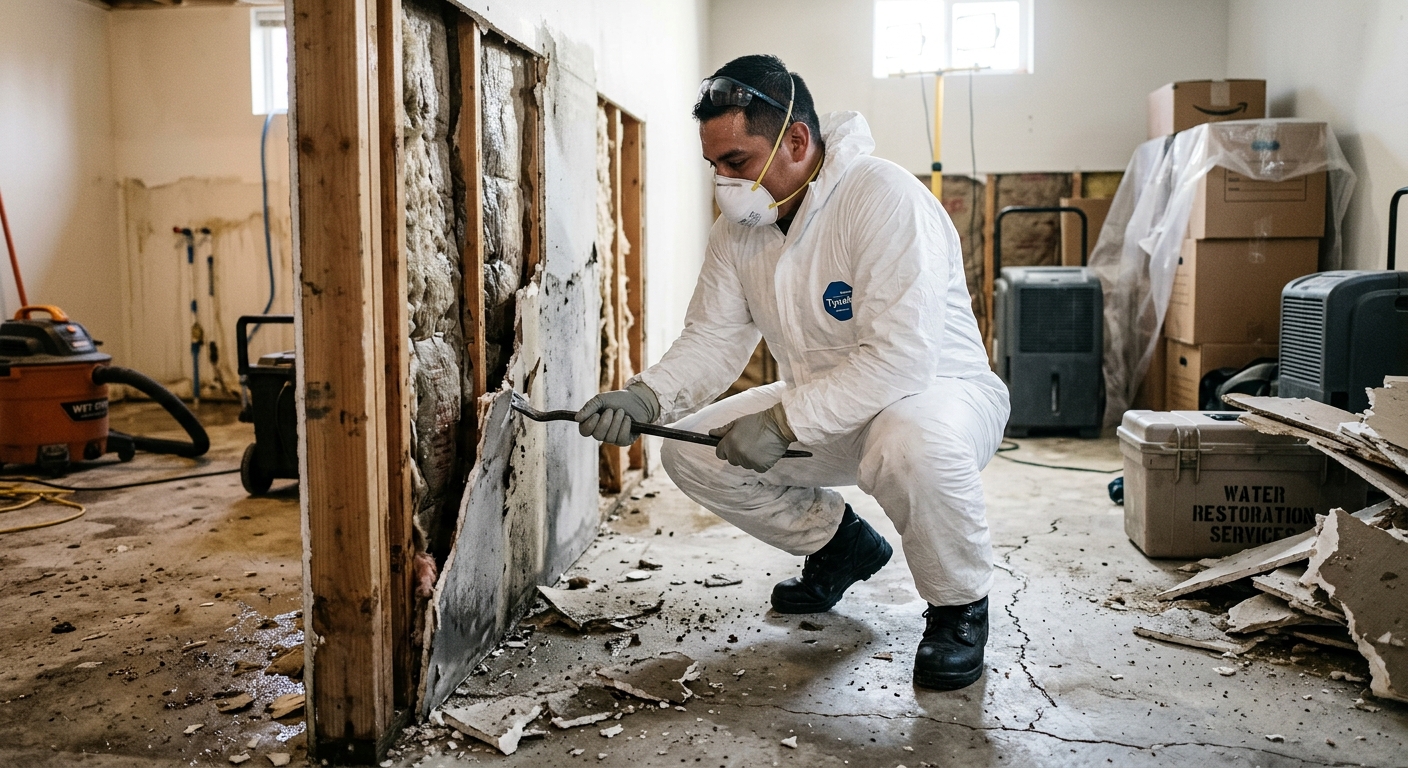
In Bristol’s Levittown-era homes, most losses involve finished basements or split-level lower levels with a mix of drywall, batt insulation, and both vinyl and hardwood flooring—much of it dating to the 1960s or earlier. If water was clean and was discovered quickly, some materials can survive. Fiberglass batt insulation and carpet pad, however, almost never do—these are inexpensive to replace and retain water, leading quickly to mold. Drywall below the waterline (typically up to eight or 24 inches, called a “flood cut”) almost always comes out. Plaster—still found in parts of older Bucks County homes—can hold moisture much longer than drywall, so expect longer drying times or occasional selective removal depending on condition.
Solid hardwood floors sometimes survive if specialty drying mats are deployed quickly, but engineered wood (common in Bristol remodels) rarely can be salvaged—water gets trapped between layers and delamination follows. Cabinets depend on the substrate: plywood cases may dry if water exposure is brief, but particle board cabinets will expand and fail. If a contractor recommends removing every wall, ceiling and piece of trim by default, get a second opinion—selective demolition is usually possible. But beware anyone promising to leave everything in place: undetected wet materials, especially in full basements with utility runs, set up an expensive mold remediation down the line. Full or partial pack-out is common when the affected area is large or contents must be moved for thorough drying—especially given the age and basement orientation of homes in the township.
Frequently asked questions — water damage restoration in Bristol
Is a shop vacuum enough for standing water?
In many Bristol homes with full basements, a shop vacuum is rarely sufficient for water damage—especially with more than a half-inch of standing water. Most homeowner-grade wet/dry vacuums can only handle a few gallons at a time, and quickly reach capacity with even a moderate leak, let alone a full sump pump failure. On top of that, using any non-commercial equipment can expose you to electrical hazard if it's not rated for flooded conditions. For comparison, professional truck-mounted extraction—part of a typical water extraction and drying job ranging from $1,300–$8,100—can remove hundreds of gallons quickly and safely, drying the area before materials are ruined. Relying solely on a shop vac in a finished Bristol basement could mean salvageable items or floors are lost to preventable delays. It’s best used only for minor incidents, and never with sewage or when water has entered electrical receptacles.
Why did the crew cut my drywall two feet up?
This technique, often called a “flood cut,” is standard practice in Bristol and throughout Bucks County to remove all drywall and insulation that has wicked up standing water or high moisture. Water travels vertically inside the wall cavity, especially with the common gypsum board construction found in local 1950s–60s homes. By cutting two feet up, crews ensure no wet, hidden materials are left behind to feed future mold. The lower section is the most likely to be saturated, especially in a full basement. This targeted removal speeds both drying and repairs, lowering your risk of needing expensive mold remediation—sometimes costing as much as $11,500 if mold is discovered later. It’s not overkill; it’s the industry’s best practice for returning the space to pre-loss condition in older structures.
Does insurance cover mold after water damage?
Coverage for mold after water damage in Bristol generally depends on how quickly you report and address the water loss. If mold develops as a direct result of a covered peril—a sudden pipe burst, for instance, in your Bucks County home—most standard policies will pay for reasonable mold remediation, up to a stated limit, especially if you act fast. However, coverage often excludes mold from long-standing or unreported leaks (typically classified as “maintenance neglect”). Some policies require separate add-on coverage for extensive mold claims. Mold remediation with proper containment and clearance testing can range from $1,600–$11,500 in Bristol, so check your policy for limits and requirements, and avoid unnecessary delays in making a claim and starting mitigation.
Can hardwood floors be saved after flooding?
Solid hardwood flooring in Bristol homes sometimes can be saved if specialty drying equipment—such as drying mats and strong dehumidification—is deployed within the first 24–48 hours. Success relies on catching the loss quickly and ensuring the subfloor isn’t saturated. However, engineered wood and laminate, both found in many regional remodels, rarely survive a flood event; these often require full replacement or risk mold growth. Attempting to rescue these when swollen is often wasted effort and money. While trying aggressive drying (typical cost: $1,100–$7,600 if only structural drying is needed) may seem appealing, ask your contractor to be honest about the likelihood of success. In older, basement-heavy Bristol homes, always verify that the subfloor is dry before reinstalling any finishes.
Can a contractor waive my deductible in Pennsylvania?
No, contractors in Pennsylvania cannot lawfully waive or “cover” your insurance deductible. This is specified under Pennsylvania consumer protection law, which applies to any Bristol project over $500. Offers to eat or rebate your deductible are a red flag—it may sound helpful, but it sets up both you and the contractor for potential insurance fraud claims. Insurers know to look for this tactic, and reputable restoration companies will not risk losing their standing or license over it. If you’re offered a deal that seems too good to be true in the restoration process, especially during a time of stress, take it as your cue to move on. Your deductible must come out of your pocket according to the policy and state law.
Should I call my insurer or a restoration company first?
In Bristol, the best results come when you document the damage thoroughly (photos, video) and then call both your insurer and a trusted restoration contractor as soon as possible. The order isn’t as important as making sure you don’t delay; every hour counts toward preventing higher damage, especially mold and structural issues. Insurers may recommend preferred vendors, but Pennsylvania law leaves the choice to you. Professional contractors can typically begin mitigation while you’re on the phone with your adjuster, avoiding extra delay. Since jobs can rapidly escalate from a $1,300 extraction to a $6,500 mold remediation in just 24 hours, immediate action is your best protection—just be meticulous with documentation either way.
Do older Bristol homes need different treatment?
Absolutely. A majority of Bristol’s housing stock—over 84%—was built before 1980, often with original materials and construction techniques seen across lower Bucks County. These homes have full basements, batt insulation, and aged plumbing, which make them uniquely susceptible to multi-level water migration and hidden moisture traps. The wall systems, subfloors, and insulation all require more attentive, professional drying and selective demolition approaches than newer construction. Standard “one-size-fits-all” restoration can miss moisture in plaster or behind paneling, setting up mold issues ranging from $1,600 to $11,500 to remediate later. Insist on contractors with real experience in older Bucks County homes—not just new builds or commercial spaces—for the best results.
What does mold remediation cost in Bristol?
Mold remediation costs in Bristol depend on the size of the affected area, level of containment required, and the amount of material that must be removed and replaced. For most homes, the price ranges from $1,600–$11,500, with the typical scenario around $6,500. This covers full containment with plastic sheeting and negative air, HEPA-filtered removal, antimicrobial treatments, and final clearance testing to ensure a safe result. Because older Bristol homes often have hidden or recurring moisture problems—especially in finished basements—jobs can swing toward the higher end if walls, insulation, or built-ins are involved. Always request a written scope and avoid vendors who offer “treatments” without proper demolition and clearance testing.
Is sewer backup covered under a standard policy?
No, standard homeowners policies in Bristol and across Bucks County typically do not include sewer or drain backup as a default. You can add this coverage with a specific endorsement or rider—worth considering given the locally documented inflow and infiltration issues in lower Bucks. Without this, all cleanup and repair after a sewage backup (which usually costs $2,700–$13,000) are paid out of pocket. Check your current policy declarations page or call your agent to add this essential coverage before a loss happens. Most insurance professionals strongly recommend it, especially in older neighborhoods known for sewer backup events after heavy rain or thaw.
Is emergency after-hours service more expensive in Bristol?
Most reputable restoration companies serving Bristol do not surcharge simply for after-hours arrival, as the Bucks County market is highly competitive and firms regularly cover late-night and weekend events. However, once a loss is reported—especially outside office hours—companies will move to stabilize and document first. Costs still rise if the extent of the damage is greater due to overnight delays—a job needing $1,300–$8,100 water extraction during business hours may grow to full mold remediation pricing if left unchecked until morning. In this market, the urgency of response is not about getting charged more for time—it’s about avoiding far more costly repairs later. Always check the “emergency service” section of your signed contract before agreeing to work.