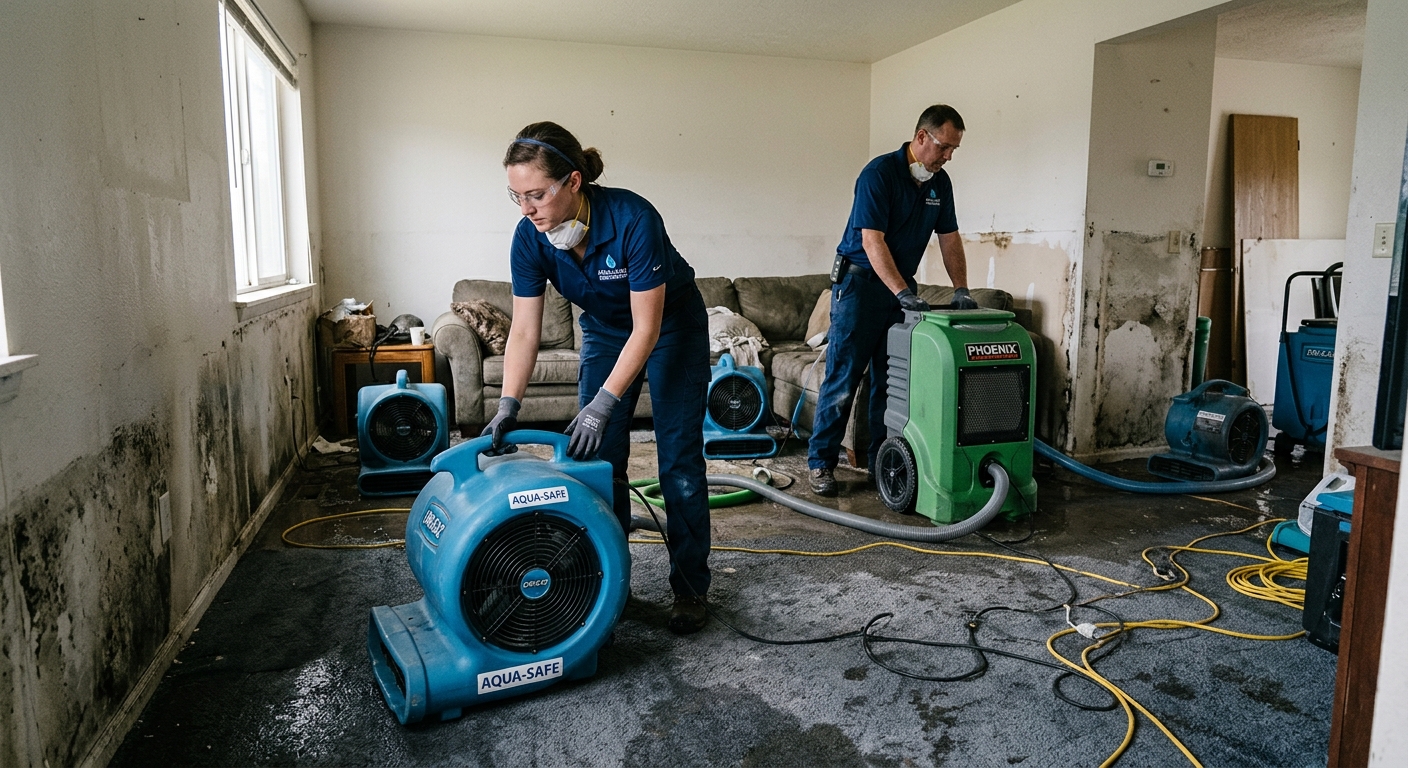
Allentown water damage pricing by scope — 2026
If you’re searching for water damage restoration pricing in Allentown, there’s a strong chance you’re dealing with a live emergency. The costs below reflect what homeowners here can actually expect. Because Allentown’s housing is mostly pre-1950 row and twin homes with full basements, water losses here tend to involve both sudden pipe failures and hidden water migration—often making jobs larger and more complex than in newer suburbs. With 85.4% of the housing built before 1980 (U.S. Census Bureau, ACS 2024), many homes need both extraction and extended drying, especially where water moves behind old plaster, lath, or finished basement walls.
Prices range as widely as the jobs themselves. If you catch it early and it’s on hard surface flooring, you might come out at the bottom end. But the minute water interacts with porous drywall, insulation, or runs down into a finished basement, the figures rise. Most of the cost is determined by how long the water sits and how much has to be removed to dry to standard. Mold and sewage, when present, add another layer of required protocol and cost. Here’s what you’re facing for restoration work in Lehigh County for 2026:
| Service |
What it covers |
Typical duration |
Price range |
| Water extraction + emergency drying (Cat 1) |
extraction, air movers, LGR dehumidifiers, daily moisture monitoring |
3–5 days |
$1,200–$7,400 |
| Structural drying only (post-extraction) |
drying to standard after water is already out |
3–5 days |
$1,000–$6,900 |
| Mold remediation with containment |
containment, HEPA filtration, removal, antimicrobial, clearance test |
3–7 days |
$1,500–$10,500 |
| Sewage backup cleanup (Cat 3) |
biohazard protocol, disposal of porous materials, disinfection |
2–5 days |
$2,500–$12,000 |
| Emergency board-up / tarping |
stop further water entry, secure the structure |
same day |
$350–$900 |
Estimates for a typical Allentown home. Category, affected area and how long the water sat move these figures more than anything else.
Preventing the next one
In Allentown’s older, basement-heavy housing, prevention focuses on the most common and costliest failures. The most cost-effective move remains replacing old braided steel or rubber supply lines to washers and water heaters—expect $60–$140 per appliance if hiring out, and less with a quick DIY if you’re handy. Leak sensors are the cheapest smart upgrade: battery-powered sensors from the big box stores ($20–$45 each) can sit under sinks, beside water heaters, or in a basement laundry area—well worth it for early warning in the city’s older rowhomes especially.
If your basement is below grade (like most in Allentown), a sump pump is near-essential. Standard sump plus battery backup install runs $850–$2,400. That battery backup is critical—when power goes out in a rainstorm, you’re vulnerable. For homes with a history of sewer backups (common in Allentown’s combined sewer areas), a backwater valve may cost $800–$2,500 installed, and is worth considering if your plumber confirms compatibility with your lines.
Automatic water shutoff valves (typically $600–$1,200 installed) are a luxury rather than necessity here unless you travel frequently. Water heater pans and drains ($85–$240 installed) are only justified if your water heater is above finished spaces.
Pipe freeze is a real risk—our frost depth is 36", and any pipes/crawlspaces on exterior walls must be insulated. Expensive smart leak-detection systems can run over $1,200 but are overkill for most Allentown homeowners.
Vetting a contractor when you have no time
In Lehigh County’s dense Allentown–Bethlehem–Easton corridor, several restoration firms have local crews that can show up in an hour—meaning you don’t have to hire the first truck that knocks. But in an active loss, no one has the luxury of days to research. If you’re on the phone trying to stop the damage from getting worse, focus all your questions on the basics: is the company actually registered as a Pennsylvania Home Improvement Contractor, do they have workers’ compensation insurance (and can they send proof), and is the tech arriving IICRC-certified with their card? Get these three on the phone first.
Before any fan is set or a wall drilled, have these three in hand: a written contract as required by the PA Home Improvement Consumer Protection Act (over $500), their HIC registration number (verify at hic.attorneygeneral.gov), and their workers’ comp certificate for Pennsylvania (verify through WCAIS). If the job involves demo or mold, ask for proof of IICRC training and, for pre-1978 homes, EPA Lead RRP certification.
- Confirm HIC registration number — check it yourself online
- Get a copy of workers’ compensation insurance (your address should be listed as certificate holder)
- Ask if the lead technician is IICRC-certified — and see the card
- Request a written scope or contract before any work
- Ask for a plan for daily monitoring and documented drying goals
- If mold is present in an older home, request Lead RRP if applicable
- Read every page before signing — there is a 3-day right to cancel over $500
- No crew or equipment unloaded until paperwork is signed
- Ask directly who your point of contact is and how communication will work
Common pressure tactics in Allentown restoration: pushing for an unsigned “work authorization,” having the crew unload gear before you agree on price, or vague contracts that just list “mitigation.” Stay firm. Don’t sign anything blank or partial, and don’t be afraid to say “stop” until you see the written contract and proof of registration and insurance.
What a Pennsylvania restoration contractor must actually hold
Pennsylvania does not license restoration or mold professionals; there is no state restoration, mold, roofing, plumbing, or HVAC license for these trades in Allentown or any part of Lehigh County. Instead, a Home Improvement Contractor (HIC) registration—issued by the Pennsylvania Office of Attorney General—is the only legal requirement for jobs over $500. Do not assume a business card or a slick truck means more than that; always verify at hic.attorneygeneral.gov.
IICRC certification is not a state requirement but is the standard your insurer wants—it means the technician trained to protocols expected by insurance companies (S500 for water, S520 for mold). Always ask to see the lead technician’s IICRC card. For homes built before 1978, federal EPA law requires a Lead RRP certified firm for any demolition likely to disturb paint—verify at certifiedrenovatorsearch.epa.gov.
In Allentown, a permit is typically required if repairs will include framing or drywall replacement (reconstruction) but not for water extraction, drying, or demolition alone. Workers’ compensation is mandatory for all employers in Pennsylvania—ask for a certificate and verify it directly using the WCAIS system (wcais.pa.gov). Before any work starts, have: a written HICPA contract (all jobs over $500), copy of the HIC registration, proof of insurance, and a clear drying scope.
How a Allentown crew dries a house
The core of professional drying starts with mapping everything wet. Crews use moisture meters—readings are logged for walls, floors, and humidity. In Allentown, old row homes with lath and plaster or multiple layers hide wet studs and cavities, so expect both pin and pinless meters and daily logs. If your contractor can’t show you a log of readings, you have no proof things are drying: you’re guessing.
Once extraction is done (wet-vacuums and pumps out the standing water), air movers are directed at surfaces to speed up evaporation, and LGR (low-grain refrigerant) dehumidifiers pull the moisture out of the air. Why can’t you just open the windows? Our climate—6,100 heating degree days and a winter design of 4 °F—means open-air strategies don’t dry; they just chill your structure and raise your heating bills.
All equipment stays running 24/7 until “drying goals” are met. These goals are not a guess; they are the measured, documented moisture content of undamaged (control) areas of your home—for wood, drywall, and concrete. Every day, someone checks, logs readings, and adjusts equipment as needed. You should see a written log daily.
If a crew can’t or won’t provide daily moisture logs, they aren’t really measuring. This is your safeguard—ask for them before you pay. In the variable spring and muggy summer, especially, outdoor humidity means dehumidifiers (not just air) are the backbone of competent drying across Allentown’s older homes.
Finished basements and water damage in Allentown
With full basements common to Allentown’s older housing, water migrating below grade brings unique challenges. Hydrostatic pressure means water doesn’t flow out by gravity—it pushes in from outside due to saturated soils, especially where drains are outdated or missing. Finished basements complicate matters: water seeps behind drywall, paneling, studs, and insulation, and is invisible until walls are opened.
The most common single source of major basement loss in Allentown? Sump pump failure—melt, rain, or rising groundwater all overwhelm pumps, especially if power is lost. That’s why a battery backup (costing $400–$1,200 as an add-on) is far more than a luxury here; it gives you hours of coverage until utility power returns. Once water gets under finished flooring or up into the walls, scope of the job can double—what might have been $1,200–$3,000 to dry a bare basement quickly becomes $3,000–$7,400 or more when drywall, insulation, and baseboard must be removed and replaced.
High ground water and a frost depth of 36 inches mean exterior water lines and uninsulated pipes are vulnerable to breaks and freezing, feeding more water into basements. If your basement is finished, insist that the crew does a thorough cavity inspection—thermal imaging or moisture meters, not guesses. Hidden moisture grows mold in Lehigh County’s humid summers and isn't visible until it appears as stains or musty odors—by then, restoration costs are higher and insurance may be less likely to cover all repairs.
Flooding vs plumbing failure in Allentown
In Allentown, the difference between “flood” and “leak” isn’t just semantics—it changes everything about your insurance and who pays for what. If water enters from outside, such as overland flow or rising water from the Lehigh River or Little Lehigh Creek corridors, this is “flood” in the eyes of your insurer, regardless of the source. Your standard homeowner’s policy flatly excludes flood. You need separate flood coverage, which typically comes through the National Flood Insurance Program or a private carrier, and it comes with a waiting period—usually 30 days—so you can’t buy it when a big storm is announced and expect immediate protection.
If the source is a burst pipe, failed appliance, or broken supply line inside your home, that’s considered a covered loss under most homeowner policies (pending the specifics of your contract and exclusions). It makes no difference to the adjuster that both events might result in two feet of water in your basement with identical damage. The root cause—a river overbank, or a worn-out copper pipe in an 80-year-old twin—defines claim eligibility.
Flood zone designations do apply in sections of Allentown adjacent to both the Lehigh River and Little Lehigh Creek, including parts of the core rowhome neighborhoods. Know your property’s risk. It’s all too common to see large restoration bills after overland flooding that insurance doesn’t touch—whereas the same job from a burst supply line might be fully covered. Don’t wait for the forecast to sort it out.
Frequently asked questions — water damage restoration in Allentown
Do I need a permit for water damage repairs in Allentown?
For basic water extraction and drying, you do not need a permit in Allentown. However, if there’s enough damage to require framing repairs or drywall replacement (“reconstruction”), you will typically need a building permit issued by the City of Allentown Bureau of Building Standards. That’s because structural repairs after water damage fall under the Pennsylvania Uniform Construction Code as enforced locally. If your job is just emergency drying, expect prices in the $1,200–$7,400 range without triggering permits. But if walls or ceilings must be rebuilt, your contractor should pull the necessary permits before starting that phase. For any work over $500, a written contract under HICPA is required, permit or not.
Is bleach effective against mold?
Bleach isn’t a true solution for mold in Allentown homes, especially in those with plaster, lath, or finished basements common throughout Lehigh County. Bleach can lighten stains but doesn’t address hyphae growing inside porous materials—plus it can worsen moisture in drywall or wood behind the surface. IICRC S520 protocol, the de facto Pennsylvania standard, calls for removal of affected building materials, HEPA filtration, and post-remediation verification—not just surface cleaning. Proper mold remediation starts around $1,500–$10,500 here, with scope depending on how far the contamination has traveled behind walls or under flooring. For any significant mold in your Allentown row/twin, request a plan based on removal, not just cleaning or spraying.
Should I call my insurer or a restoration company first?
In Allentown, especially during active losses in older homes, it helps to do both nearly simultaneously. Start your claim promptly with your insurer—timeliness improves your coverage position and may get an adjuster out sooner. But don’t wait for insurer permission to stop active water flow or to begin emergency water extraction (typically $1,200–$7,400). Policies require you to “mitigate loss”—meaning take steps to prevent things from getting worse. Make sure you pick a local, HIC-registered contractor and keep receipts and daily logs for every bit of work completed before the adjuster arrives. This approach covers your bases under Pennsylvania’s Homeowner Policy expectations.
Is sewer backup a known problem in Allentown?
Yes—sanitary and storm sewer inflow is a well-documented problem in parts of Allentown’s older neighborhoods, especially after heavy rain. The risk is highest in houses near the city’s combined or undersized sewer systems. Sewage backup cleanup (Category 3 water) is a specialty service and commands higher prices: restoration and disinfection typically runs $2,500–$12,000 in Lehigh County. Many homeowners policies exclude or limit coverage for backup unless specific sewer backup riders are added. If your home is in a risk area, a backwater valve and sump pump with battery backup are both recommended, and you should double-check your insurance coverage.
What is an assignment of benefits and should I sign one?
An assignment of benefits (AOB) transfers your right to insurance payments to the contractor, who then deals directly with your insurer. While it can simplify claim handling, in Allentown you should be cautious. Some contractors use AOBs to sidestep the need for a clear written contract, and you might lose control over repairs and dispute resolution. Instead, demand a standard written contract as required under Pennsylvania’s Home Improvement Consumer Protection Act. There’s no reason to sign an AOB for most water jobs (typically $1,200–$7,400) in this market; only consider one if your insurer is familiar with the contractor and you already trust both parties.
Is emergency after-hours service more expensive in Allentown?
After-hours or weekend water damage response is usually billed at the higher end of the standard price band in Allentown, as multiple local firms maintain 24/7 on-call crews. So while emergency service isn’t “extra” so much as “premium within range,” expect jobs to cluster near the higher price for the same mitigation scope—something like $3,900–$7,400 for extraction and drying, depending on the extent. You probably won’t see explicit surcharges, but there’s less flexibility for negotiation after midnight or during regional storms, when demand spikes and multiple Allentown crews may be busy.
How much does a flooded basement cost to restore in Allentown?
In Allentown, full basements dominate—and when these flood, costs depend on whether the space is finished or not. For a bare basement, full extraction and drying usually falls in the $1,200–$3,900 zone if caught fast. For finished basements with drywall, insulation, and built-ins, the cost can double: $3,900–$7,400 or more. Mold, sewage, or long-standing water further drive up costs. Always insist on a full cavity check and moisture log; hidden water behind old walls is a common source of surprise expense in Allentown’s pre-1950 homes.
Does wet insulation have to be replaced?
In nearly every Allentown water loss involving wall or ceiling insulation, replacement is necessary. Fiberglass, once saturated, loses its R-value and is slow to dry, even with aggressive air movement and dehumidification. Wet insulation in old lath or finished basements (common in Lehigh County’s pre-1950 housing) grows mold quickly and holds odor. If the insulation got wet during a typical basement loss (restoration in the $1,200–$3,900 range), removal and replacement costs are usually included in the estimate. If the crew suggests “drying in place,” demand a written guarantee of restored performance—otherwise, new insulation is cheaper than a future mold job.
What is a clearance test and do I need one?
A clearance test is a third-party air or surface sampling after mold remediation, confirming the project meets IICRC S520 guidelines and is safe to reoccupy. In Allentown’s older, multi-layered homes, clearance testing is especially wise when members of your household have allergies, or when work is done in finished basements or behind drywall. Mold remediation projects between $1,500–$10,500 typically include this service, but get it in writing. The test is performed by an independent technician—not by the crew who did the cleanup—and provides a lab report. If not included, you can usually add it for a few hundred dollars, and it’s worthwhile for peace of mind and for real estate transfers.
Does insurance cover mold after water damage?
Standard homeowners policies in Allentown respond to “sudden and accidental” water damage, and may provide limited mold coverage if you act fast (usually as a dollar cap or rider—often $1,500–$5,000). If water sits without action, or if mold is from seepage, old leaks, or chronic basements (common in Lehigh County), insurance may deny it. Most mold jobs here, with the bill ranging from $1,500–$10,500, are settled partly out-of-pocket. The safest bet: mitigate quickly, keep records, and check your policy’s endorsements and exclusions. Many Allentown homeowners are surprised by how tight the fine print is—especially in older row homes where mold can be concealed for months.