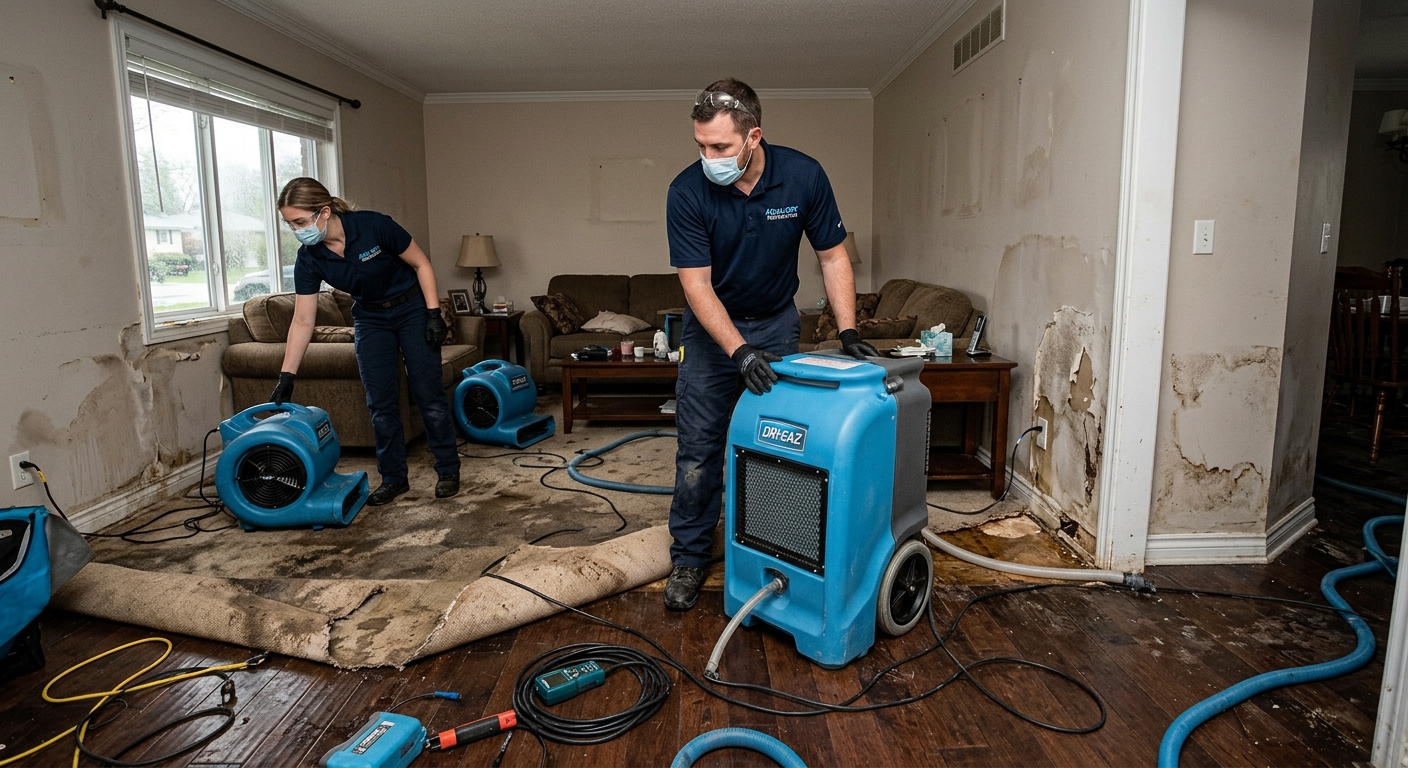
What water damage restoration costs in Lower Burrell
If you're dealing with water in your Lower Burrell home right now, you need to know what the real numbers are before you commit to anything. Most homes here are single-family, owner-occupied houses (over 80% according to the U.S. Census Bureau, ACS 2024), and more than three-quarters were built before 1980. These older homes—especially the post-1950 ranches and split-levels common in nearby townships—have full basements and aging drain systems that turn even a modest water issue into a bigger, costlier problem. Water losses here almost always mean below-grade spaces with hidden water damage behind drywall, affecting both the structure and your belongings.
Costs in Lower Burrell are higher when basements are finished, when sump pumps fail, and when water sits for more than a day. Here’s what typical services cover and what you can expect to pay in 2026:
| Service |
What it covers |
Typical duration |
Price range |
| Water extraction + emergency drying (Cat 1) |
extraction, air movers, LGR dehumidifiers, daily moisture monitoring |
3–5 days |
$1,200–$7,500 |
| Structural drying only (post-extraction) |
drying to standard after water is already out |
3–5 days |
$1,000–$7,000 |
| Mold remediation with containment |
containment, HEPA filtration, removal, antimicrobial, clearance test |
3–7 days |
$1,500–$10,500 |
| Sewage backup cleanup (Cat 3) |
biohazard protocol, disposal of porous materials, disinfection |
2–5 days |
$2,500–$12,000 |
| Emergency board-up / tarping |
stop further water entry, secure the structure |
same day |
$350–$900 |
Estimates for a typical Lower Burrell home. Category, affected area and how long the water sat move these figures more than anything else.
Basements: where most Lower Burrell losses happen
Nearly every modern home in Lower Burrell was built with a full basement, taking advantage of hilly local terrain and the construction boom in the decades after 1950. Basements are the main target for water damage because they sit below grade, where hydrostatic pressure drives groundwater through cracks—especially when clay or shale keeps water from draining away quickly. Our region’s 36-inch frost depth and repeated freeze‑thaw cycles only worsen this, letting moisture intrude through foundation walls or around the perimeter.
Sump pump failures account for a large portion of losses in Lower Burrell basements. Many homes have a basic sump but lack a battery backup system; when a power outage lines up with heavy rain, water can rise fast. With so many finished basements—where drywall, insulation, and flooring cover the concrete—water spreads unnoticed, damaging structure and contents beneath the surface. The cost to dry and restore a finished basement is often double that of an unfinished space with the same amount of water, since walls, carpet, and sometimes built‑ins need to be cut out and replaced.
If your basement is finished or partially finished, investing in a battery backup for your sump pump is money well spent. Once water gets into finished walls or cabinets, it nearly always means a larger job—more days for air movers, higher risk of mold, and a higher bill in the end.
Credentials and permits for restoration work in Lower Burrell
Pennsylvania does not license restoration or mold remediation contractors. That means anyone can print a business card, so don’t rely on “licensed and insured” as proof of qualification. The real standard for insurers and reputable firms is IICRC certification—ask to see the crew leader’s card, and don’t be shy about verifying it. For work in homes built before 1978, the EPA Lead RRP Rule applies if more than six square feet of painted surface is disturbed—check for an EPA-certified renovator if this applies to you.
Permits in Lower Burrell and other Westmoreland County municipalities are usually not required for water removal or drying. Reconstruction work is different: if walls are being reframed or new plumbing is installed—especially in Greensburg—a permit is mandatory. No permit generally means faster mitigation starts, but you should always check with your local code office if you’re unsure.
Before work starts, request in writing: proof of Home Improvement Contractor (HIC) registration (verify it online), proof of workers’ compensation insurance as tracked by WCAIS, and the detailed written contract required by the Home Improvement Consumer Protection Act. Never sign for emergency work over $500 unless these are provided and you understand your three-day right to cancel. Insurance for restoration work should list your address as the certificate holder, not just a general policy.
The first hour: what to do before anyone arrives
If you’ve just discovered water in your Lower Burrell basement or anywhere else in your home, here’s what to do—step by step—while waiting for help:
- Shut off the water at the main valve, especially if the source is a broken pipe or appliance.
- If water has reached electrical outlets or appliances, only shut off power to those circuits if the panel is dry and safe to access—don’t take risks.
- Use your phone to photograph all affected areas from multiple angles before you move or touch anything. This is critical for your claim and for the restoration scoping later.
- Move contents like boxes or valuables up off wet flooring—but do not carry wet items through finished parts of the house without laying barriers (garbage bags or plastic sheets).
- Never use a household vacuum on standing water; it’s a shock hazard and standard vacuums aren’t rated for water extraction anyway.
With documentation underway, call your insurance carrier’s claim number, or reach out to a reputable local restoration company—either one can come first as long as you’re snapping photos and tracking every damaged item. The biggest mistake is waiting overnight, thinking it will be cheaper to call in the morning. The reality: after just 24–48 hours, the job shifts from Category 1 water extraction (starting at $1,200–$7,500) to potential mold remediation (which can more than double costs). Getting started quickly is almost always cheaper and preserves more claim eligibility.
Your belongings after a water loss
Your insurance covers not only the building itself, but also your belongings—known as contents. Yet most Lower Burrell homeowners under-claim here, especially in packed basements. After a loss, the restoration crew might recommend a pack-out, removing your items to an off-site facility for cleaning, drying, and deodorizing. The entire process relies on careful inventorying: before anything moves, photograph every room and item, and keep a written list. The more photos and details, the smoother the claim process, especially when the adjuster asks for proof.
Contents are distinct from the structure on your policy. Structure covers walls, floors, and built-ins, while contents covers personal property—furniture, electronics, clothing, and keepsakes. Some items are easy to save and well worth restoring: solid wood furniture, certain electronics, and heirlooms that didn’t sit in water. Others rarely justify the cost or risk: upholstered furniture contaminated by sewage (Category 3 losses), particleboard shelving and cabinets (which swell and fall apart), and mattresses almost never make it through the process.
Take extra time up front for documentation. Insist on a clear written inventory from your contractor, and talk to your adjuster about policy limits on high-value contents categories.
Filing a water damage claim in Pennsylvania
The distinction that ends up costing Lower Burrell homeowners the most? Sudden, accidental water damage from inside the home—like a burst pipe or water heater—is usually covered under a typical Pennsylvania homeowners policy. By contrast, flooding from surface water outside (heavy rain, creeks overrunning, ground seepage) is almost always excluded from standard coverage unless you bought a separate flood insurance rider. Many learn this only after the fact, especially during spring flooding from the Loyalhanna Creek or heavy rains near Rostraver or Greensburg.
Watch for exclusions: damage from long-term leaks, seepage, or poor maintenance are not covered by most policies. Sewer backup protection isn’t standard—it’s a separate rider that’s worth having, especially given local infrastructure and older homes with finished basements.
Your claim will be paid out by either “actual cash value” (depreciated) or “replacement cost” (new for old)—this makes a difference in your out-of-pocket expenses. The carrier and the restoration firm will create a scope of loss: a detailed room-by-room inventory of damages, needed work, and estimated costs.
Direct billing and assignment of benefits let the restoration company bill the insurer directly. If you assign benefits, you let the contractor negotiate and get paid directly; you lose some control, but it can speed up the process. In Pennsylvania, the Home Improvement Consumer Protection Act requires a written contract for work over $500 and gives you a three-business-day right to cancel. Waiving your deductible is prohibited by law—if a contractor proposes this, it’s a red flag that could jeopardize your claim or expose you to liability.
Mitigation, then reconstruction: two different timelines
Most homeowners in Lower Burrell expect water damage restoration to be one continuous process. In reality, it’s two separate phases with different crews, contracts, and timelines. The first phase, mitigation, covers immediate water removal, structural drying, and sometimes selective demolition. It happens within days, is urgent, and is often billed directly to insurance, wrapping up when moisture levels reach safe “dry standard.”
After mitigation, there is often a waiting period before reconstruction begins. This is normal and not a sign of neglect; it’s partly due to the moderate density of restoration firms serving Westmoreland County from Greensburg, Murrysville, and Pittsburgh. Reconstruction—replacing drywall, flooring, cabinets, or trim—takes weeks to months. Permits may be needed if framing or new plumbing is involved, especially in places like Greensburg.
The awkward gap—when equipment leaves and nothing seems to happen—happens in almost every project. Homeowners often feel abandoned, but this is just the transition between two separate jobs. Knowing about this divided process up front helps set realistic expectations and prevents surprises.
Frequently asked questions — water damage restoration in Lower Burrell
Does homeowner's insurance cover water damage in Lower Burrell?
Most standard homeowners policies in Pennsylvania, including those for Lower Burrell residents, cover sudden and accidental water damage from internal sources—such as burst pipes or failed appliances. However, damage caused by external surface flooding (like from the Loyalhanna Creek or runoff during heavy rain) is typically excluded and only covered if you have a separate flood insurance policy. Some types of claims, like mold that develops after water sits for over 48 hours, may also be excluded if the insurer determines it was preventable. For Category 1 water losses, expect a bill in the $1,200–$7,500 range, most of which is usually eligible for coverage after your deductible if you meet policy requirements. Always review your policy details and ask your agent specifically about sewer backup riders and limitations on mold coverage.
Are Lower Burrell basements especially prone to flooding?
Yes, basements in Lower Burrell and surrounding Westmoreland County communities are especially vulnerable to water intrusion. This is due to the hilly terrain, widespread use of full basements, and aging perimeter drains found in homes built before 1980. Freeze-thaw cycles and the region’s heavy clay or shale subsoils compound the risk by slowing drainage and letting groundwater build up against foundations. Sump pump failures are a leading cause. Finished basements, a common feature in post-1950 ranch and split-level homes nearby, can double the restoration scope and cost—sometimes pushing a job from $3,900 to over $7,000 once drywall and flooring are involved.
How do I verify a restoration contractor's insurance?
In Lower Burrell and anywhere in Pennsylvania, ask every contractor to provide a certificate of insurance with your name and address listed as certificate holder. Do not accept a generic printout. For workers’ compensation, Pennsylvania uses the WCAIS system for verification. You can ask for proof and check the policy status yourself at wcais.pa.gov. For Home Improvement Contractor (HIC) registration—which is legally required for any contract over $500—verify their number at hic.attorneygeneral.gov. These steps help ensure that you’re not liable for any injuries or property damage during the restoration job, which can range in cost from $1,500–$10,500 for major mold work.
Is bleach effective against mold?
While bleach can temporarily lighten visible mold stains on non-porous surfaces, it does not penetrate deeply enough to eliminate mold that has colonized drywall, wood framing, or other porous materials. In Lower Burrell’s older homes—especially those with finished basements—attempting to handle mold with household bleach won’t meet the insurer-expected IICRC S520 standard and rarely passes clearance testing. Mold remediation here involves HEPA filtration, removal under containment, antimicrobial application, and sometimes replacement of affected materials. Professional work ranges from $1,500–$10,500. Save the bleach for bathroom grout, not for actual remediation.
Should I call my insurer or a restoration company first?
It makes little difference for your claim in Lower Burrell whether you call your insurer or a restoration company first—as long as you document thoroughly and call both promptly. Every insurer wants to see strong photo evidence “pre-mitigation,” so start by photographing everything before you move a thing. Restoration companies can typically respond within hours, sometimes preventing a small leak from becoming a large mold claim (which can rise to $10,500 if delayed). Delaying overnight is the real mistake; adjusters value quick, well-documented action more than the sequence of who called first.
Why did the crew cut my drywall two feet up?
Crews in Lower Burrell often perform what’s called a “flood cut”—removing drywall 12 to 24 inches above the highest water line—because water wicks up behind walls and insulation. Cutting higher than the visible mark makes sure wet insulation, hidden mold, or lingering moisture don’t lead to future problems. In basements with full-depth flooding, drywall and insulation are almost always unsalvageable. While this may look drastic, it simplifies drying, helps pass clearance testing, and keeps mold remediation from spiraling toward the top of the cost range: $1,500–$10,500.
Is emergency after-hours service more expensive in Lower Burrell?
Emergency rates in Lower Burrell are sometimes higher for after-hours work, mainly due to labor and equipment mobilization. However, the coverage area—including Greensburg, Murrysville, and greater Pittsburgh—means many regional firms absorb after-hours costs to win business, keeping premiums competitive. Remember that a prompt response can actually save money overall: same-day extraction and drying (starting at $1,200–$7,500) prevents escalation to costly mold jobs that take longer and require more demolition. Always ask if there is a special emergency surcharge before authorizing work.
Does insurance cover mold after water damage?
In Lower Burrell and throughout Pennsylvania, standard insurance policies typically cover mold remediation only if it results directly from a covered water loss—such as a sudden pipe burst—provided the homeowner took reasonable steps to mitigate damage. If you let water sit for days before calling anyone, mold coverage may be denied or limited to a set sub-limit, even though remediation jobs often cost $1,500–$10,500. Always read your policy carefully; some carriers exclude mold outright or cap payments regardless of actual cost. The safe approach is to act fast and notify your insurer as soon as water is discovered.
Can hardwood floors be saved after flooding?
In Lower Burrell, the salvageability of hardwood flooring after flooding depends on how quickly extraction and drying begin. If Category 1 water (clean source) is removed within 24 hours, many solid wood floors can be saved using specialized drying mats and dehumidifiers, generally within a price band of $1,200–$7,000. If water seeps under the boards or sits for longer, permanent cupping, buckling, or mold can result, especially on engineered or laminate floors, which usually cannot be restored. Fast action and proper documentation give your insurance adjuster more grounds to approve repair or replacement.
How much does water damage restoration cost in Lower Burrell?
Costs for water damage restoration in Lower Burrell depend on the type of water, location, and how long it sat. Clean-water extraction and drying typically run $1,200–$7,500. Structural drying alone after water is out ranges from $1,000–$7,000, while a full sewage cleanup (Category 3) can reach $2,500–$12,000. Finished basements cost more than unfinished ones, and waiting 24–48 hours can mean additional mold remediation, starting at $1,500–$10,500. The most significant price drivers are how much is affected, the finish level of the space, and the speed of your response.