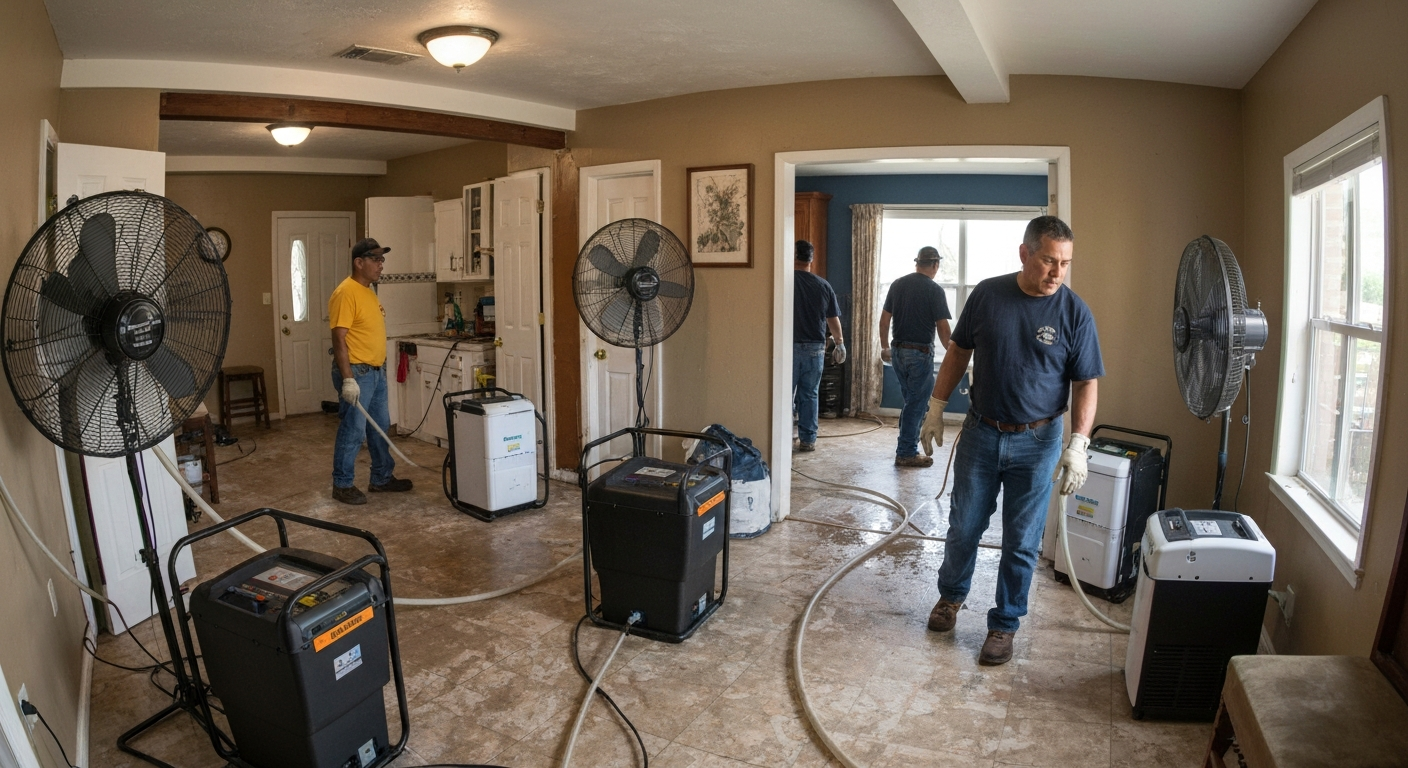
What water damage restoration costs in College
If you’re dealing with water damage in College, fast action matters—and so does knowing what you’ll pay. In a town with mostly single-family homes and a high homeownership rate (U.S. Census Bureau, ACS 2024), costs often reflect how much of the structure is finished below grade and the era of construction. With many 1950s-1980s Penn State-era houses, finished basements are particularly vulnerable to losses from Spring Creek and appliance failures. In these homes, water spreads quickly through insulation, walls, and flooring, making basement losses the single most common—and most costly—scenario.
Typical service sees a price range tied closely to the duration and the amount of the home affected. Here’s what homeowners in College can expect to pay for the most common water-related restoration jobs:
| Service |
What it covers |
Typical duration |
Price range |
| Water extraction + emergency drying (Cat 1) |
extraction, air movers, LGR dehumidifiers, daily moisture monitoring |
3–5 days |
$1,250–$7,900 |
| Structural drying only (post-extraction) |
drying to standard after water is already out |
3–5 days |
$1,050–$7,400 |
| Mold remediation with containment |
containment, HEPA filtration, removal, antimicrobial, clearance test |
3–7 days |
$1,600–$11,000 |
| Sewage backup cleanup (Cat 3) |
biohazard protocol, disposal of porous materials, disinfection |
2–5 days |
$2,600–$12,500 |
| Emergency board-up / tarping |
stop further water entry, secure the structure |
same day |
$350–$900 |
Estimates for a typical College home. Category, affected area and how long the water sat move these figures more than anything else.
Regulation, certification and verification in College
Pennsylvania does not license restoration or mold remediation contractors. In Centre County and the College area, this means a restoration company’s business card is not proof of any state qualification—anyone can print one. What does matter is independent certification: the insurer-expected standard for water damage mitigation is IICRC S500 (ask for the lead technician’s IICRC card on arrival). For mold, the IICRC S520 protocol is recognized, but again, there’s no legal licensing—just industry standard.
Permits: For most water mitigation (extraction, drying, mold remediation, tearing out wet materials), the Pennsylvania Uniform Construction Code does not require a permit. Permits are typically triggered only when you move to actual reconstruction or new installations, especially anything structural or electrical. The local authority—State College Borough Codes Administration—enforces this in your area.
Contractor registration: For any project over $500, a written contract is required by the Home Improvement Consumer Protection Act. You can verify a company’s Home Improvement Contractor (HIC) registration at the state’s official site before signing. Always ensure workers on-site are covered by workers’ compensation; you can check this via Pennsylvania’s WCAIS system. Do not proceed without a written scope of work—including exactly what will be removed, dried, and reconstructed—before any equipment is set up or demolition begins.
Drywall, hardwood, insulation: what survives
In College, water losses often hit finished basements, especially in the 1950s-1980s Penn State-era homes with full basements and a mix of older materials. When water enters these spaces, here’s the honest survival rate by material:
- Drywall: Anything below the waterline almost always needs to be cut out. It absorbs water rapidly, and even one or two hours of standing water in finished basements is enough to justify demolition up to a clear, dry line plus a buffer. Trying to dry drywall in place below the waterline encourages hidden mold behind the wall.
- Fiberglass insulation and carpet pad: Once wet, these are not salvageable in any finished basement scenario—mold growth and loss of insulating value are essentially guaranteed. Expect removal and disposal.
- Solid hardwood: In main level rooms, quick extraction and the use of specialty floor drying systems can occasionally save solid hardwood, but in basement installations—common in College—saturation beyond a few hours generally dooms even these floors. Engineered hardwood and laminate almost never survive bulk water.
- Plaster: Plaster walls (more common in older Bellefonte and State College housing) hold moisture much longer and can conceal persistent wet spots. These may demand more selective demolition and longer drying.
- Cabinets: The substrate matters—plywood can sometimes dry, but particle board will swell and delaminate even after short exposure.
If a contractor tries to sell you full demolition before a proper assessment with moisture meters, get a second opinion. If someone promises to dry everything with no demolition after several hours of standing water, they’re likely setting up a mold problem down the line.
What a sewage loss requires
Sewage backup in a College home isn’t “just water damage with a worse smell”—it’s a biohazard clean-up requiring serious controls. Here’s why it’s different:
PPE and containment: Workers use full protective equipment (respirators, boots, coveralls, gloves) and may set up containment walls with negative-air machines to prevent the spread of pathogens. The goals are to protect everyone and keep contamination from spreading to clean areas.
Mandatory disposal: All porous materials—drywall, insulation, carpet, pad, some furniture—are removed and discarded, regardless of how clean they look. Disinfection and deodorisation follow, using hospital-grade chemicals to fully neutralize bacteria and viruses. This is not negotiable; even a corner missed could lead to illness.
Occupancy: Residents should not be present until full professional clearance, especially in finished basements where hidden seepage is possible.
Backflow prevention can reduce the risk of repeat events, but municipalities here do not cost-share valve installation—any upgrade is out-of-pocket. Sewage cleanup in College typically costs $2,600–$12,500, mainly based on how much finish and contents are lost in the affected area.
Why your neighbour's bill was half of yours
In water restoration, College homeowners are often surprised that two seemingly similar jobs can come back with bills differing by thousands. The reason? Two separate factors drive cost: CATEGORY (how contaminated is the water?) and CLASS (how much of the structure was saturated?). These are independent: a small sewage backup (Category 3) often costs more than a large, clean pipe burst (Category 1), because every affected surface in a Category 3 loss must be removed and disposed of.
For example, a small basement sewage backup can hit $2,600–$12,500, while a much larger supply line break might land around $1,250–$7,900—and time is money. Clean water degrades to Category 2 after 24–48 hours and to Category 3 after 72+ hours just from sitting, so “waiting a couple days for adjuster approval” can move an event from a carpet-drying job to a full gut and biohazard protocol. Delay is the real category changer.
| Classification |
Source or extent |
Health risk |
Cost effect |
| Category 1 — clean |
supply line, appliance line, rainwater |
low |
baseline |
| Category 2 — grey |
washing machine, dishwasher, sump failure |
moderate |
+20–40% |
| Category 3 — black |
sewage, groundwater, water standing 72+ hrs |
biohazard |
$2,600–$12,500 |
| Class 1 |
small area, little absorption into structure |
— |
low end of $1,250–$7,900 |
| Class 2 |
whole room, water into walls and subfloor |
— |
$1,250–$7,900 |
| Class 3 |
saturation from above; insulation and walls wet |
— |
$1,050–$7,400 |
| Class 4 |
deep saturation of hardwood, plaster, concrete |
— |
service2 upper range |
When water damage becomes a mold problem
The difference between “just water damage” and “now it’s mold” in College is often a matter of hours. Mold can begin colonizing wet surfaces within 24–48 hours, especially in Centre County’s long heating season, high humidity, and common finished basements. That’s why immediate extraction and the start of drying isn’t just about comfort—it keeps the job from moving into a higher price band.
Early, you might get away with dry-in-place methods: extraction, air movers, and monitoring at $1,250–$7,900. Past the first two days, if saturated walls and insulation aren’t dry, selective demolition and possible containment for microbial prevention become necessary—and costs rise. At a week or more, or if you see or smell mold, you’ve crossed into full remediation: plastic containment walls, HEPA filtration, surface removal, and formal clearance testing, now in the $1,600–$11,000 range (U.S. Census Bureau, ACS 2024).
Clearance testing means a third-party professional inspects the remediated area with air sampling and moisture checks and certifies it’s free of visible and airborne mold—a certificate you should get in writing before rebuilding starts. In College, with its long, damp winters and slow-drying basements, don’t let anyone talk you into skipping that step.
Choosing a restoration company in twenty minutes
When you have water on the floor in College, you rarely have a week to gather quotes. With multiple firms serving Centre County and crews frequently working out of State College and Centre Hall, competition is moderate, but you still need to make fast decisions under stress. Here’s how to compress the usual background-check process into twenty minutes:
First, confirm these three things on the phone before anyone leaves their office:
- Home Improvement Contractor (HIC) registration status (for any job over $500)—verify it as required under Pennsylvania law.
- Proof of current workers’ compensation insurance—for every person arriving on your property.
- Lead technician’s IICRC certification for mitigation or mold (ask for their personal certification, not just the company’s).
- Clear written description of services to be performed, and what will/won’t be removed.
- How daily updates and moisture monitoring are handled (including when you can be home or must be out).
- Whether emergency equipment fees are capped or itemized (so no surprise up-charges).
- The anticipated range of outcomes (including when demolition can be avoided—and when it can’t).
- Who handles permit questions if repairs are needed later.
- What testing they use for clearance (for mold or biohazard areas).
- Timeline—when work will start and estimated job duration.
Specific pressure tactics to watch out for in College include: crews beginning to unload equipment before you’ve signed a formal contract; being given a blank or open-ended scope of work; being told “we need to start now and get your signature later.” Refuse work until you’ve reviewed a written contract (required by Pennsylvania law for jobs over $500), a clear work authorization, and proof of insurance—all before a blower is plugged in.
Frequently asked questions — water damage restoration in College
How much does sewage backup cleanup cost in College?
Sewage backup (Category 3) cleanup in College ranges from $2,600–$12,500, with most projects for a finished basement ending up near the middle of that range. The price depends on how much finish and contents need to be removed and replaced. Because older homes here have full basements and lots of finished space, even a relatively small backup can be serious—especially if it sits, as every extra hour means more demolition to prevent recurring odor or health issues. This covers mandatory disposable of drywall and insulation, HEPA air cleaning, and post-disinfection clearance. Most insurance policies require a written contract for claims, so never skip documentation.
What should I do in the first hour of a water leak?
In College, the most important thing is to stop the flow—find and shut off the supply line if it’s a plumbing loss, or clear standing water from the lowest point if safe. Call your insurer to report the loss, but don’t wait on an adjuster to begin mitigation. Remove valuable contents from wet areas if you can do so safely; leave any electrical appliances untouched if the floor is damp. Contact a registered restoration contractor and insist on a written agreement—Pennsylvania law requires a contract over $500. Faster response usually means costs at the lower end of the $1,250–$7,900 band; delay moves you up the price scale rapidly as category degrades.
How much does water damage restoration cost in College?
For typical water extraction and emergency drying in College, homeowners pay between $1,250–$7,900, with most losses to finished basements of Penn State-era homes landing around $4,100. Costs are highly influenced by how fast you act (since delayed response lets water creep up from clean to contaminated category) and how much of your basement or living space is finished. Mold remediation, if needed, can add $1,600–$11,000. Costs reflect the high rate of finished basements in College (U.S. Census Bureau, ACS 2024), where even a small loss can require significant demolition.
Do I need a permit for water damage repairs in College?
For the initial mitigation phase—removing water, drying, and removing unsalvageable materials—no permit is required under the Pennsylvania Uniform Construction Code in College. You’ll only run into permit requirements if you’re doing structural repair, electrical rewiring, or major reconstruction work after drying is completed. The local code authority is the State College Borough Codes Administration; for basic restoration and mold remediation, no inspection or approval is triggered. Always make sure your contractor provides a written contract over $500. Structural repairs after water loss can fall into a new price band, but initial drying and mitigation remain inside $1,250–$7,900.
Can I rent dehumidifiers instead of hiring a company?
You can rent standard dehumidifiers locally, but they are often not powerful enough for a typical College finished basement—especially given the region’s high heating degree days and seasonal humidity. Restoration companies use commercial LGR (low grain refrigerant) units and air movers stacked to meet standards for square footage and material saturation. Rental might keep you on the low end of the $1,050–$7,400 band for small, very recent, clean-water events. For multi-room or basement losses, DIY falls short, can delay drying, and may push you into mold remediation, which is significantly more expensive. If in doubt, ask a pro for price and timeline before doing it yourself.
Is basement flooding covered by insurance in Pennsylvania?
In College and throughout Pennsylvania, regular homeowner policies usually cover water damage from sudden, accidental causes like burst pipes, but not ground seepage or overland flooding (Spring Creek overflows, for example, need separate flood insurance). Always review your policy—and note that for insurance to pay, you’ll need a written contract for work over $500 as required by state law. A typical covered claim for water extraction and drying would run $1,250–$7,900, but flood-specific losses can exceed this if not covered or if extensive mold results from delay.
Is sewer backup covered under a standard policy?
In most standard Pennsylvania homeowner insurance policies, sewer or drain backup is excluded unless you specifically purchased backup coverage, which is an optional rider. In College, with many finished basements and older infrastructure, adding this coverage is worthwhile. If you’re covered, cleanup for a typical event runs $2,600–$12,500. Check your policy now, not after the loss. When you file a claim, Pennsylvania law prohibits waiving your deductible as part of the contract, so be cautious with any company offering those terms.
Does wet insulation have to be replaced?
Yes—in nearly all College scenarios, once fiberglass or cellulose insulation is wet, it loses R-value and supports mold and odor within hours. Finished basements in the area are especially prone to wet insulation from wall-to-wall carpet and frequent appliance failures. Restoration crews will insist on removal and disposal as part of the protocol, and your repair cost should reflect this in the structural drying or sewage cleanup,
often in the $1,050–$7,400 band. In rare cases, small areas might be removed selectively, but full replacement is the safest, most code-compliant practice.
How does north-central Pennsylvania's climate affect drying times?
College sits in a zone with a long heating season and high ground snow loads, leading to cool, damp basements and low evaporation rates for much of the year. That means structural drying often takes the full 3–5 days minimum—even with commercial-grade equipment—because moisture gets trapped in the concrete and finished surfaces so common in mid-century basements here. Don’t expect rapid drying unless you’re able to control humidity and heat in the affected space. The typical cost for this extended drying is within $1,050–$7,400, but those not using professional equipment can see delays and increased risk of mold.
Can I turn the dehumidifiers off at night?
The short answer in College: No. Turning off dehumidifiers and air movers stops the drying cycle and lets humidity climb back up, especially in the cool, closed basements found in this area. This interruption can add an extra day or two to the process, increase your bill (as most companies charge by the day within the $1,250–$7,900 bracket), and risk mold growth if the space is wet for more than 48 hours. Ask your contractor if equipment is too loud or problematic at night, but do not unplug without direct instructions. Consistent, uninterrupted drying is what keeps the project on track and avoids escalation.